
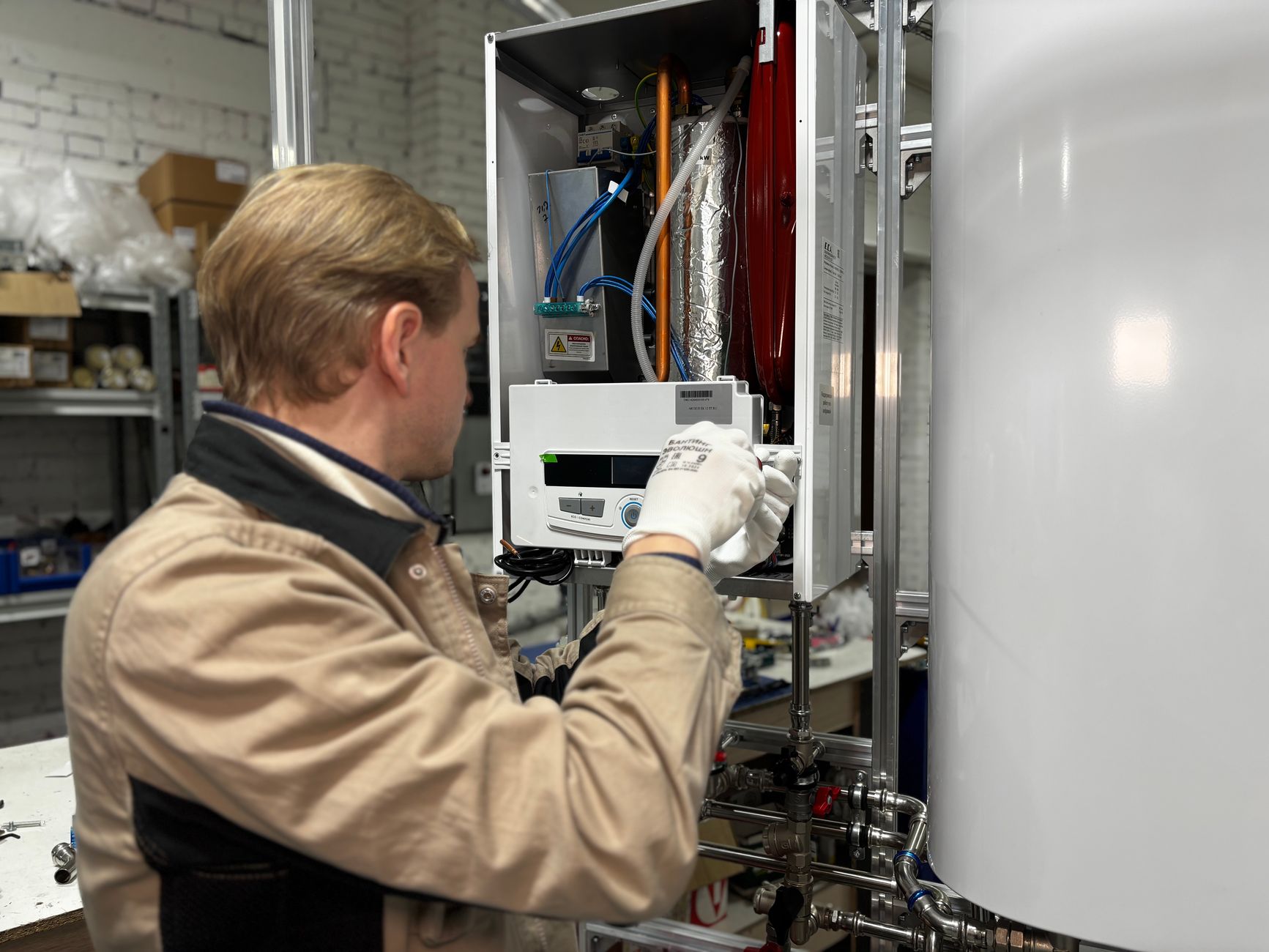
You turned the tap. Nothing but cold. Or worse, a lukewarm trickle that swings hot, cold, hot while you're standing there with shampoo in your hair. Tankless units are supposed to end that. So why is yours acting like a sulking teenager?
Here's the part most people miss: tankless heaters don't usually die. They throw a code, drop their flow rate, or scale up until they give up. That's actually good news, because it means most failures are fixable without ripping the unit off the wall. And if you're in the northern Connecticut area and need it handed off, the folks at tankless water heater services berlin ct deal with this exact call constantly. For everyone else, you can diagnose a surprising amount of it yourself.
Below is the order I'd check things in. It's the same order a good tech uses, and it's roughly the reverse of how likely you are to guess.
The error code is doing you a favor
Every tankless unit made in the last twenty years logs a fault code, and the manufacturers were not subtle about it. A blinking light or a two-digit number on the display is a message, not a mystery.
Find the sticker inside the front cover or the manual. Most codes split into four buckets: ignition failure, flame failure, water flow issues, and overtemperature. I'll bet you a coffee your code lands in one of those. Your job is to figure out which bucket, because each one has a totally different fix.
If your unit has a reset button, press it once and watch. A unit that runs fine after a reset but fails again in three days is telling you something is drifting, not broken, and that's usually a flow or flame signal problem, not a dead machine.
Cold water, warm words: check flow first
This trips up more homeowners than any other single issue. Tankless heaters need a minimum gallons-per-minute flow to fire up at all. Drop below it and the unit simply won't ignite. Open one tap to a modest stream and you may get nothing but a shrug.
So test it properly. Open a single hot tap wide. Give it ten to fifteen seconds. Still cold? Open a second hot tap somewhere else and see if the unit kicks on. If it fires with two taps running but not one, you've got a flow or restriction problem, not an ignition problem.
Common culprits: a clogged inlet filter screen, a showerhead or aerator limed up solid, or a flow sensor that's grown lazy. The filter is the one you can fix in five minutes with a wrench and a toothbrush. Pull it, rinse it, put it back. This alone resolves an enormous share of "it just stopped working" calls.
Scale is the silent killer
Water carries minerals. Heat it and they drop out of solution and stick to the inside of your heat exchanger. Do that over and over and your nice one-inch pipe turns into a drinking straw. Your unit works harder, heats less, and eventually faults out on overtemperature or just surrenders.
Hard water areas are hit worst, and a lot of Connecticut well water qualifies. According to the Environmental Protection Agency, water hardness is a widespread issue across much of the country, so you're not special or unlucky. You're just a homeowner with minerals.
The fix is descaling, done with a small pump, two hoses, and a jug of white vinegar or commercial descaler. Manufacturers set a descaling schedule based on your water hardness, and skipping it is the number one reason tankless units underperform. Do it annually. Do it twice a year if your water is nasty.
So you want to know whether it's the gas
Ignition failures are usually gas or spark. If you smell nothing, hear a click-click-click without a whoosh, and get a flame-failure code, start at the gas side.
Check that your gas valve is fully open. Check whether other gas appliances are behaving. If your furnace and stove are fine, the supply isn't the problem and you're looking at the igniter, flame sensor, or the air intake and exhaust path. A blocked vent or an intake clogged with lint, snow, or a bird's nest will shut down a unit fast, and it's a dead simple thing to eyeball from outside.
Leave the gas piping itself alone. That's not a DIY job and I won't pretend otherwise.
What I'd actually do before calling anyone
Here's the sequence I recommend to friends, in order. It takes about twenty minutes and it catches most of what's fixable at home.
- Read the code. Write it down. This is your whole diagnosis in one number.
- Cycle the power. Kill the breaker, wait a minute, restore it. Watch what the unit does on restart.
- Test flow. One tap wide open, then two taps. See whether it fires.
- Pull the inlet filter and clean it. Five minutes, high yield.
- Look at the outside vent. Clear any obstruction from the intake and exhaust.
- Check the set temperature. Someone may have bumped it or it reset to a low default.
If it still won't run after that, don't keep poking. Open the unit further and you're into gas train and exchanger territory where a bad decision costs real money.
Repair or replace? The honest math
Here's where I'm going to give you a straight opinion instead of a fence-sit. A tankless unit under ten years old with a flow, scale, or ignition problem is almost always worth repairing. Those are the cheap, common failures.
A heat exchanger with a crack or a badly scaled-through core is a different story. That's the heart of the machine and replacing it costs close to a new unit. If your unit is north of a decade and the exchanger is the issue, put the money toward a replacement.
|
Symptom |
Likely cause |
Fix level |
|
Won't ignite, code on display |
Igniter, flame sensor, or gas supply |
Pro |
|
Only works with two taps open |
Flow restriction or filter |
DIY |
|
Water swings hot and cold |
Scale or mixed pressure |
DIY descale, then pro |
|
Overtemperature fault |
Scaled heat exchanger |
Pro descale or replace |
|
Rust-colored water |
Corrosion inside the unit |
Replace |
One more thing about efficiency, since it drives the repair decision. The Department of Energy notes that tankless water heaters can be more efficient than storage tanks, but only when they're installed and maintained correctly. A neglected unit doesn't hold that advantage. It just costs you more per hot shower.
Keeping it from happening again
Most of what kills a tankless unit is boring and preventable. Descaling on schedule is the big one. Clean the inlet filter every few months, especially if you're on well water. Watch your vent for snow and debris before winter. And keep an eye on that error display so a small drift doesn't turn into a cold weekend.
If you're handy and patient, you can stay ahead of nearly all of it. The National Institute of Standards and Technology work on measurement and calibration is a reminder that small tolerances matter, and your water heater runs on the same principle. A tiny bit of scale, a slightly lazy sensor, and the whole thing stalls.
The honest bottom line: cold water from a tankless heater is usually a signal, not a funeral. Read the code, test the flow, clean the filter, and know when to hand it off. A machine that was running fine last week is rarely past saving.
So what's your unit doing right now, blinking a code or just running cold? Grab the model number and start there, and you'll know within twenty minutes whether you're fixing it or calling it in.