
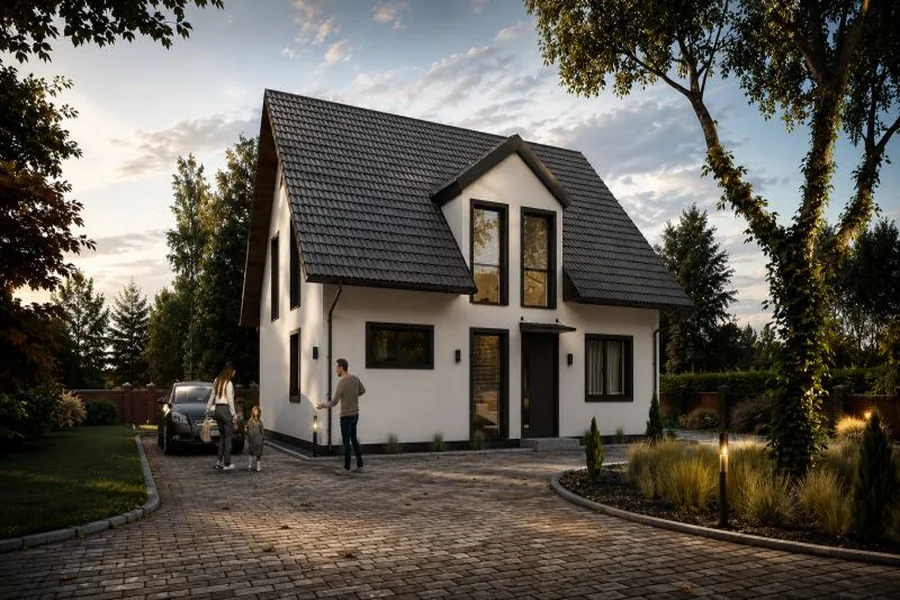
Imagine pulling up to a home that doesn’t exist yet.
You see the driveway curve in from the street. The front façade catches the afternoon light. You walk past the entry, around the side garden, and up to a rooftop terrace with a view over the neighbourhood.
None of it has been built. But you’ve just experienced it anyway.
That’s the promise of architectural animation. It’s not a single picture of a home. It’s a journey through one, built entirely from the architect’s drawings, long before construction starts.
Table of Contents
The Driveway: Where the Story Begins
Every home has an arrival moment, and it starts at the driveway.
A static image can show a driveway from one angle. An animation lets you approach it the way you actually would, in a car or on foot, watching the home reveal itself gradually instead of all at once.
At Ecompapi Studio, we treat this opening sequence as more than a formality. It sets the tone for everything that follows, the same way walking up to a real home does.
The Façade: A Closer Look
Once you’re at the front door, the details start to matter.
How does the cladding catch the light? Does the entry feel welcoming or closed off? These are things a floor plan simply can’t answer, and even a single rendered image only tells part of the story.
This is where a good 3D rendering house exterior earns its value. It shows the materials, the proportions, and the shadows exactly as they’ll appear in real life, giving everyone from the architect to the future homeowner a shared, accurate picture to work from.
Moving Around the Home
The story of your house is not confined to the front porch, and your video shouldn’t be either.
An architectural animation video gives you the freedom to walk through the entire property, going from the side garden to the walkway to the outdoor space. Every space performs a certain function, and the video provides the viewer with a clear understanding of how the home works, not just how it looks.
From the point of view of marketing your real estate development, this factor becomes even more important. While potential buyers do not make decisions about buying based on plans, they do so when they see themselves in it.
Up to the Rooftop
The other element that many designs leave till the very end is the roof.
It may be just the basic roof shape, the modern roof deck, or the roof terrace with views to the city skyline, but it is from here that the essence of the house becomes really evident.
The virtual tour is able to take the viewer to the roof level and show how the house fits into its environment, something that would never be possible through photographs of the completed house since the latter doesn’t exist yet.
Who Gets the Most Out of It
The homebuyer uses these virtual tours to envisage day-to-day living in the house well before its actual construction, from the morning stroll down to the mailbox to relaxing evenings on the rooftop deck.
They are used by developers to sell home-and-land packages, off-the-plan apartments, and master-planned communities even prior to the opening of any display centre. They are used by real estate agents to put a new property up for sale in advance of any physical listing, allowing the buyer a much more interesting experience than a simple floor plan and a few generic pictures.
Architects, too, make use of them, though not only for the purposes of marketing. A guided virtual tour around one’s own design, room after room and level after level, is bound to raise issues that are unlikely to be discussed based solely on the drawings.
What Makes an Animation Worth Watching
Not all animations have a proper delivery. But there are certain characteristics that make some of them successful.
Their movement is as human as possible; no grandiose sweeps are used. They allow enough time to absorb the space before moving to another. And the finishes, the lighting, and the landscaping are true to the materials selected for the construction of the property, and not just their imaginary counterparts.
Get these right, and an animation will no longer seem like a promotional device but a preview of the future home of someone.
Why the Journey Matters More Than the Image
One image provides the answer to, “How does this house look?”
One animation provides the answer to, “How would it feel to be there?”
This difference is far more significant than one would think. It’s not floor plans that people fall in love with, but rather the experience of moving around a home, and architectural animation happens to be one of the ways to give buyers such experience even before anything is built.
That is how animation becomes so helpful when it comes to the creation of display homes, house and land packages, and even larger residential projects.
Bringing It All Together
Every animation at Ecompapi Studio begins as if you were making a real visit: from the driveway all the way to the rooftop, going through the relevant spaces with an understanding of the final feeling of your new home.
It’s a more comprehensive way to present a house to those who will one day live there, which is why it is being increasingly preferred by architects, builders, and developers for pre-construction visualisation of their projects.
At Ecompapi Studio, we help Australian architects, builders and developers bring their projects to life through architectural animation, 3D exterior rendering, and immersive visual storytelling.