
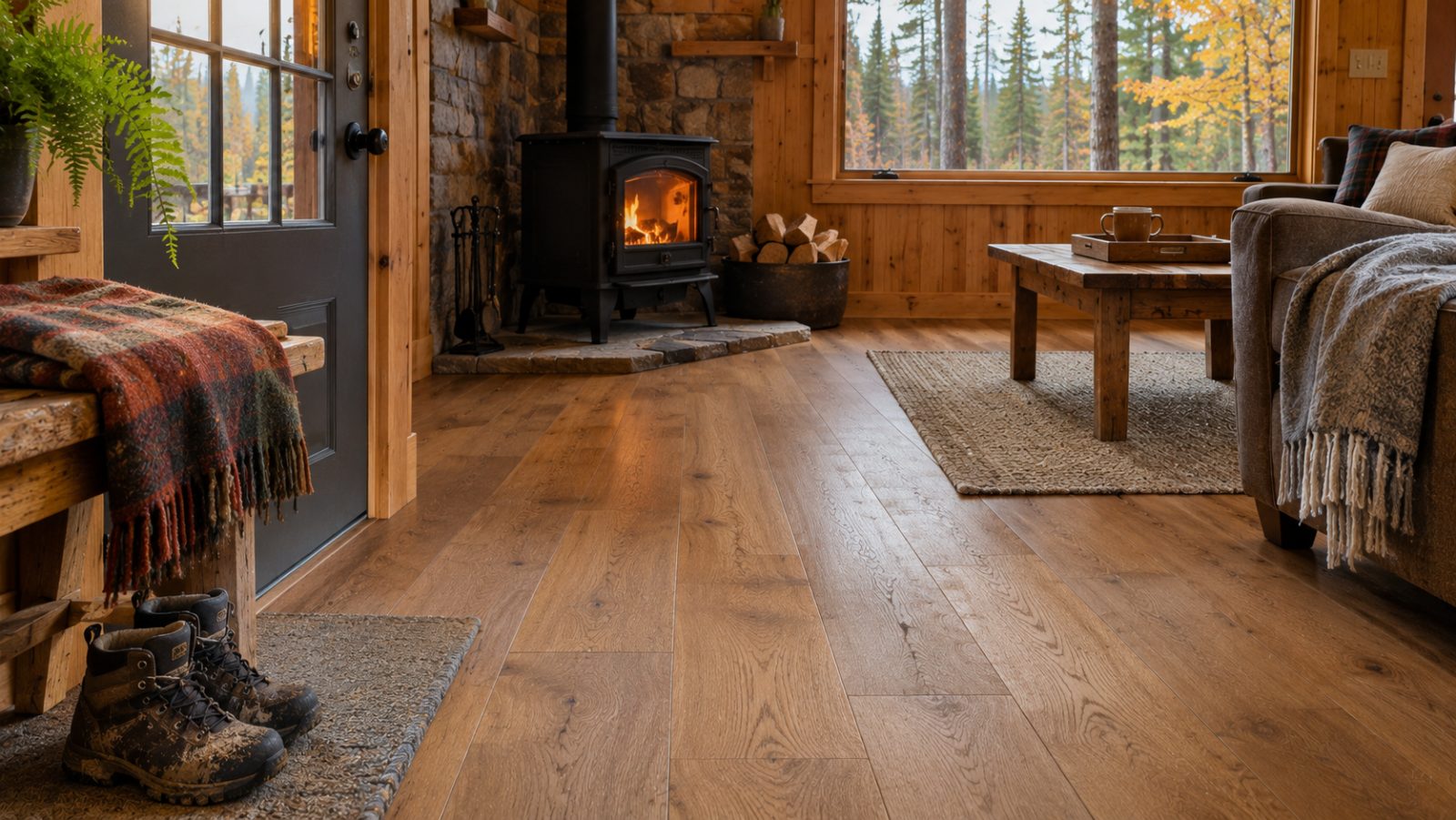
Replacing the floors in the house you live in is a project you can watch. You see the crew arrive, you look at the subfloor when the old carpet comes up, and you notice if a transition strip sits crooked before anyone leaves.
A cabin, a lake house or a winter place in the desert is different. You may be a few hours away or a few time zones away when the work happens. Someone else holds the keys, and you see the result in photos before you see it in person. That makes the choice of company more important than the choice of plank.
Most hiring checklists assume the owner is standing in the room. The five checks below are written for the owner who won't be.
Table of Contents
- Why a second home changes the decision
- Check 1: They are licensed where the house is
- Check 2: Someone measures the house in person
- Check 3: The quote covers the whole job
- Check 4: You know who will be in the house
- Check 5: The warranty works from a distance
- Which floors hold up in a cabin
- Before you sign
Why a second home changes the decision
A house that sits empty for weeks or months puts different stress on a floor. In a mountain cabin the heat may be turned down to just above freezing all winter, then the wood stove brings the room up to 70 degrees in an hour on the first night. In a desert vacation home the air conditioning may be set high for the summer, and the inside of the house bakes.
Wood and wood-based floors expand and shrink with those swings. Some vinyl products have temperature limits written into their installation instructions. A leak under the sink can run for a month before anyone notices. And the entry takes a beating from wet boots, sand and dogs when the house is full.
All of this affects which product makes sense, how it should be installed and what the warranty will actually cover. A good installer asks about it before quoting. A rushed one doesn't.
Check 1: They are licensed where the house is
A contractor licensed in your home state may not be licensed where the cabin is. Look up the company with the licensing board in the state where the property sits, and ask for a certificate of insurance that names the property address. If the house will be empty during the work, ask whether their liability coverage applies to an unoccupied property, and check your own homeowner's policy for vacancy rules while you're at it.
A company based near the property has another advantage that has nothing to do with paperwork. When something needs a second look in six months, they can drive over the same week.
Check 2: Someone measures the house in person
A quote built from a floor plan you emailed is a guess. Before you agree to anything, someone should walk through the house, measure every room and look at what's under the current floor.
Use that visit to talk about how the house is used. Is the heat kept on all winter? How quickly does it warm up when you arrive? Does the air conditioning stay on in summer? A careful installer will want these answers, because they decide whether solid hardwood is a reasonable choice or a problem waiting to happen, and whether a floating floor needs a moisture barrier over the slab. If the subfloor needs leveling or repair, you want to hear about it now, with a price attached, rather than in a phone call after demolition.
Check 3: The quote covers the whole job
Remote projects are where vague quotes cause the most trouble. When you're not there, every surprise turns into a phone call and an approval made on the spot.
A complete quote spells out:
- removal and disposal of the old flooring
- moving furniture and appliances, and putting them back
- subfloor preparation, including any leveling
- underlayment and moisture barrier, if needed
- baseboards, transitions, stair nosing and door trimming
- cleanup and haul-away
- the start date and how long the work will take
Agree in writing on how changes will be handled. A simple rule helps: anything over a set amount needs your approval by email, with photos, before work continues.
Check 4: You know who will be in the house
Many flooring stores sell the material and pass the installation to an independent crew. That isn't always a problem, but it matters more when you're not there. You want to know who will have the keys, who you'll speak to during the job and who answers if something goes wrong a year later.
Ask directly whether the company uses its own employees. A local flooring company that handles sales, measurement and installation with its own crews gives you one point of contact for the whole project. Settle the practical details before work starts:
- how the crew will get in (lockbox, caretaker, property manager)
- how often you'll get progress photos or a short video
- who checks the finished floor before the crew leaves
- how the house will be locked up and the thermostat set afterward
Check 5: The warranty works from a distance
Two warranties matter here. The product warranty comes from the manufacturer and often has conditions, such as keeping the house within a temperature range or following a specific installation method. Ask the installer to show you those conditions for the product you're choosing and confirm they fit how the house is used.
The labor warranty comes from the installer. Ask how long it lasts, what it covers and how a repair visit works when you're out of state. A company that offers a long labor warranty and is based close to the property is the easiest one to hold to it.
Some companies make the decision part easier too. In Las Vegas, for example, Expert Flooring Solutions lets customers take free samples home and offers complimentary design help, which matters when you only get to see the house on weekends. Its own crews provide floor installation services for the products it sells, move furniture and clean up at no extra charge, and back the work with a lifetime labor warranty.
Which floors hold up in a cabin
The right company will help you choose, but it helps to know the usual answers before the first visit.
- Rigid-core vinyl plank (SPC). The lowest-worry option for most second homes. It is waterproof, stays stable through temperature swings and cleans up fast after a busy weekend. Check the product's temperature limits if the house is left unheated or very hot.
- Engineered hardwood. Real wood on top with a cross-layered core underneath, so it moves far less than solid wood. A good fit where the house keeps some heat or cooling year-round.
- Porcelain tile. Close to indestructible in entries, mudrooms, kitchens and bathrooms. It is cold underfoot in a mountain cabin unless you add rugs or radiant heat.
- Laminate. Affordable and scratch resistant, but keep it away from entries and wet areas, and don't count on it surviving a slow leak.
- Solid hardwood. Beautiful, but the riskiest choice for a house that sits cold and then warms up fast. It works best where the heat stays on all winter.
- Carpet. Fine in bedrooms, where it adds warmth and quiet. Skip it near entries, where it holds sand, mud and moisture.
Before you sign
Run through the five checks with every company you're considering: license and insurance where the house is, an in-person visit, a complete written quote, clear answers about who will be inside your home, and a warranty you can use from far away. The company that handles all five without hesitation is usually the one that will handle the job the same way when you're not there to watch.