
Dubai is a city built around the car, but there is a threshold where the car stops working. It arrives the moment the airport pickup involves six relatives and their luggage, or the company wins a contract that needs a crew moved to a site every morning, or the wedding guest list outgrows anything with a boot. At that point the market answers with a category most visitors never think about until they need it, and then need urgently: the van.
The segment is deeper than it looks from outside. Browsing the OneClickDrive van rentals listings reveals everything from seven-seat family MPVs through luxury people-movers to fifteen-seat shuttles and panel vans for cargo, posted by suppliers across the city with daily, weekly, and monthly rates shown live for your dates, and booking handled directly with each company by WhatsApp or phone with no commission added in between. The comparison takes minutes; knowing what to compare is the part worth learning, and it starts with an honest count of seats and bags.
Matching the Van to the Job
The family end of the market belongs to the MPVs. The Kia Carnival and Hyundai Staria carry seven or eight in genuine comfort, with sliding doors that end car-park door dings and boots that still take airport luggage with every seat filled, commonly listed from around AED 250 to 500 per day. These are the right answers for visiting grandparents, school-run months, and group holidays where comfort matters as much as capacity. A step above them, the Mercedes V-Class turns the same format into a lounge, from around AED 750 per day, which is why hotels and executive transport run it constantly.
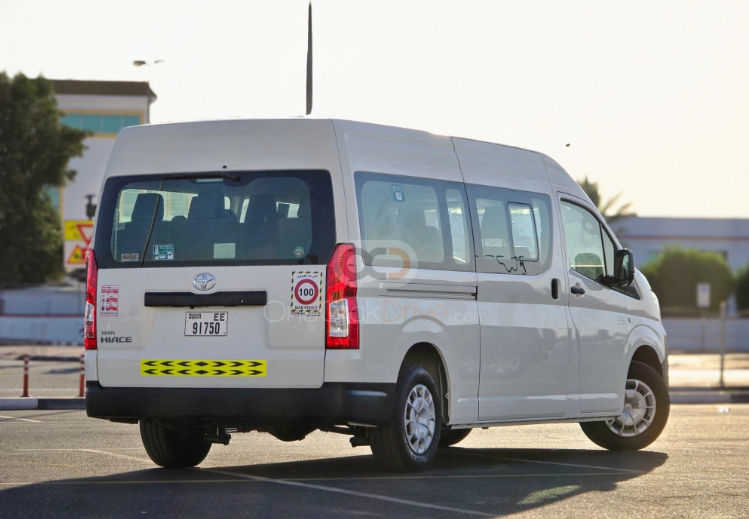
The workhorse tier is where the true vans live. The Toyota Hiace and Nissan Urvan dominate it, with passenger configurations running from around ten seats to fifteen, high-roof versions allowing near-standing headroom in the aisle, and daily rates commonly between AED 300 and 500 depending on seats and year. Chinese rivals such as King Long compete underneath them on price with similar formats. These are the airport-shuttle, tour-group, and staff-transport machines, honest rather than luxurious, and priced per seat they embarrass every SUV in the market.
Above fifteen seats the conversation changes vehicle class entirely, into midibuses and coaches around thirty to fifty seats that rent with professional drivers, commonly from around AED 1,600 per day upward. And parallel to all of it runs the cargo side, panel vans with flat load floors for deliveries, exhibitions, and small moves, the cheapest of which undercut hiring movers for anything one strong friend can help carry.
The Licence Question Nobody Expects
Here is the detail that catches renters out more than any pricing term. A standard UAE light-vehicle licence, and the visitor equivalent of a home licence with an International Driving Permit, covers cars and the smaller van configurations, but higher seat counts can fall under light-bus licence categories, and the threshold is exactly what to confirm with the supplier for the specific vehicle before assuming self-drive is possible. Suppliers deal with this daily and will tell you straight, and the with-driver option dissolves the problem entirely for the larger formats, which is precisely why the biggest vans and all the buses come with a professional behind the wheel.
For the self-drive formats, the requirements are the market’s usual set. Residents need their UAE licence and Emirates ID, visitors need the home licence, permit, and passport, minimum ages generally start at 21, and companies renting for staff transport should expect to provide a trade licence copy and an authorisation letter alongside the driver’s documents. None of it is difficult; all of it goes smoother, confirmed in the first WhatsApp message rather than discovered at handover.
What the Terms Look Like
Van rentals follow the wider market’s structure with a few segment-specific wrinkles. Insurance is included at a basic level and excludes off-road use and reckless driving, with an excess that stays your responsibility, and commercial users should declare the intended purpose since passenger-transport and cargo work can carry different cover conditions. Mileage caps commonly run 200 to 300 kilometres per day, with monthly allowances often between 3,000 and 5,000 kilometres, and this is the term that deserves real arithmetic from anyone running routes, because a cheap headline rate with a tight cap loses to a fair rate with a generous one within the first week of a daily shuttle.
Deposits commonly sit around AED 1,000 to 2,000 on self-drive vans, held on a card and released after return, while with-driver arrangements often replace them with contract terms. Fuel returns at the level received on self-drive bookings, and with-driver day packages frequently include fuel for a set number of hours, so ask what applies beyond them. Delivery is widely offered and often free, including site and airport handover, and Salik tolls plus any fines bill back after the rental with a small administration fee, a line item that adds up quickly on repeated routes through toll gates and belongs in any route-cost calculation from the start.
Monthly terms are where the segment does most of its real business. Passenger vans commonly land between AED 5,000 and 7,500 per month depending on configuration, MPVs from around AED 4,500, and the arithmetic against ownership is straightforward for any business: a fixed line item with insurance and maintenance included, no capital tied up, no downtime risk, and the ability to scale the fleet up for a season and back down after it.
Booking It Right
The comparison discipline is the same as anywhere in the rental market, sharpened by this segment’s variety. Confirm the exact seat count and layout against the listing’s photos, since a thirteen-seater and a fifteen-seater look identical from outside and matter enormously at the airport. Confirm self-drive or with-driver, the licence category the configuration requires, the mileage allowance against your actual routes, and the deposit and fine-handling terms. At handover, walk the vehicle with the supplier and film the panels, every seat row or the cargo bay, and the fuel level, because documented condition is what keeps the final settlement clean on a vehicle that will work hard for you.
For most renters weighing the passenger formats, the shortlist eventually narrows to the segment’s benchmark, and there is a reason for that. Browsing the options for a Toyota Hiace for rent in Dubai shows why the model anchors half the city’s shuttle fleets: a durability record no rival has matched, configurations from around ten to fifteen seats with high-roof versions for frequent-stop work, and enough units in circulation that availability holds even when event season strains the market. Price a Hiace listing against its rivals for your exact dates and seat count, and the comparison usually explains itself within a few minutes of scrolling.
The broader point is that Dubai’s van market rewards the renter who arrives with numbers rather than guesses. Count the people, count the bags, map the routes against the mileage cap, and confirm the licence question early. Do that, and the segment delivers exactly what it exists for, which is making a group move like a plan instead of a convoy, at a cost per seat that no fleet of sedans will ever touch.
1 thought on “The Complete Guide to Van Rentals in Dubai for Groups, Families, and Businesses”