
Everyone got paid on time. The bank payments look right and the payslips went out without a hitch. Yet your payroll control account still shows a balance nobody can explain.
It happens more often than owners admit. Whether you run payroll in-house or outsource payroll, accurate wages are only half the job. You also need records that tie the payroll reports, the journal and the bank together. This guide shows why they drift apart, how to reconcile them monthly, and how to stop it recurring.
Why Do Payroll Journals and the General Ledger Not Match?
Payroll can be right while the accounts are wrong. The wage calculation and the accounting entry are separate steps, and either can fail.
Missing or duplicated journals. An import fails and a month of wages never reaches the ledger. Or the journal imports twice, or someone keys a manual one after the automatic one posted. Either way, expenses and liabilities go wrong.
Wrong nominal codes. A journal can balance and still mislead. Bonuses buried in basic wages, or employer National Insurance posted as a deduction, distort your profit figures.
Manual corrections and off-cycle runs. Fixes posted twice, final salaries and backdated pay all slip past the normal process.
Timing. Staff may work in March and get paid in April. That isn’t automatically an error, but you must be able to explain it.
What Should a Payroll Journal Include?
A payroll journal is created to transfer payroll costs and liabilities from your payroll system into your accounts. This will include gross wages (before any deductions), employee deductions (PAYE, National Insurance and pensions) and employer costs (National Insurance and pensions). Deductions are liabilities that you owe to HMRC or the pension provider.
Here is an illustrative example. The figures are not statutory rates.
|
Account |
Debit |
Credit |
|
Gross wages |
£10,000 |
|
|
Employer National Insurance |
£1,200 |
|
|
Employer pension cost |
£300 |
|
|
Net wages payable |
£8,000 |
|
|
PAYE and National Insurance liability (£1,500 employee + £1,200 employer) |
£2,700 |
|
|
Pension liability (£500 employee + £300 employer) |
£800 |
|
|
Total |
£11,500 |
£11,500 |
Employee deductions of £2,000 are £1,500 of tax and National Insurance plus the £500 pension contribution. Each liability should be clear when you pay it.
How to Reconcile Payroll to the General Ledger Each Month?
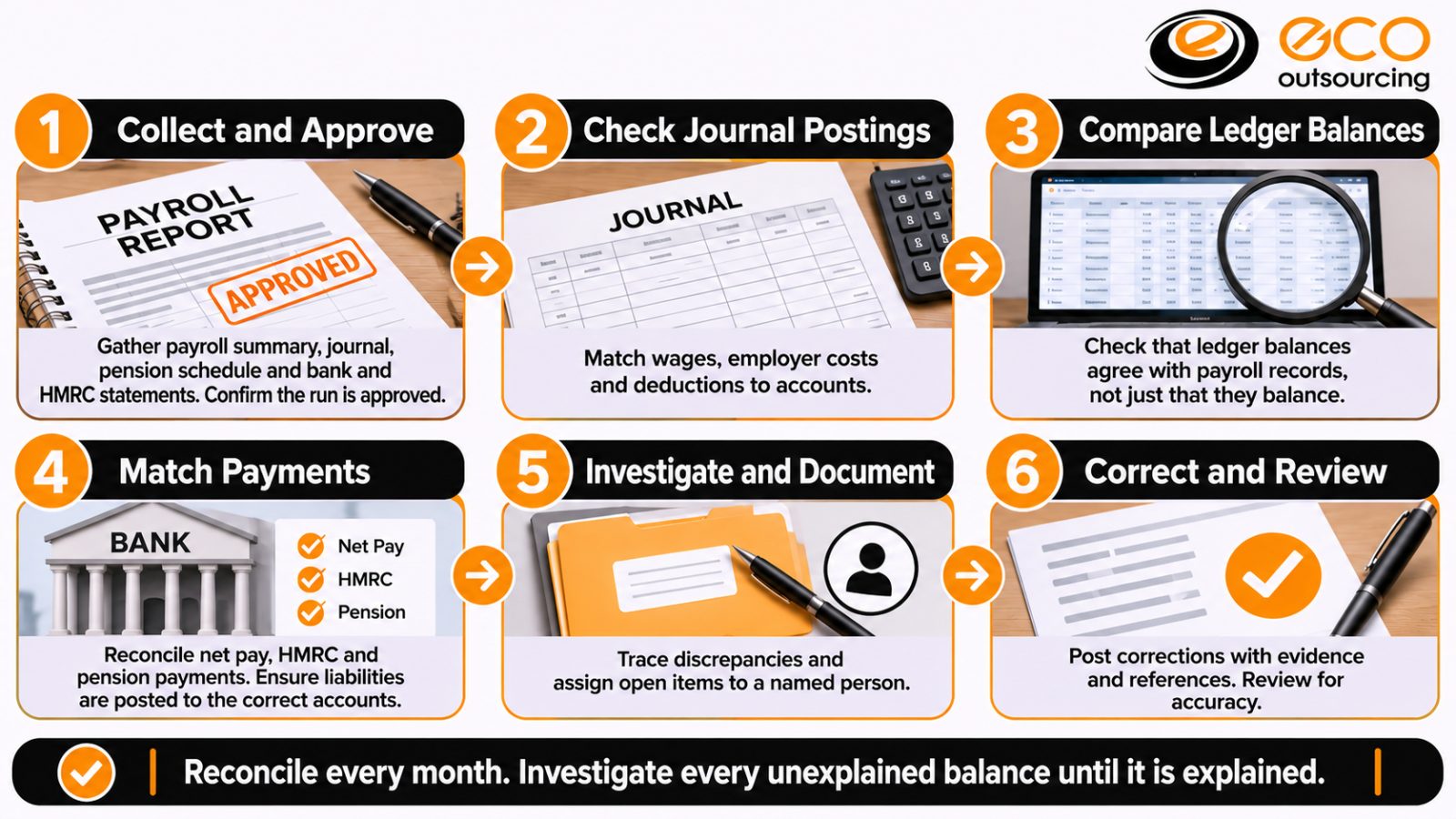
Monthly Process ensure you have all the required documents, including Payroll summary gross to net report, Journal, Pension, schedule and Bank and HMRC statements
Ensure that the run has been approved. Include any corrections/offs due in the run.
Ensure that the salary and employer expenses are matched to the correct accounts. This should include your wage account, employer NIC and pensions.
Ensure that the deductions match. PAYE, employee NIC and pensions should all be going to the correct liability accounts.
Check that the net pay matches with the bank. Note any payments that were bounced or manually paid. This does not mean that the journal is correct.
HMRC and pension payments should be reconciled. Allow for any true time differences.
Investigate and document. If there are missing, duplicated or misallocated amounts then ensure that they are corrected using evidence. Any outstanding amounts should be passed to a specific person.
Monthly checklist:
- Final reports collected and run approved
- Gross wages, employer costs and deductions matched
- Net pay matched to bank
- HMRC and pension balances reviewed
- Duplicates, corrections and open items documented
Common Problems and How to Fix Them
Why is there a balance on the clearing account? Payroll journals and payments are held on this account until reconciled. Balances occur due to missing entries, duplicate entries, incorrect allocations and payments in transit. You should investigate the balance.Never force it to zero with an unsupported journal.
Why is PAYE still showing after payment? A liability is what you owe, and a payment is what you paid. If the payment went to the wrong account or tax period, the balance stays. Compare your books with HMRC.
The principles are the same regardless of whether you are using Xero, Sage or another package. Investigate and understand why something has occurred, look at the source documents and make adjustments based on evidence.
Weekly Payroll and Month End
Most of the time weekly payrolls will not line up with your calendar months. The period of pay relates to when the staff earned the money. The payment date shows when they received the money. Finally, the accounting period will show you which month the cost should go into.
If your team worked in the last week of March, you close your books on 31st March and pay wages in early April. This means the cost should be in March, therefore you may need to accrue some costs.
Accruals are when you estimate how much you have incurred but haven’t paid for. You will need to reverse this in April. Ensure you check both months to ensure you aren’t double counting the wage.
What to Do With an Unexplained Balance and How to Prevent One?
Make sure you do not carry any balances forward. If you have a balancing journal, make sure you don’t have any. You need to trace back to the first period when the balance was created. Compare the report and journal from this period with any payments and adjustments.
This will help identify if any duplicates were corrected or there are any unexplained entries. There may be valid balances such as outstanding liabilities. If the balances are significant, get your accountant to review.
To prevent them coming back again, make sure that whenever you create a new payment category or change the software you review your nominal mapping. Assign clear owners for preparing, approving, posting, paying and reconciling. Review all of your payment runs.
Make sure you have everything together including reports, journal references and any correction notes. While integrations can save time they will only be as good as how you set them up.
Can Outsourcing Payroll Help?
If your business is small, then yes. You can outsource payroll processing including payslips, PAYE and National Insurance reporting, pension information and journal processing so your records are consistent each month.
However and there’s always an however! Some outsourcing companies will only offer part of the process. Payroll processing, journal processing, posting and reconciling accounts can be split into 4 different processes. Be specific about what the company will do.
Payroll outsourcing is great for those without a dedicated payroll member of staff, frequent posting errors or if you’re finding control account balances confusing. Eco Outsourcing provides payroll outsourcing services which focus on providing you with reliable and documented reporting.
No outsourcing company will eliminate all errors so it’s important to understand who is responsible and to have regular checks in place.
Frequently Asked Questions
Why is my payroll journal not matching the general ledger?
The most likely reasons are that you have missed out some journals, duplicate journals, the wrong nominals, adjustment entries or timing differences. It is best to check the payroll final report against the ledger line by line.
Should the payroll clearing account always balance?
Try to make sure it does but if there is genuine timing difference you may want to leave it for a period of time. Everything else should be investigated.
How often should I reconcile my payroll?
You should reconcile your payroll each time you run a pay. Do a complete reconciliation at month end. If you have a large or complicated payroll you may wish to do more careful reconciliations.
How do I correct a journal that was incorrectly posted to a nominal?
Find where the original entry was made. Make sure you know which account should be used. Post a correction with a reference and ensure you have an audit trail.
Is the payroll journal dealt with by the outsourced provider?
Many will prepare the journals but they will not be posted and reconciled to the ledger. Ensure in writing who is responsible.
Conclusion
Correct pay doesn’t guarantee correct accounts. Missing journals, loose mappings and uncleared liabilities quietly distort your ledger until they’re expensive to untangle. A short monthly reconciliation catches them early. If it’s eating your time, professional payroll support, such as Eco Outsourcing’s payroll service, can take the strain.