
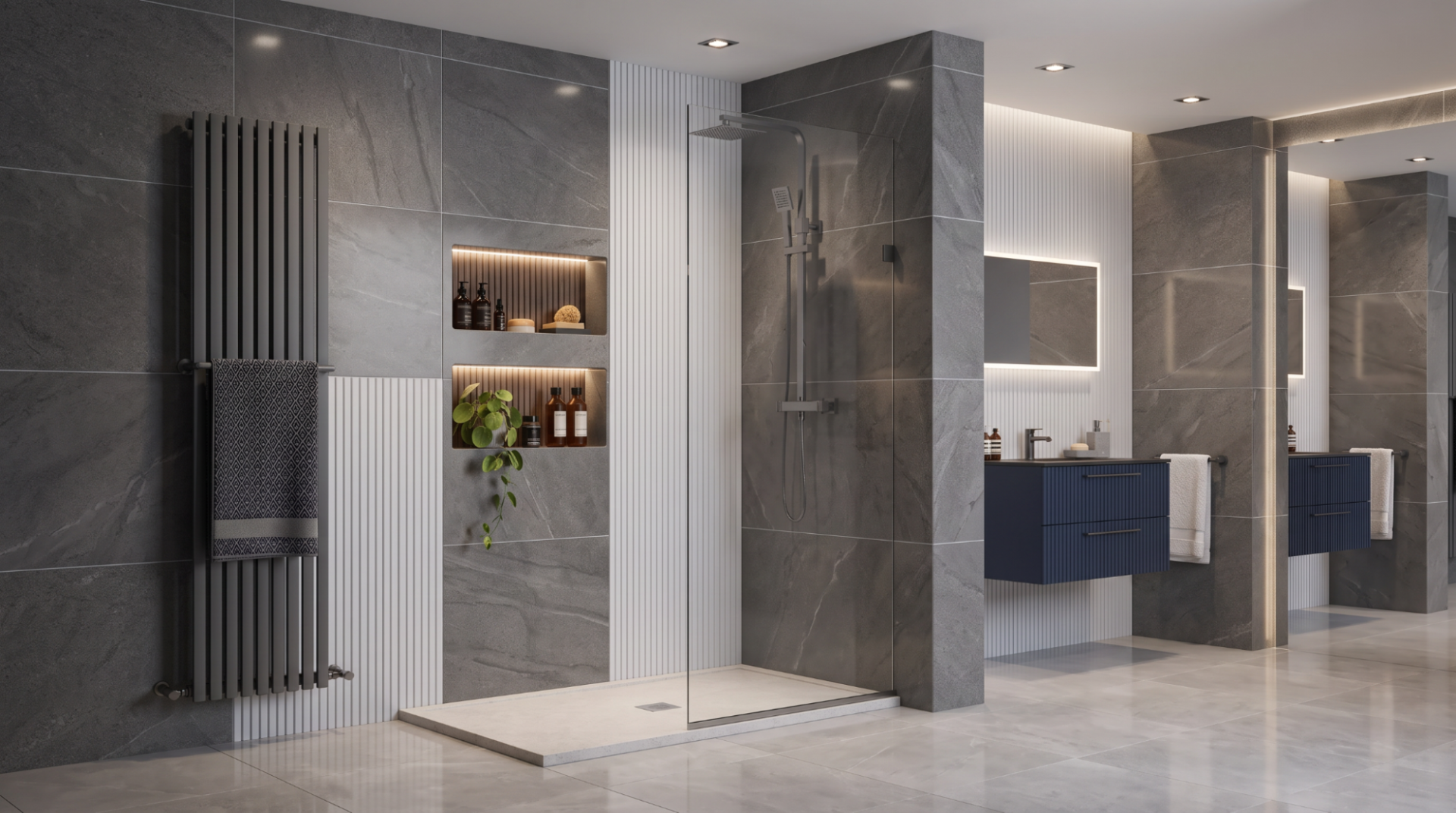
A damaged, cracked, or outdated shower enclosure does not always require replacing the entire system. In many bathrooms, the stationary glass panel can be replaced while the existing shower layout, hardware, and surrounding finishes remain in place. The challenge is making sure the replacement glass matches the original panel closely enough to fit safely and function properly. A fixed panel shower screen replacement is not simply a piece of glass cut to a particular width and height. Its thickness, glass type, edgework, mounting method, hardware locations, and relationship to the shower curb and walls all matter. A small measurement error can turn an apparently simple replacement into an expensive installation problem.
For homeowners considering a fixed shower panel replacement, the first step is understanding exactly what needs to be replaced and which specifications must be verified before ordering new glass.
Table of Contents
- Fixed Shower Panel Explained
- When Does a Fixed Shower Panel Need to Be Replaced?
- Can You Replace Only the Glass Panel?
- How to Measure Replacement Shower Glass
- Why Glass Thickness Matters
- Tempered Glass Is Not the Same as Ordinary Glass
- What About Frameless Shower Panels?
- Should You Reuse the Existing Hardware?
- Common Mistakes During Shower Glass Replacement
- Replacement vs. Complete Enclosure Replacement
- How to Order a Replacement Panel Correctly
- Final Considerations
Fixed Shower Panel Explained
A fixed shower panel is a stationary piece of glazing that forms part of a shower enclosure without opening or sliding. It may be installed beside a hinged shower door, used as a single walk-in shower screen, or incorporated into a larger enclosure.
Unlike an operable shower door, a stationary panel generally has no hinges or moving hardware. It may instead be secured with glass-to-wall brackets, U-channel, clips, clamps, or stabilizer bars.
Fixed panels are common in frameless and semi-frameless shower designs because they provide a relatively open appearance while helping contain water within the shower area. Current U.S. products are available in several configurations, including 1/4-inch, 5/16-inch, 3/8-inch, and 1/2-inch glass, depending on the design and manufacturer.
When Does a Fixed Shower Panel Need to Be Replaced?
Replacement is usually considered when the glass has broken, developed damage, or can no longer be used safely. However, not every visible problem means the entire enclosure needs to come out.
Cracked Or Shattered Glass
A crack in shower glass should not be treated like a cosmetic defect. Shower enclosures are subject to specific safety requirements because people can fall against glazing or come into contact with broken glass.
Federal regulations specifically include shower doors and enclosures within the scope of the architectural glazing safety standard. The regulation addresses risks associated with breaking, installation, replacement, and handling of glazing materials.
Tempered glass is commonly used in shower enclosures because of its safety characteristics. When properly tempered glass breaks, it is designed to fracture into relatively small particles rather than producing the large sharp shards associated with ordinary annealed glass. Federal definitions specifically distinguish tempered glass from annealed glass and note that tempered glass cannot normally be cut or drilled after treatment without fracturing.
If a shower panel is cracked or shattered, replacing it with ordinary window glass is therefore not an appropriate shortcut.
Severe Edge Damage
Chips or damage along an exposed glass edge can also be a reason to have the panel evaluated. Edges are particularly important because they interact with channels, clamps, brackets, and other mounting components.
A replacement panel should be fabricated with the appropriate edge treatment and dimensions for its mounting system rather than modified casually at the job site.
Major Bathroom Remodeling
Replacement can also make sense when the bathroom layout or appearance is being updated. A homeowner may keep an existing shower curb or enclosure footprint while changing the glass configuration.
For example, an older framed enclosure might be replaced with a cleaner frameless stationary panel if the surrounding construction and drainage configuration allow it. The important point is that changing the glass style can also require changes to hardware and support.
Can You Replace Only the Glass Panel?
In many situations, yes. The existing shower enclosure does not necessarily need to be completely removed just because one stationary panel is damaged. If the remaining components are structurally sound and compatible with the new panel, replacing the glass alone may be possible.
The decision depends on several factors: whether the existing hardware is reusable, whether the original glass dimensions can be accurately established, whether the mounting system remains suitable, and whether the surrounding walls and curb are still properly aligned.
This is where replacement becomes more complicated than simply measuring the old piece.
A shower panel is fabricated for a specific installation. Its dimensions may account for wall conditions, channels, clips, clearances, silicone joints, and adjacent glass. The replacement must reproduce the necessary geometry rather than simply matching the visible opening.
How to Measure Replacement Shower Glass
Accurate measurements are one of the most important parts of the process. Start by identifying the exact panel that needs replacement. Do not assume the stationary panel and adjacent shower door have identical dimensions or thicknesses.
Measure the finished opening at multiple locations because walls and curbs are not always perfectly square or plumb. For a panel mounted between two surfaces, measurements near the top, middle, and bottom can reveal variations that a single measurement would miss. Record the panel:
- Width
- Height
- Glass thickness
- Edge configuration
- Notches or cutouts
- Holes or penetrations, if any
- Mounting hardware locations
- Relationship to adjacent panels
For an existing panel that is still intact, measuring the glass itself can be useful. If the original glass has already shattered, however, measurements of the opening and hardware become much more important.
Do not assume that the nominal size of an existing shower system is the exact glass size. Manufacturer specifications often distinguish between the overall enclosure dimensions and the actual glass dimensions.
Why Glass Thickness Matters
Glass thickness affects the compatibility of the panel with its hardware and overall enclosure design. U.S. shower products demonstrate that fixed panels can be manufactured in different thicknesses. For example, some current products use 1/4-inch tempered glass, while others use 3/8-inch or thicker glass.
The correct thickness should be determined from the original installation, manufacturer specifications, engineering requirements, or the hardware being used. It should not be selected simply because thicker glass appears stronger.
A 3/8-inch panel, for example, is not automatically interchangeable with a 1/4-inch panel. Hardware channels, clips, seals, and brackets may be designed around a particular glass thickness. This becomes especially important when replacing a panel while retaining existing hardware.
Tempered Glass Is Not the Same as Ordinary Glass
One of the biggest mistakes in shower glass replacement is treating architectural glass like ordinary flat glass. Tempered glass undergoes a heat-treatment process that changes its breakage characteristics. Federal regulations recognize tempered glass as one of the glazing materials used in architectural products and specifically include shower enclosures within the applicable safety framework.
The U.S. safety framework references testing requirements associated with ANSI Z97.1. Industry documentation also identifies ANSI Z97.1 and CPSC 16 CFR 1201 in connection with shower glazing.
That matters because tempered glass generally needs to be completely fabricated before tempering. Cutting, drilling, notching, or significantly altering tempered glass after treatment is not comparable to modifying ordinary glass.
If a replacement requires a hole, notch, corner modification, or unusual shape, those details need to be specified before the glass is tempered.
What About Frameless Shower Panels?
Frameless shower systems make accurate replacement especially important because there is less framing to conceal dimensional differences. A frameless stationary panel may be supported by several small clamps, brackets, a U-channel, or a stabilizing bar. The glass therefore becomes an important structural component of the enclosure system.
Some current fixed-panel products use 3/8-inch tempered glass, while others use different specifications depending on the design. A replacement panel should therefore be evaluated as part of the entire enclosure rather than as an isolated sheet of glass.
Should You Reuse the Existing Hardware?
Sometimes, but not automatically. Existing clamps and channels should be inspected for corrosion, damage, deformation, loose fasteners, and compatibility with the replacement glass. Hardware also has dimensional requirements. A U-channel designed for one glass thickness may not securely accommodate another. Likewise, a clamp intended for a particular thickness should not be forced onto a thinner or thicker panel.
If the original hardware is obsolete or damaged, replacing the hardware at the same time may be more practical than trying to preserve an aging installation. The same principle applies to silicone seals. Old silicone should generally not be treated as a permanent structural component simply because it is still present.
Common Mistakes During Shower Glass Replacement
The most expensive mistakes usually happen before the new glass reaches the bathroom. One common error is measuring only once. A wall can be slightly out of plumb, and a shower curb can vary in width. Another is measuring the overall enclosure rather than the actual glass requirement.
A third mistake is ordering glass based only on width and height while overlooking holes, notches, radius corners, clipped corners, or mounting locations.
Another problem is assuming the replacement glass should have the same thickness as a nearby shower door. Different components within one enclosure can have different specifications.
Finally, homeowners sometimes attempt to modify tempered glass after fabrication. That is fundamentally different from working with annealed glass and can result in breakage.
Replacement vs. Complete Enclosure Replacement
Replacing one panel makes the most sense when the rest of the enclosure is in good condition and the original design remains suitable. A complete enclosure replacement becomes more reasonable when multiple glass panels are damaged, hardware is deteriorated, the bathroom has been substantially remodeled, or the original system is obsolete and difficult to match.
There is also a visual consideration. New glass installed beside heavily aged glass may have a noticeably different appearance, especially if the original panel has developed mineral deposits, scratches, coatings, or discoloration.
For a relatively new enclosure with one damaged stationary panel, however, replacing only the affected glass can often be the more targeted solution.
How to Order a Replacement Panel Correctly
Before ordering, create a complete specification sheet for the panel. Document the finished opening dimensions, intended glass thickness, glass type, edge finish, hardware configuration, and any required cutouts. Photographing the existing enclosure can also help identify the mounting arrangement.
If the original enclosure came from a known manufacturer, locate the model number and installation documentation. Manufacturer specifications can provide useful information that cannot be determined reliably from visual inspection alone.
For example, published shower-door specifications may identify exact glass thickness, opening requirements, mounting conditions, and installation clearances.
For unusual installations, professional field measurement is often worthwhile. The cost of verifying the dimensions is small compared with the cost of fabricating an incorrect piece of tempered glass.
Final Considerations
A successful fixed panel shower screen replacement is primarily a measurement and specification exercise, not simply a glass-ordering exercise. The replacement needs to match the enclosure’s dimensions, glass requirements, hardware, support method, and safety specifications. Tempered safety glass is generally central to modern shower enclosure construction, and U.S. regulations specifically address glazing used in shower doors and enclosures.
Before ordering replacement shower glass, verify the panel dimensions at multiple points, confirm the glass thickness, document all holes and cutouts, inspect the existing hardware, and determine whether the surrounding enclosure remains suitable for reuse.
The most important rule is simple: do not treat shower glass as generic flat glass. It is a fabricated architectural component designed for a particular installation. Getting the specifications right before fabrication is far easier—and usually far less expensive—than correcting an incorrectly manufactured panel afterward.