
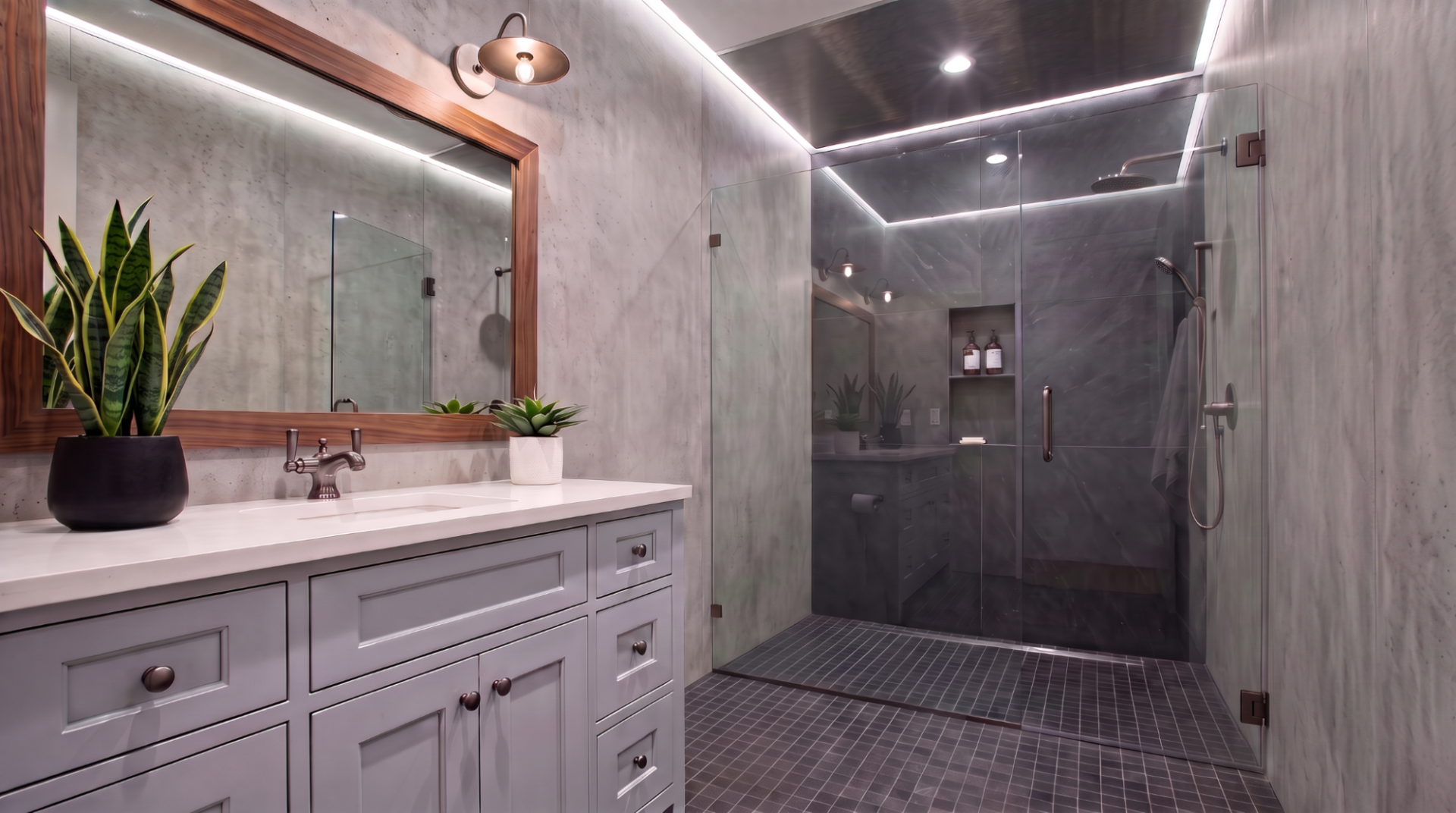
When planning a bathroom remodel, the frameless shower door cost can be difficult to estimate because there is no single standard configuration. A small single-panel door and a large custom enclosure may both be described as a “frameless shower,” yet their final prices can differ by thousands of dollars. Current U.S. pricing data puts many professionally installed frameless shower door projects around $1,000 to $2,500, with more complex custom installations reaching $3,000 or substantially higher. The important point is that the price is not determined by the glass alone. Glass thickness, dimensions, configuration, hardware, installation conditions, and customization all influence the final number.
Table of Contents
Overview of Frameless Shower Door?
A frameless shower system uses thick tempered safety glass with minimal metal framing. Instead of relying on an aluminum frame around each panel, the glass is supported by hardware such as hinges, clamps, brackets, channels, rollers, and handles.
This construction creates the clean appearance commonly associated with contemporary bathrooms. It also requires more precise fabrication and installation than many framed systems.
The term can describe several different configurations. A single hinged door is one project; a door combined with a fixed side panel is another. A corner enclosure with multiple panels, or a sliding system with heavy rollers, requires additional materials and labor.
That distinction matters when comparing quotes. A $1,000 single door should not be compared directly with a $2,500 multi-panel enclosure simply because both are called frameless.
How Much Should You Budget?
For planning purposes, current U.S. pricing sources provide a useful range rather than one universal number.
A basic frameless fixed panel may fall around $600 to $1,200 installed, while a single swinging door commonly lands around $900 to $1,800. A swinging door combined with a fixed panel can reach roughly $1,400 to $2,800, and frameless sliding systems can run approximately $1,800 to $2,500 or more depending on the configuration.
Larger custom enclosures can exceed $3,000, particularly when they use oversized glass, premium hardware, specialty glass, unusual geometry, or difficult installation conditions. In higher-cost markets, custom frameless installations can reach $5,000 or more.
These figures are planning ranges, not guaranteed quotes. Local labor rates and the actual condition of the bathroom can substantially change the total.
The Biggest Factors That Affect Price
Glass Size and Number of Panels
Glass is one of the most obvious cost factors, but the total area is only part of the equation. A single 30-inch-wide door requires considerably less material and hardware than an enclosure consisting of a door, return panel, and additional fixed panel. Larger pieces also become heavier, which can require more substantial hinges or other supporting hardware.
Oversized panels can be particularly expensive because transportation, handling, fabrication, and installation become more demanding. This is why measuring only the width of the door opening isn’t enough to estimate the total project cost.
Glass Thickness
Frameless shower systems generally use thicker tempered glass than conventional framed shower doors because the glass has a greater structural role.
Common residential specifications include 3/8-inch and 1/2-inch tempered glass, although the appropriate thickness depends on the panel dimensions, configuration, hardware, and applicable installation requirements.
Thicker glass costs more and weighs more. That additional weight can also influence the hardware and installation requirements.
The right thickness should therefore be selected based on the specific shower design rather than simply choosing the thickest available option.
Door Configuration
The configuration can have a major effect on the budget. A simple hinged shower door is relatively straightforward. A door with a fixed panel requires additional glass, edge finishing, hardware, and installation work. Sliding systems add tracks, rollers, guides, and additional panels. Corner and neo-angle enclosures introduce still more glass and connection points.
For example, current 2026 planning estimates place a simple single-panel project toward the lower end of the range, while sliding and multi-panel systems generally move toward the higher end.
The lesson is simple: define the configuration before comparing prices.
Hardware Can Change the Quote
Hardware is easy to overlook because glass is visually dominant, but hinges, handles, clamps, brackets, rollers, and seals can represent a meaningful part of the project. A basic chrome hardware package may cost less than upgraded finishes such as matte black, brushed nickel, or other specialty finishes. Sliding systems also require mechanical components that do not appear in a hinged-door installation.
Hardware quality matters beyond appearance. The components must be appropriately rated for the glass weight and application, particularly with large doors.
When comparing quotes, ask exactly what hardware is included. Otherwise, two apparently similar estimates may actually specify very different components.
Installation Is More Than Labor
Installation isn’t simply a matter of attaching glass to the wall. A professional installation may involve checking the finished opening, positioning panels, mounting hinges or rollers, aligning the door, installing seals, adjusting clearances, and sealing appropriate joints.
Current U.S. estimates commonly place professional labor in the range of roughly $50 to $100 per hour, although actual rates vary significantly by market and project complexity. Angi estimates that installation and glass materials together commonly place a frameless project around $1,000 to $2,500.
Site conditions can add to that number. Uneven walls, inadequate reinforcement, difficult access, tile conditions, waterproofing problems, or changes to an existing shower can require additional work. A low installation quote isn’t necessarily a bargain if it excludes necessary preparation.
Custom vs. Standard Shower Doors
Standard shower doors are manufactured around common opening dimensions. Because they can be produced in repeatable configurations, they are generally less expensive.
Custom shower doors are fabricated around the actual finished dimensions of the bathroom. That makes them useful when the opening is unusual, walls aren’t perfectly square, or the homeowner wants a particular configuration.
Custom fabrication also requires more precision. Once tempered glass has been manufactured, it cannot simply be cut down on site. Measurements therefore need to be accurate before fabrication.
For this reason, custom work generally carries a premium, but that premium can be justified when a standard-size door cannot properly accommodate the opening.
Framed vs. Semi-Frameless vs. Frameless
Price comparisons become much more useful when the construction type is clearly defined.
Framed shower doors use metal framing around much or most of the glass. They are typically the budget-friendly option and can be more forgiving when dealing with certain wall conditions.
Semi-frameless systems reduce the amount of visible framing while retaining some structural metal components. They occupy the middle ground in both appearance and price.
Fully frameless systems minimize visible framing and rely more heavily on thicker glass and engineered hardware. They typically cost more because fabrication, hardware, and installation requirements are more demanding.
There is no universal winner. The appropriate choice depends on the bathroom, budget, desired appearance, and installation conditions.
Clear Glass vs. Specialty Glass
Standard clear tempered glass is usually the baseline specification. Homeowners can also consider options such as low-iron ultra-clear glass, frosted glass, patterned glass, or other decorative treatments. Specialty glass can increase the material cost.
Low-iron glass, for example, is designed to reduce the green tint that can become more noticeable around the edges of ordinary clear glass. It may be worthwhile when visual clarity is a priority, but it is not necessary for every bathroom.
The same principle applies to decorative treatments: choose them because they solve a design or privacy requirement, not simply because they sound premium.
Don’t Compare Quotes by Square Foot Alone
One of the biggest mistakes homeowners make is comparing shower-glass quotes strictly by square footage. A price per square foot does not necessarily include hinges, handles, seals, clamps, installation, delivery, measurement, or other project-specific costs. Two contractors could quote the same nominal glass area but provide very different systems. A better comparison asks:
- What glass thickness is specified?
- Is the glass tempered?
- How many panels are included?
- What hardware is included?
- What finish is the hardware?
- Is installation included?
- Are measurement and delivery included?
- Does the quote include seals and sweeps?
- Are site-preparation costs included?
- Are there additional charges for oversized or unusual panels?
What Can Make a Shower Installation More Expensive?
Several less obvious factors can increase the final price. An unusually wide or tall door may require heavier hardware. A shower with multiple angles may require more custom glass fabrication. A wall that isn’t plumb can make installation more complicated. Difficult access can increase labor and handling requirements.
Existing shower conditions also matter. If tile, waterproofing, framing, or reinforcement needs correction before the glass can be safely installed, those repairs can add to the project. Premium finishes and specialty glass can increase material costs as well.
In other words, the cheapest-looking shower design on paper isn’t always the cheapest project once the actual bathroom is measured.
Is a Frameless Shower Worth the Higher Price?
That depends on what you value. If the goal is simply to create a functional barrier around a shower, a framed system may provide better value for a limited budget.
A frameless system makes more sense when appearance, visual openness, and a minimalist design are important. The reduced framing can make a bathroom feel less visually crowded, particularly in smaller spaces.
Maintenance is another consideration. With fewer metal framing channels, there may be fewer surfaces where soap residue and mineral deposits accumulate. However, frameless glass still requires regular cleaning, and water spots will remain visible if the glass isn’t maintained.
It is therefore a design and usability decision—not automatically a better investment for every bathroom.
How to Get an Accurate Estimate
The most reliable estimate comes from a clearly defined configuration and accurate measurements of the finished shower opening. Start by deciding whether you want a hinged, pivot, sliding, fixed-panel, corner, or multi-panel design. Then determine the approximate glass dimensions, preferred glass type, thickness, and hardware finish.
After that, have the actual opening professionally measured before fabrication. This is particularly important with frameless systems because tempered glass is fabricated to its required dimensions before installation. A measurement error can become an expensive problem after fabrication.
A good quote should clearly identify what you’re paying for rather than providing one unexplained lump sum.
Final Takeaway
The answer to frameless shower doors cost is not a single number because the term covers everything from a basic single-panel door to a large custom enclosure. For many U.S. homeowners, a reasonable 2026 planning range is roughly $1,000 to $2,500 for a professionally installed project, while simpler configurations may cost less and large, premium, or highly customized installations can exceed $3,000. The biggest variables are glass size, thickness, configuration, hardware, customization, labor, and site conditions.
Rather than choosing a contractor solely by the lowest number, compare the actual specifications behind each quote. A properly measured enclosure with suitable tempered glass, compatible hardware, and professional installation is far more useful than an artificially low price that leaves important components out.
1 thought on “Frameless Shower Doors Cost: What Affects the Price?”