
–
How do you keep a Milan day under control when it includes a showroom appointment in Tortona, a stand at Rho Fiera and an evening flight out of Linate? Mostly by managing time rather than distance: pre-agreed pickup points, one vehicle across the day, one person to call when something moves. A booked car does not remove traffic or security queues. It reduces the number of decisions you have to make while they happen.
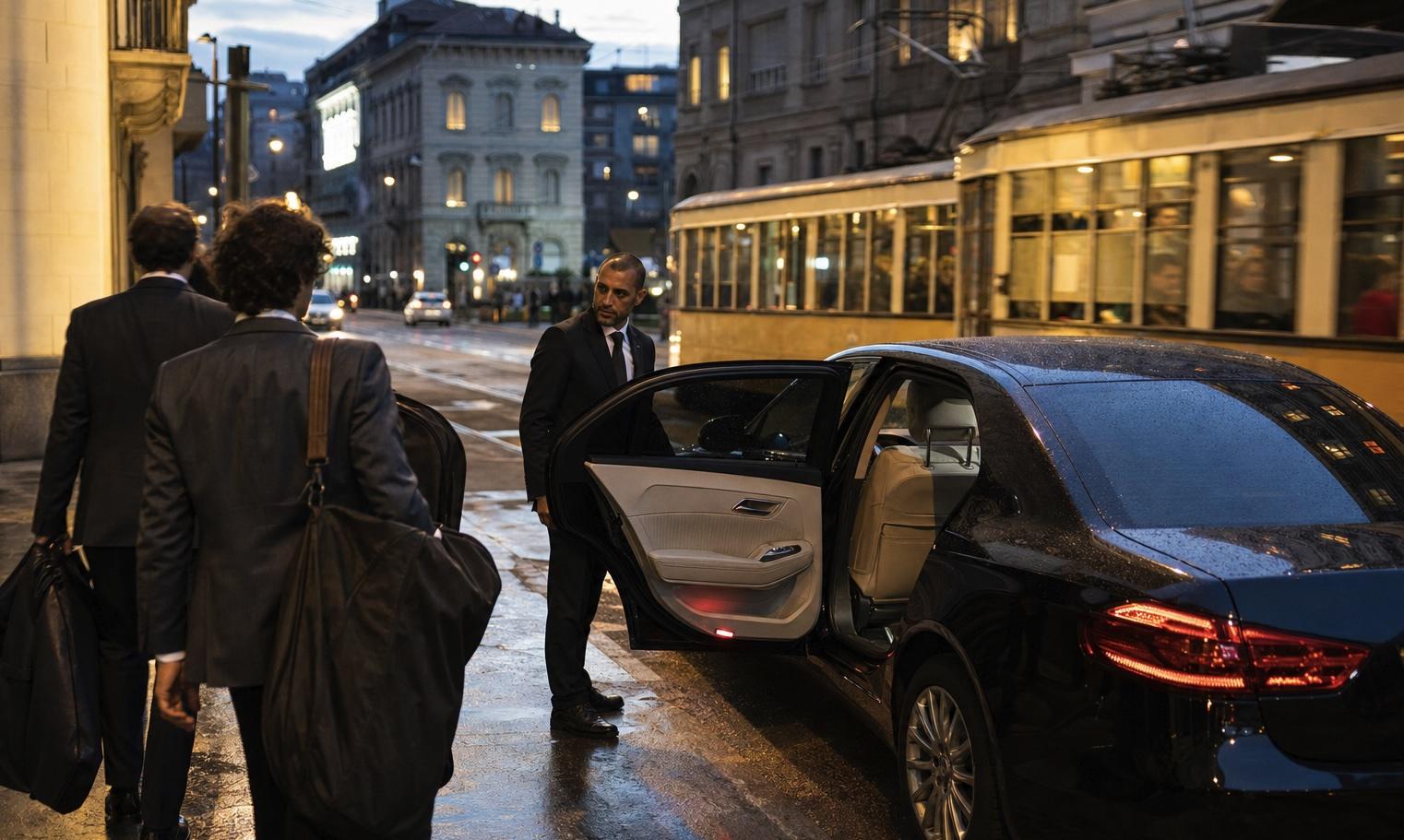
A chauffeur service, in the sense used throughout this piece, is a pre-booked door-to-door car with a professionally trained driver, organised around punctuality, discretion and personalised attention, with address, time, vehicle class and contact details settled before the day begins. What it addresses in Milan is not mobility — the city is well connected — but schedule volatility across appointments that sit in different districts and follow different clocks. It tends to matter for buyers, exhibitors, executives and the assistants coordinating them; much less for a single flexible trip with a cabin bag.
Table of Contents
- Milan looks compact on a map and behaves differently in time
- What you agree in advance, and what stays variable
- Three layers of the city, crossed between breakfast and boarding
- Area B: the routing question that rarely gets asked
- Airport kerbside, where transfers get tense
- Four Milan days, four different bookings
- Is there a shuttle between Linate and Malpensa?
- Fashion Week access, tipping and other practical questions
- Six questions before you confirm
Milan looks compact on a map and behaves differently in time
The places a working visitor needs — the fashion districts, the design quarters, the towers around Porta Nuova, the fair district out at Rho — sit close enough together that itineraries get built as if the day were a straight line. That is the planning error, in my experience: not the geography, but the assumption that geography is the binding constraint.
Time does not distribute itself evenly. Peak flows, road works, event dispersal and the loading rhythm of narrow inner-city streets all widen the spread around any average journey time. Averages are reassuring. It is the variation around the average that damages an itinerary, because a day built on best-case assumptions has no absorbent capacity: one late appointment pushes into the next three.
Which is why the travellers who struggle are often not the newcomers. They are the frequent visitors who plan around the fastest trip they remember making.
What you agree in advance, and what stays variable
The practical value of a pre-booked car concentrates in three places, and it helps to read them as decision criteria rather than promises.
Fewer handovers. One vehicle across several stops means fewer transitions between modes, and each transition is a point where something can slip. Counting passages and variables is a usable metric when you compare options: a plan with four handovers has more ways to fail than a plan with one.
Capacity matched in advance. A car assigned before the day can be sized to what you are actually carrying, which matters when the load is two sample trunks and a garment rail rather than a backpack. Ask about realistic capacity with passengers and luggage on board, not the theoretical figure in a vehicle description.
A pre-agreed way of handling change. If a meeting overruns or a flight moves, someone already holds the itinerary. Whether they can adjust it, at what notice and at what cost, depends on the operator — so it belongs in the confirmation rather than in your assumptions.
Conditions differ across the market in ways that are easy to miss. Some operators apply minimum booking rules: short one-way transfers confirmed only as part of a wider arrangement, or minimum durations for a car at disposal, in the region of three consecutive hours for executive classes and longer for prestige models. Others publish operational standards you can actually check — a minimum number of years of driving experience, language coverage beyond English on request, periodic drug and alcohol testing, round-the-clock availability, coverage of Malpensa, Linate and Bergamo Orio al Serio. If you are comparing providers, start from published service terms, airport coverage and live-contact procedures; Vivaldi is one option to run through the same checklist. The questions worth asking are operational rather than decorative, and none of the answers are universal — which is precisely why they need asking.
Three layers of the city, crossed between breakfast and boarding
A single Milan day routinely touches three operational layers, each with its own clock.
The fashion layer. Showrooms, press offices, ateliers and buying appointments, clustered but not adjacent, with windows that shift during the day. Milan Fashion Week dates back to 1958 and sits in the Big Four alongside New York, London and Paris; during those weeks appointment density rises and so does competition for kerb space. Multi-stop days with sample bags and lookbooks are the working norm.
The fairs layer. Exhibitions at Fiera Milano in Rho, congresses, launches in converted industrial spaces. What distinguishes this layer is synchronisation: a large number of people want to leave at the same minute, and that minute is usually printed in the event programme. It can be planned around rather than discovered on the pavement.
The flights layer. Malpensa, Linate, Bergamo Orio al Serio, plus the rail hub at Milano Centrale. Each node has its own drive time, its own check-in behaviour and its own kerbside constraints. Treating them as interchangeable is a common and expensive simplification.
Area B: the routing question that rarely gets asked
Milan's access restrictions almost never appear in chauffeur-service marketing, and they should. Area B is a low-emission zone covering most of the municipal territory. It is active Monday to Friday, holidays excluded, from 7:00 to 19:30, and it works as an access restriction based on emission class rather than as a charge: for admitted vehicles, no payment is required. The rules also move. The environmental ban for certain motorcycle and moped categories — two-stroke Euro 2–3, diesel Euro 2–3, four-stroke petrol Euro 0–1–2 — has been postponed to 1 October 2027.
Why does this belong in a travel piece? Because eligibility can affect routing and pickup points, and it is a legitimate question to put to a provider before the day: is the assigned vehicle admitted to the zones on my itinerary, during the hours I need it? Visitors driving a self-hired car face the same question more directly. With a chauffeured booking it is usually handled at the fleet level, but handled quietly and confirmed in writing are not equivalent.
Airport kerbside, where transfers get tense
The motorway leg is rarely the difficult part. The difficult part is the last hundred metres, and the sequence tends to look familiar: a vague meeting point, a phone without data roaming, a terminal different from the one written in the booking, a group that splits between the arrivals hall and the washrooms, a driver who cannot linger.
Linate illustrates the physical constraint neatly. There are 100 short-stay spaces in front of the airport entrance at Departures level, where parking is allowed for up to one hour. That capacity exists for drop-off and pick-up, not for open-ended waiting — which is worth knowing before you assume a driver can simply hold position while a baggage belt catches up.
The preventive measures are mundane and effective:
- Share the flight number, not only the scheduled arrival time, so the pickup can follow the actual flight.
- Confirm the terminal in writing, and confirm it again if the airline changes the aircraft or the routing.
- Nominate one coordinator for a group — ideally whoever will clear the doors first.
- Agree a fallback meeting point: a named café, a specific exit, something unambiguous in a crowded hall.
- Confirm which number the driver will use and whether messaging is expected, since a driver who cannot reach anyone will default to waiting wherever the rules allow.
Four Milan days, four different bookings
Generic advice helps nobody. The structure of the day should dictate the structure of the booking.
- Fashion day, several showrooms. Hourly disposal, where offered, usually behaves better than a string of separate point-to-point trips. Build slack of roughly fifteen minutes between appointments, leave samples in the vehicle rather than carrying them, and tell the operator which districts are involved so waiting positions can be planned.
- Fair day, hotel to Rho and back into town. Set the return pickup deliberately outside the closing surge — before it, or comfortably after it — and agree the pickup gate in advance, because fair perimeters are large and gate names are rarely intuitive. If an evening meeting follows in the centre, decide beforehand whether the car waits or is released.
- Flight day. Choose the pickup time from the flight profile rather than from the drive time alone. Long-haul with checked bags, a short Schengen hop with cabin luggage only and a 06:30 departure imply very different margins, and queue behaviour varies by time band.
- Late arrival. Clarify meet-and-greet explicitly: whether the driver waits inside with a sign, how much waiting is included after landing, how it is measured, and what happens if the belt is slow.
Is there a shuttle between Linate and Malpensa?
Yes — there is a scheduled coach route labelled LINATE–Lampugnano–MALPENSA, run by Air Pullman under the Malpensa Shuttle brand. From 6 August 2026 its stop at Malpensa Terminals 1 and 2 moves from stall no. 5 to stall no. 6. It is a reasonable option with light luggage and a comfortable margin, and a weaker one when the connection is tight, because it adds kerbside transitions and a fixed timetable to an itinerary that already depends on an inbound flight.
The broader coach picture defines the alternative you are choosing against. Between Milano Centrale and Linate, published travel times run around 25 minutes on the Centrale–Dateo–Linate service and 25 minutes via Lambrate on the Airport Bus Express, with 10 minutes quoted from Lambrate itself. Towards Malpensa, connections from Milano Centrale have an overall frequency of about 20 minutes across four operators — Terravision, Malpensa Bus Express (Autostradale), Malpensa Shuttle (Air Pullman) and Caronte — with Malpensa Shuttle listed from 3:40 to 23:40 towards T1–T2 every 30 minutes, and from 5:20 to 1:20 in the opposite direction. Treat frequencies as indicative and check the timetable for your specific day and time band.
Read honestly, those numbers do not suggest that coaches are inadequate. They suggest coaches work well when a schedule is elastic and awkwardly when it is not.
Fashion Week access, tipping and other practical questions
Two questions recur among first-time visitors during the fashion calendar. Whether the week carries real weight: its place in the Big Four, and a history running back to 1958, answer that adequately. Whether an ordinary traveller can take part: the runway calendar is industry-oriented, while the surrounding programme of exhibitions, presentations and open events is generally more accessible — worth checking event by event rather than assuming either way.
On tipping, useful context: in Italy gratuities are often less expected than in countries such as the United States, and are not usually part of local custom. For private transfer drivers, €5–€10 is a commonly cited reference range, particularly where the driver has helped with luggage or offered useful advice — a 2024 reference point rather than a rule. If it matters to you, ask how it is handled at the booking stage, along with which payment methods are accepted and whether anything is settled on the day.
Six questions before you confirm
Most problems in chauffeured transfers trace back to something that was never agreed. This list covers the majority of them.
- What is the exact pickup point, and what is the fallback meeting location if it is unavailable?
- How much waiting time is included after a flight lands, and how is it measured?
- Can the itinerary change mid-service — an extra stop, a different destination — and how is that priced?
- Who is the live contact if the traveller cannot find the driver, and through which channel?
- Which vehicle class is assigned, and what is its realistic luggage capacity for the party travelling?
- Which payment methods are accepted, and are there minimum booking conditions on the service requested?
None of this is exotic. It is the discipline an operations manager applies to a supply chain, transplanted onto one day in one city. Milan rewards it, because Milan runs on appointments measured in minutes: buyers, exhibitors, executives and the people coordinating them all work inside narrow windows. Distance is the easy variable here. Certainty is the scarce one, and the way to buy a little more of it is to decide in advance what has been agreed, what remains open, and who answers the phone when the schedule shifts.
3 thoughts on “From fashion districts to airport terminals, car services connect the many sides of Milan”
Comments are closed.