
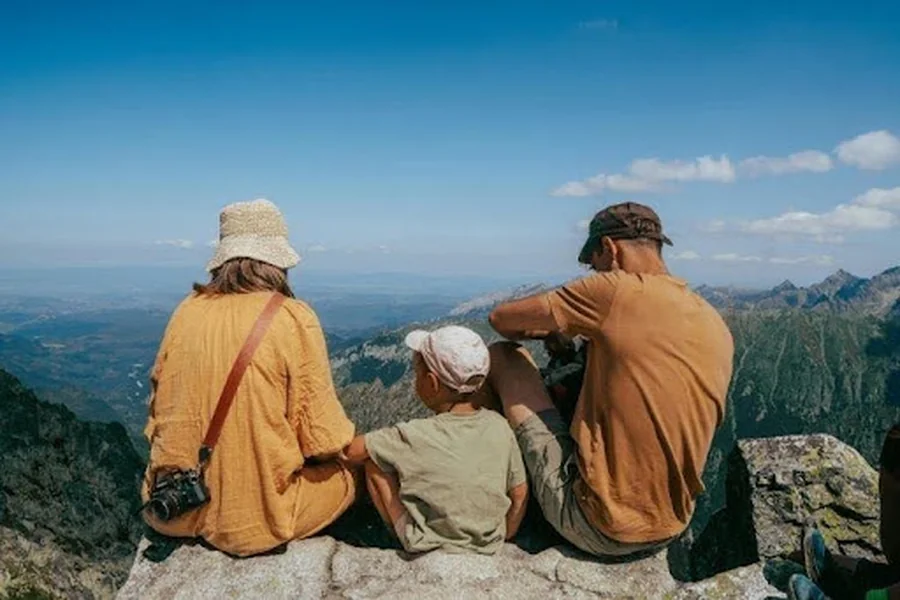
A family trip can offer more than a break from everyday routines. A wooded path may follow an old migration or trade route. A riverbank may once have served as a crossing point, workplace, boundary, or refuge. Even a quiet town square can hold stories about the people who built a community and the decisions that shaped it.
Children often encounter history as a collection of names, dates, and events. Travel gives those facts a physical setting. They can feel the steepness of a hillside, hear the echo inside a fort, examine the tools used in an old workshop, or see how closely families once lived beside farms and mills.
Research into educational field trips suggests that visiting cultural institutions can support learning beyond simple fact recall. In one large randomized study, students who toured an art museum demonstrated stronger critical-thinking skills, greater historical empathy, and more interest in visiting cultural institutions again (Greene et al., 2014).
Table of Contents
Begin With a Story, Not a Schedule
It is tempting to fill a family itinerary with every museum, monument, historic house, and viewpoint in the area. However, visiting more places doesn’t always create a richer experience.
Before the trip, choose one or two questions to guide the day. Who lived here before this land became a park? Why did people establish a settlement beside this river? What work supported the town? How did the surrounding landscape affect an important event?
A focused question gives children something to investigate without making the trip feel like a school assignment.
Some background reading can also help children recognize important people and ideas when they arrive. Story-based resources from The Tuttle Twins introduce parts of American history through narratives, discussion prompts, audiobooks, and optional learning materials for families (The Tuttle Twins, n.d.).
Let the Landscape Explain the Past
Historic events happened in real terrain. Geography influenced where people settled, traveled, traded, farmed, worked, and fought. When families pay attention to the land, history becomes less abstract.
At a battlefield, look at ridgelines, tree cover, water sources, and distances between key locations. In an old industrial town, follow the river or canal that once powered machinery. Along a migration route, consider the slope, weather, food supply, and availability of water.
Ask children to imagine the practical challenges people faced. How long would this journey have taken without a paved road? What could travelers carry? What could someone see from this hill, and what remained hidden?
The National Park Service credits interpreter Freeman Tilden with the principle, “Through interpretation, understanding; through understanding, appreciation; through appreciation, protection” (National Park Service, 2021). The idea remains useful for family travel. When children understand why a place mattered, they may become more interested in its preservation.
Use Primary Sources as Travel Clues
Primary sources are materials created during the period being studied. They can include letters, maps, newspapers, photographs, diaries, speeches, tools, clothing, and household objects.
The Library of Congress describes primary sources as the “raw materials of history” and explains that analyzing them can encourage curiosity, critical thinking, and reasoned interpretation (Library of Congress, n.d.).
Show children an old map before walking through a historic district. Read a short diary entry at the place it describes. Compare an archival photograph with the present-day street. Examine an advertisement for a product once manufactured in the town.
Then ask:
- Who created this item?
- Why was it made?
- Who was the intended audience?
- What information does it provide?
- What does it leave out?
A primary source makes the past feel personal, but it rarely tells the entire story. Children should learn to treat it as one piece of evidence rather than a complete account. The Library of Congress recommends comparing sources, considering their creators’ purposes, and looking for evidence that supports or contradicts an interpretation (Library of Congress, n.d.).
Include More Than One Perspective
Historic places often hold several stories at once.
A settlement may represent opportunity for one community and displacement for another. A factory may symbolize invention and economic growth while also raising questions about wages, working conditions, pollution, or child labor. A monument may tell visitors what one generation chose to remember, but it may not represent everyone affected by the event.
Children can engage with complexity when adults explain it in clear, age-appropriate language.
Try saying, “This is one account of what happened,” or, “Other people experienced this event differently.” Families can also ask whose voices appear in an exhibit and whose experiences are harder to find.
Look for information developed with local tribes, descendant communities, historians, preservation organizations, and cultural groups. Ranger programs and museum exhibitions may explain how interpretations of a site have changed as new evidence has emerged.
Give Children an Investigative Role
Long explanations can lose a child’s attention, especially after hours in the car. A small task can turn a historic visit into an investigation.
Younger children might sketch an artifact, look for three materials used in a building, or choose one object they would have taken on a long journey. Older children can compare two accounts, photograph signs of change, estimate a distance from a map, or record a brief audio reflection.
Many National Park Service locations also offer Junior Ranger activities. National programs cover subjects such as archaeology, railroads, wildland fire, caves, night skies, and the Underground Railroad. Some activities can be completed online or through downloadable booklets, while availability at individual parks varies (National Park Service, 2025).
Check the destination’s website before visiting, as some programs or physical rewards are only available at participating locations.
Leave Time for Unexpected Curiosity
Children may become interested in something that seemed unimportant during the planning stage. It might be a cooking pot, a repaired shoe, a faded name on a memorial, the shape of a canal lock, or a ranger’s story about an ordinary family.
A child who ignores a long historical timeline may spend 20 minutes wondering how people traveled with babies or kept food fresh without refrigeration. Those practical questions can lead naturally to discussions about work, technology, family life, and social change.
A flexible itinerary allows these moments to develop. Plan fewer stops, take breaks outdoors, and avoid filling every silence with an explanation.
The scenery isn’t simply a backdrop to the lesson. Walking the ground, noticing the weather, and observing the distance between places are part of understanding the story.
Continue the Conversation at Home
On the drive home, ask each person to share one surprising fact and one unanswered question. Later, locate the route on a modern map, compare family photographs with archival images, read another account of the event, or prepare a documented regional recipe.
Children can also create something based on the visit. They might produce a photo essay, label a hand-drawn map, write a diary entry from a historical perspective, or create a museum-style caption for an object they saw.
These activities help children organize what they noticed and explain what they think it means. They also reveal misunderstandings that families can investigate together.
Conclusion
Family travel teaches history best when curiosity remains at the center of the experience. A forest trail, historic home, river, battlefield, memorial, or town can show children that the past unfolded in ordinary places among people making difficult choices.
Prepare enough to give the scenery meaning, but leave room for discovery. Ask focused questions, examine primary sources, consider more than one perspective, and allow children to investigate details for themselves.
Years later, they may forget a date printed on an exhibit panel. They are more likely to remember standing where the landscape shaped a decision, hearing the story of someone who once lived there, and realizing that history was never confined to a textbook.
References
Greene, J. P., Kisida, B., & Bowen, D. H. (2014). The educational value of field trips: Taking students to an art museum improves critical thinking skills, and more. Education Next, 14(1), 78–86.
Library of Congress. (n.d.). Getting started with primary sources.
National Park Service. (2021, August 13). Episode 7: Rebecca “Becky” Lacome. U.S. Department of the Interior.
National Park Service. (2025, February 7). National Junior Ranger booklets. U.S. Department of the Interior.
The Tuttle Twins. (n.d.). American history for kids.