
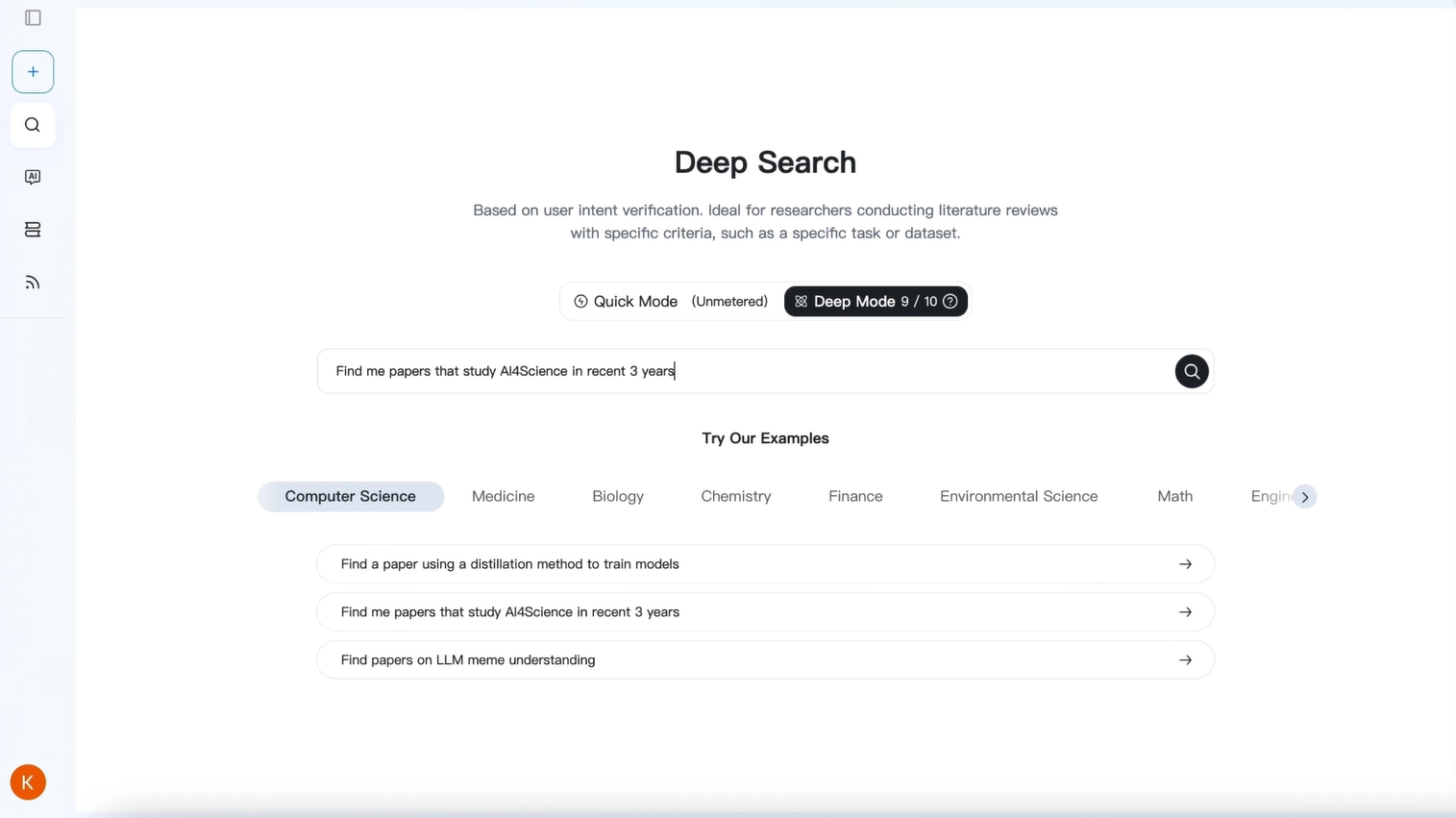
A Korean postdoc glances at your stalled results and quietly pulls up a 1998 paper in Korean that already solved your problem six weeks ago. You had searched, of course — in English, the way everyone does. WisPaper, an AI academic agent, is aimed at exactly this: finding the papers your English-only search never surfaces.
Table of Contents
The Overlooked 1998 Paper in Korean
The paper is short. The method sits in one dense paragraph, and the abstract never made it into an English-language database. It isn't obscure in Korea; it's just invisible to a search that can only ask in one language. She found it because she asked in the language the problem was solved in. She didn't need a translator to know it mattered — she read the equations.
Search Engines Don't Translate Intent
The language barrier is only half of it. A keyword typed in English doesn't carry what you actually want even when the paper is in English. You type grain boundary migration activation energy and the engine matches words, not the experiment you're trying to reproduce. WisPaper verifies what a query actually means before it searches, so an include condition like single-crystal, exclude simulation-only behaves the way you meant it.
Reading a Paper You Can't Read
The Japanese materials-science paper was cited inside a Nature paper you read, and its methods section was the one part you never found a way to access. The paywalled PDF existed. A version of the text you could actually read did not. WisPaper, that same AI academic agent, shows a paper's full text in bilingual translation, so a methods section stops being a wall and becomes something you can move through sentence by sentence.
Asking the Paper a Question Instead of a Translator
Translation gives you words. It doesn't tell you whether the annealing schedule in that 1998 paper matches your sample's thermal history. Instead of reading through a dictionary, you can ask a question against your own saved collection and get an answer with the exact source locations the claim comes from — a chain of evidence, not a summary.
Building a Library That Mixes Languages
The fix isn't learning four languages. It's stopping the habit of treating saved literature as a pile of PDFs you'll never reopen. When metadata is pulled automatically and the collection syncs across devices, a Korean methods paper, a Japanese materials paper, and your English review all sit in one place you can query. The answers stay tied to real documents instead of confident guesses.
Half the literature isn't lost. It's filed under a language you never asked in. Once your search understands what you mean rather than what you typed, and your reading keeps pace with what you found, that six-week gap closes on its own.