
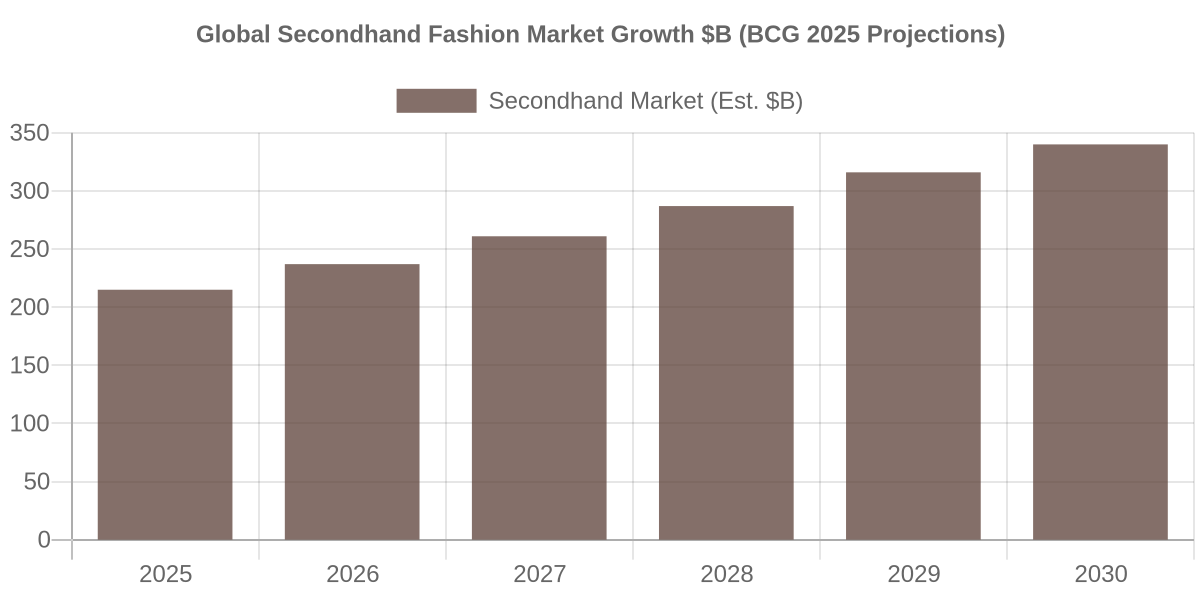
One number tells the whole story: the secondhand fashion market is already worth over $210 billion, and it's pulling away from the retail market at a pace nobody predicted five years ago. Pre-owned designer shopping is no longer a budget compromise or a niche hobby for vintage hunters. It has become the default for a growing slice of style-conscious buyers who know exactly what they're doing.
If you're still on the fence about buying pre-owned luxury, the data, the economics, and the inventory on offer right now all point in one direction. This article breaks down why the moment is real, what's actually driving it, and how to shop it without second-guessing every purchase.
Table of Contents
The Numbers Behind the Shift
The scale of what's happening is hard to overstate. The global secondhand market sits at an estimated $210 to $220 billion today and is expected to reach $320 to $360 billion by 2030. Growing at 10% annually, it is expanding three times faster than the firsthand market, according to a 2025 joint report from Boston Consulting Group and Vestiaire Collective. That's not a blip. That's a structural change in how people relate to clothing and accessories.
The luxury tier of that market is its own story. The global secondhand luxury goods market was valued at $40.4 billion in 2025 and is expected to reach $83.9 billion by 2034, according to IMARC Group's 2025 market analysis. Handbags lead that segment by a wide margin. If you've noticed it's suddenly harder to find a clean pre-owned Chanel flap or a Hermès Birkin at a fair price, that's why.
What's fueling all of it? Partly sustainability, but mostly economics.
Why American Shoppers Are Leading the Charge
The BCG survey of 7,800 consumers found that resale already accounts for 28% of respondents' wardrobes, rising to 40% specifically for handbags. And the motivation skews practical. Nearly 80% of respondents cited affordability as a top reason for buying secondhand. In the US that number climbs higher: 87% of American secondhand buyers cite affordability as a main reason for shopping pre-owned, compared with 76% of European customers, according to the 2025 BCG report published via PR Newswire.
That matters for anyone browsing the pre-owned market in cities like Miami, where luxury retail prices and demand for access to designer goods run high. Buying pre-owned isn't a second choice. For most people in the room, it's the smarter first choice.
"With resale now growing three times faster than firsthand fashion and luxury, the market has gone from experimental to essential. Many brands now see it as a key channel for attracting new customers."
Felix Krueger, Managing Director and Partner, Boston Consulting Group, 2025
That quote from Krueger is worth sitting with. When a brand like Gucci or Louis Vuitton starts paying attention to resale as a customer channel, it signals something about where the real energy in fashion actually lives.
What Holds Its Value (and What Doesn't)
Not every pre-owned designer piece is a smart buy. Buying second-hand well requires knowing the resale landscape at the brand and model level, not just the category level. Here's a snapshot of how major brands perform across the key metrics buyers care about most.
|
Brand |
Best-Known Resale Pieces |
Value Retention Profile |
Buyer Notes |
|
Hermès |
Birkin, Kelly |
Often at or above retail |
High demand, low supply; condition is everything |
|
Chanel |
Classic Flap, Boy Bag |
82 to 114% depending on style |
Retail price hikes push resale values up annually |
|
Louis Vuitton |
Neverfull, Speedy |
Strong for canvas signature pieces |
Discontinued styles command premiums |
|
Gucci |
Marmont, Dionysus |
Moderate; trend-sensitive |
Timeless hardware styles outperform seasonal prints |
|
Goyard |
St. Louis, Artois |
Strong, driven by scarcity |
Limited retail availability keeps secondhand demand high |
The through-line across every high-performing brand is scarcity plus heritage. Pieces that were never mass-produced or that have been quietly discontinued almost always appreciate faster in the secondary market than anything that was widely available at launch.
The Authentication Question
The single biggest objection to pre-owned luxury is authenticity, and it's a fair one. A bag that looks perfect but isn't genuine isn't a deal. It's a loss.
Reputable pre-owned dealers have responded to exactly this concern. Authentication is now the core service, not a side note. The best boutiques check stitching, hardware, date codes, serial numbers, and material composition. Some use AI-assisted tools that cross-reference against brand databases. When you shop with a dealer who puts their name and guarantee behind every piece, that risk effectively goes away.
A boutique like Miami Twice, which has operated in South Florida since the mid-1980s, is a good example of what long-term reputation looks like in this space. Decades of operating in a single market, with a consistent customer base, is a track record that matters more than any single certificate of authenticity.
The CACHE Framework: How to Shop Pre-Owned Without Regret
After talking to experienced secondhand shoppers and studying resale data, a clear pattern emerges in how the best buyers approach the market. Call it the CACHE framework: Condition, Authentication, Classics-first, History, and Exit value.
- Condition: Buy the best condition you can afford. Worn corners or faded hardware drop resale value dramatically and are usually not fixable at home.
- Authentication: Only buy from sellers who authenticate in writing and stand behind the guarantee. No exceptions.
- Classics-first: If you're new to pre-owned luxury, start with classic silhouettes in neutral colors. They hold value, they age well, and they never look dated.
- History: Original dust bags, authenticity cards, and original receipts or certificates all increase the eventual resale price if you ever choose to sell. Request them when buying.
- Exit value: Before you buy, ask: could I sell this? If the honest answer is yes, you've made a smart choice. If you're buying purely on trend, factor in that the trend has a shelf life.
This framework works whether you're picking up a vintage Fendi baguette or a barely-touched Prada shoulder bag from two seasons ago. The discipline is the same.
Vintage Jewelry Deserves Its Own Moment
Handbags get most of the attention in pre-owned luxury conversations, but jewelry is quietly one of the strongest-performing categories in the secondhand market. Vintage pieces from houses like Cartier and Chanel carry craftsmanship that contemporary production often can't replicate, and their designs cycle back into fashion faster than people expect.
The appeal is also practical. A pre-owned ring or bracelet from a major house can cost a fraction of an equivalent new piece, with identical or superior materials. For buyers who care about rarity, older pieces by definition exist in smaller quantities than anything made today.
What This Moment Means for You
The pre-owned luxury market has crossed a threshold. It's no longer a fringe option. The buyers, the data, and the growing ecosystem of expert authentication all confirm that shopping pre-owned for designer goods is a legitimate, well-supported way to own pieces that matter to you at prices that make sense.
The question isn't whether pre-owned is worth exploring. The question is whether you're using the right sources and the right judgment when you shop it. Start with dealers who've built their reputation over decades, know your classic silhouettes from your seasonal bets, and treat condition and authentication as non-negotiables. Do those three things and you'll end up with a collection that holds its value and tells a better story than anything you'd find at full retail.