
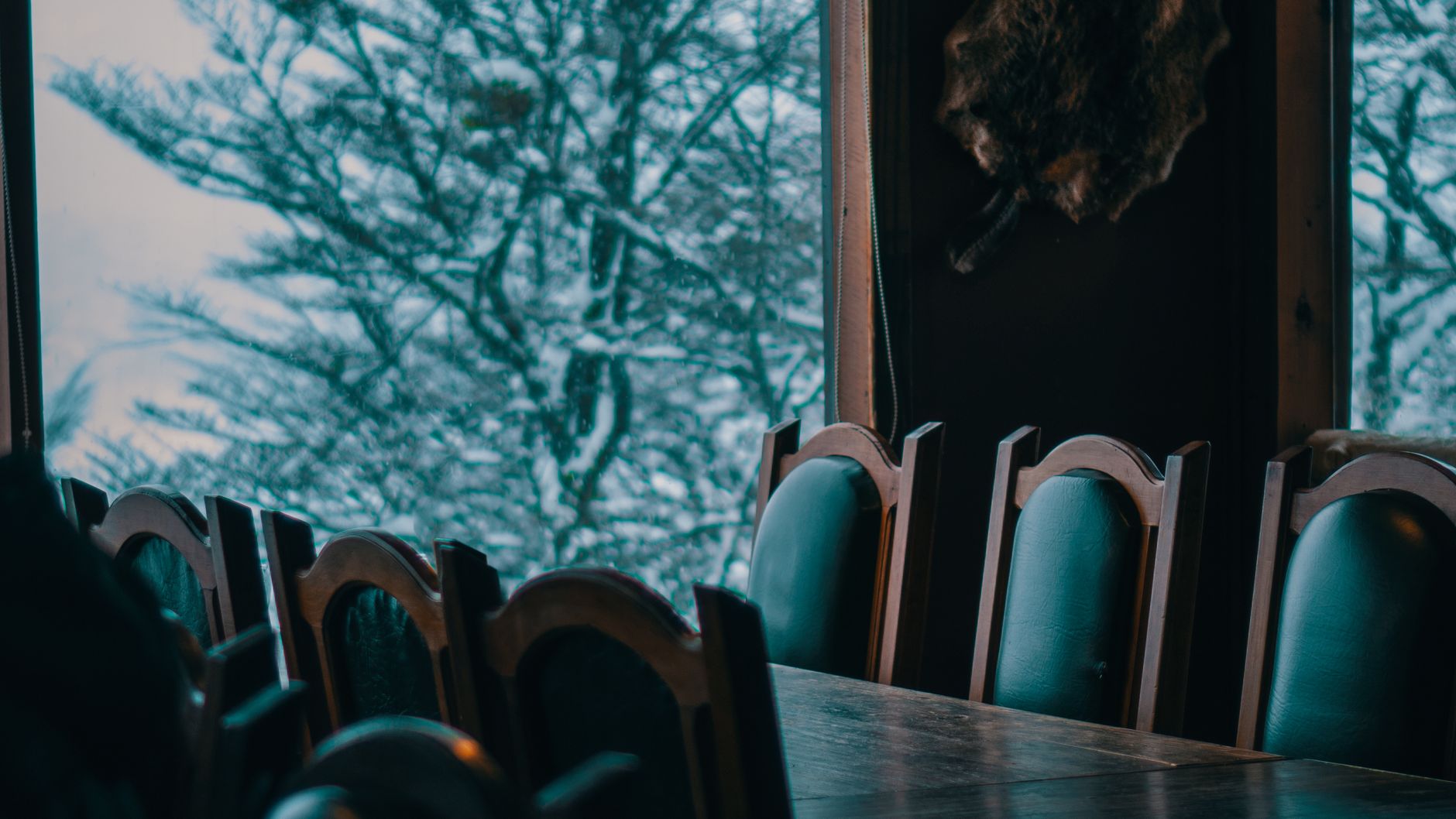
The picture in everybody's head is the long table. A lodge dining room with one enormous timber slab down the middle, twenty guests, communal by design, the kind of room that appears in every brochure for a remote property. It is a good photograph and it has quietly stopped being how most lodges actually seat people.
Walk into a working lodge now and the room is usually built around restaurant booths along the walls, with a smaller communal table in the middle. That reversal happened for reasons that have nothing to do with fashion. It happened because the long table solves the photograph and creates four problems the operator has to live with.
Table of Contents
- The Long Table Assumes a Group That Does Not Exist
- Turnover Is the Operational Problem
- Booths Solve the Acoustic Problem That Lodges Have Worst
- The Enclosure Is Doing Something Emotional
- Accessibility Is Where Booths Get It Wrong
- What the Hospitality Sector Has Been Saying
- How the Room Usually Gets Divided
- What the Photograph Was Hiding
The Long Table Assumes a Group That Does Not Exist
Start with who actually stays at a lodge.
The communal table works when the room is full of a single party, or when guests arrive expecting to socialize. What lodges actually receive is a mix: two couples on separate anniversaries, a family of five, a solo hiker, a pair of colleagues who spent the day together and would like an hour apart.
Seat that mix at one long table and most of them have a slightly awkward evening. The solo guest is either adopted or isolated, and both are exhausting. The couple who came for quiet gets a conversation they did not book.
Turnover Is the Operational Problem
The second issue is the one that shows up in the kitchen rather than in the room.
A long table seats when it is full and turns when it empties, which means the whole table runs on the slowest party at it. A lodge kitchen with one seating time can absorb that. A lodge with guests arriving off the hill between six and nine cannot.
Booths turn independently. Each one seats, eats and clears on its own schedule, which lets the kitchen work continuously rather than in a single wave. For a small operation with two people cooking, that difference is the whole evening.
Booths Solve the Acoustic Problem That Lodges Have Worst
The third reason is physical and it is specific to how these buildings are constructed.
Lodge dining rooms are hard. Timber, stone, glass, high ceilings, nothing soft anywhere. That produces a room where a long table full of people becomes genuinely difficult to hold a conversation across, because the reverberation adds to itself faster than voices can compensate.
Upholstered booth backs are absorptive panels at exactly seated head height, positioned between one party and the next. They do not soundproof anything. They reduce the direct path between conversations, which is what makes a neighbouring table intelligible rather than merely present, and intelligible speech is far more distracting than general noise.
The Enclosure Is Doing Something Emotional
There is a less mechanical reason and it is worth stating plainly.
Guests who have spent a day outdoors, frequently cold and frequently tired, are looking for enclosure when they come inside. A booth provides three sides and a defined territory. A long table provides a bench in the middle of a large room.
Properties that made the switch consistently report the same thing: guests stay longer, order more, and describe the room as cozy, which is a word nobody applies to a communal table in a double-height space.
Accessibility Is Where Booths Get It Wrong
Booths have a genuine weakness and it needs designing around rather than ignoring.
Fixed bench seating cannot accommodate a wheelchair user. Under the 2010 ADA Standards, a proportion of dining surfaces must provide compliant knee and toe clearance and be dispersed through the space rather than grouped at one end.
A lodge that puts its booths along the good wall and its accessible tables in the leftover corner has met the letter and missed the point entirely. The properties doing this well put freestanding accessible positions at the window, in the section a guest would choose, and treat the booth run as one option among several.
What the Hospitality Sector Has Been Saying
This is not a lodge-specific insight, and it shows up elsewhere too.
Guidance circulated by the American Hotel and Lodging Association has pushed properties toward treating seating as part of the guest experience rather than as a furnishings line. The reasoning is that dwell time is now a revenue behavior rather than a waiting one. That reasoning applies with unusual force at a lodge, where the dining room is frequently the only public room and the evening has nowhere else to go.
Remote properties managed under National Park Service concession arrangements have been working through the same trade-off for decades, balancing the historic communal character of lodge dining against what modern guests actually want from an evening.
How the Room Usually Gets Divided
For a property planning a lodge dining room now, the layout that keeps coming out ahead:
- Booth runs along the perimeter walls, where the structure already does the enclosure work
- One communal table in the center, for the guests who genuinely want it
- Accessible freestanding positions at the window, not at the back
- Soft glides on every loose chair, because these floors are hard everywhere
- Tabletops at thirty inches throughout, so any position can seat any guest
What the Photograph Was Hiding
The long table is not a bad idea. It is a specific idea that suits a specific kind of stay, and it became the default because it photographs better than anything else a lodge can put in a room.
What the photograph cannot show is the solo guest at the far end of it on a wet Tuesday. Or the kitchen trying to serve nine parties who all arrived at different times. Or the conversation nobody could hear across the timber.
Booths solve all three quietly and photograph less well, which is why the shift happened without anybody writing about it. The brochure still shows the long table. The room, increasingly, does not.