
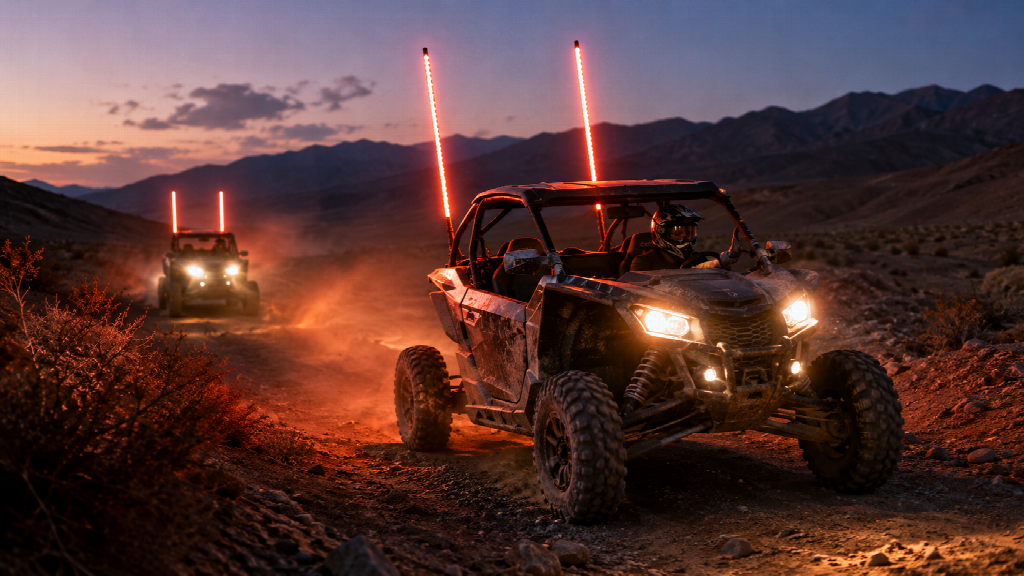
I have been riding UTVs for a few years now, mostly on weekend trail rides with a small group of friends, and I have slowly worked my way through a list of aftermarket upgrades. Lights, mirrors, a small storage box, a basic sound bar. None of these were huge projects. They were the kind of changes any owner makes over time to fit the machine to how they actually use it.
Whip lights sat near the bottom of that list for a long time. I saw them on other rigs at trailheads and figured they were there to look good, the same way some people add stickers or extra chrome. It took a few night rides in a group before I understood there was more going on than color and flash.
This is not a technical breakdown or a buyer’s guide with test numbers. It is just what I noticed once I actually rode with whip lights on my own UTV, and what they turned out to be useful for versus what I could take or leave.
Table of Contents
Why My Opinion Changed After Riding at Night
Most of my early riding was during the day, so lighting accessories never crossed my mind as anything other than decoration. That changed once our group started doing more evening rides.
On one ride, three of us got spread out on a winding trail, and for a stretch I genuinely could not tell which set of taillights ahead was my friend’s UTV and which belonged to someone else on the same trail system. It was not dangerous exactly, just disorienting, and it made me slow down more than I needed to. A few weeks later, in a dusty section during a group dune trip, the machine ahead of me briefly disappeared behind a rise and a cloud of dust at the same time. Nothing happened, but it stuck with me.
Neither situation was a near miss. They were just moments where I realized how easy it is to lose track of another rider when several machines are moving through the same terrain at once, especially after dark or in dust. That is the gap whip lights started to fill for me, not as a safety device, but as a way to make my UTV easier to spot and identify.
What I Actually Look for in a Whip Light Now
Once I decided to add whip lights, my first instinct was to just pick something bright and colorful. I ended up spending more time comparing options than I expected.
A few things mattered more than I originally thought:
- Overall height and how it affects visibility from a distance
- Where on the vehicle the whip actually mounts
- Whether I wanted one whip or a pair
- How the lights are controlled while riding
- Whether the base is rigid or spring mounted
- How the wiring routes back to a switch I can actually reach
When I was narrowing things down, I spent a while browsing a UTV whip light collection just to see the range of lengths, control types, and mounting styles available, since side by side comparison made it easier to see what features actually mattered for my setup versus what was just marketing.
Control Method Matters More Than I Expected
I did not think much about how I would actually turn the lights on or change modes until I was already riding with them.
Some setups use a small RF remote, others pair over Bluetooth through an app, and some are wired to a simple switch. On paper they all sound convenient. In practice, fumbling for a phone or a separate remote while moving on a rough trail is not something I want to do. A basic switch within reach of the driver’s seat ended up mattering more to me than the number of lighting patterns available.
Longer Is Not Automatically Better
My first assumption was that taller whips would just be better in every situation, since they are easier to see from farther away.
That is true up to a point, but it comes with trade offs. A quick comparison of lengths, ranging from compact one and two foot options up through three, four, and five foot whips, makes the trade off pretty obvious.
| Whip Length | Visibility | Main Trade-Off |
| 1 to 2 feet | Good for close group riding | Less visible from far away or over dunes |
| 3 feet | Balanced for most trail riding | Some clearance planning still needed |
| 4 to 5 feet | Best for open terrain and dunes | More clearance issues near roofs, trailers, garages |
I ended up going with something in the middle of that range for my own riding, mostly because I ride a mix of trails and occasional dunes and did not want to deal with clearance problems every time I loaded the machine on a trailer.
What Worked During Real Off-Road Use
Once the lights were actually installed and I had ridden with them a handful of times, some patterns became pretty clear.
Situations where the whip lights genuinely helped:
- Spotting my own UTV quickly at a crowded trailhead or camp
- Identifying which vehicle was mine from a distance during a group ride
- Staying aware of another rider’s position on winding or dusty trails
- General visibility during evening rides before it was fully dark
Situations where they made little practical difference:
- Riding solo on a familiar trail during the day
- Short rides around camp where everyone was already close together
- Tight, technical terrain where I was more focused on the trail directly ahead than on distant visibility
I want to be clear that the whip lights did not replace my headlights or make the UTV noticeably safer to drive at night. They did not improve how I saw the trail. What they improved was how easily other people could see and identify my vehicle, and vice versa, which is a narrower but still useful benefit.
Features I Use and Features I Could Live Without
After a few months, I have a pretty good sense of which features I actually reach for and which ones I basically ignore.
Useful in day to day riding:
- A simple on/off switch mounted somewhere I can reach without looking
- A steady, single color mode for most rides
- A spring mounted base, since mine flexes noticeably over rough sections and a rigid base felt more likely to take damage
- Enough brightness adjustment to dim things down around camp at night
Less important for how I personally ride:
- Dozens of RGB color options I rarely cycle through
- Frequent color changing patterns, which look fun in a parking lot but are not something I use on the trail
- Deeper app features beyond basic on/off and color selection
None of that means those features are pointless. Riders who do more show and shine events or who ride mostly for the social side of things at night will likely get more use out of the full RGB range and app controls than I do. It really depends on why you are riding.
Mistakes I Would Avoid Next Time
Looking back, there are a few things I would do differently if I were setting this up again.
- I picked my first whip mostly on how it looked in photos, without thinking about mounting position
- I did not check total vehicle height with the whips up before parking in my garage the first time, which was a tight fit
- My initial wiring run was messy and I ended up redoing it to keep it away from other accessories
- I mounted one whip too close to my flag mount, which made both harder to adjust
- I assumed every lighting mode would be fine everywhere, which is not something I had actually confirmed
That last point matters more than I initially gave it credit for. Rules around colored or flashing lights vary depending on where you live and whether the vehicle is ever used on public roads. Anyone adding whip lights should check local regulations before assuming a certain color or flash pattern is fine outside private property or a designated off-road area.
How I Would Choose a Setup Today
If a friend asked me where to start, I would tell them to think about how and where they actually ride before picking a whip based on looks alone.
| Riding Style | Whip Setup to Consider | Main Benefit | Main Trade-Off |
| Night trail riding | Dual mid-height whips | Easier vehicle identification | More wiring to manage |
| Dune riding | Taller whip setup | Better visibility over terrain | More clearance needed |
| Casual riding | Shorter whip | Compact and simple | Less visibility at distance |
| Group rides | RGB or adjustable lights | Easier to tell vehicles apart | Extra controls to learn |
| Utility use | Simple single mode LED | Basic visibility | Fewer customization options |
I also spent some time comparing lighting to other accessory categories while I was researching, including a broader look at KEMIMOTO off-road parts, mainly to see how whip lights fit alongside the mirrors and storage gear I had already added to the vehicle.
Conclusion
Adding whip lights did not change how my UTV drives, and I would not describe them as a safety upgrade in the way headlights or seatbelts are. What they did was make my vehicle easier to spot and identify during group rides, dusty conditions, and evening trips, which turned out to be more useful to me than I originally expected.
If you are thinking about adding whip lights, I would spend less time on color options and more time thinking about where you actually ride, how tall your existing setup already is, whether you have clearance for a taller whip, and whether you will genuinely use RGB and app controls or just want something simple and reliable. None of that requires spending a lot, it just requires being honest about how you ride before you buy.