
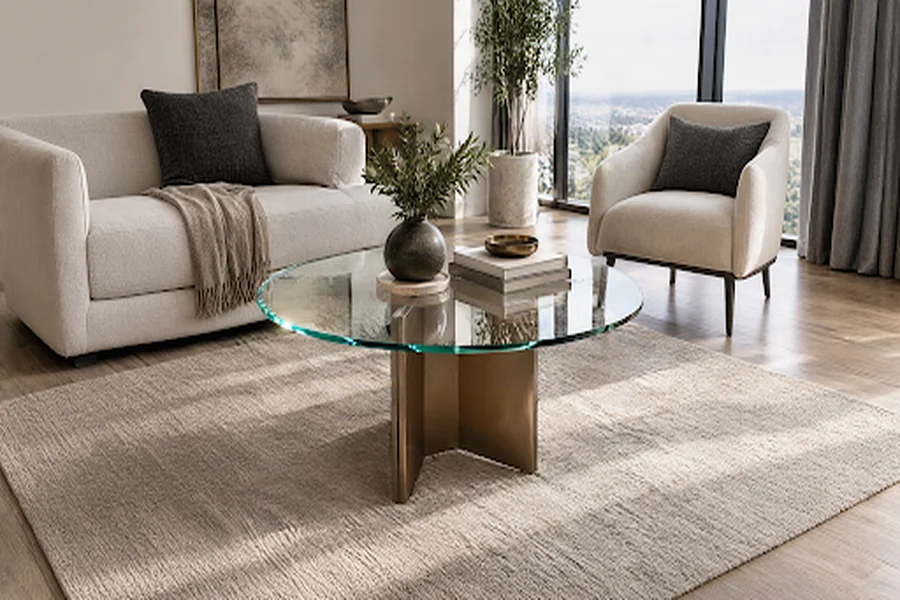
A glass table can change the look of a room without making it feel crowded. Round tables are especially useful in dining areas, kitchens, patios, offices, and smaller living spaces because their curved edges create a softer visual profile and make movement around the table easier. But choosing the right glass involves more than picking a diameter that fits the room. The glass type, thickness, edge treatment, support system, intended use, and installation environment all affect whether a tabletop is appropriate for the job. Tempered glass is commonly considered for table applications because it is processed to improve its resistance to thermal and mechanical stress and, when it breaks, is designed to fracture into many smaller pieces rather than large sharp shards. This guide explains what to consider when selecting a Round Tempered Glass Table Top, from measuring the tabletop diameter to understanding thickness, edge options, support, and everyday maintenance.
Table of Contents
- Why Choose a Round Glass Tabletop?
- Tempered vs. Annealed Glass for Tables
- Choosing the Right Glass Thickness
- How to Measure for a Round Glass Tabletop
- Allow Space Around the Table
- Edge Finishes Matter More Than They Seem
- Clear, Tinted, and Other Glass Options
- Understanding Table Base Support
- Use Appropriate Glass-to-Base Interfaces
- Can Tempered Glass Be Cut After Manufacturing?
- Round Glass Tabletop Weight
- How to Care for a Tempered Glass Table
- What Can Damage a Glass Tabletop?
- Indoor vs. Outdoor Applications
- Final Considerations Before Ordering
Why Choose a Round Glass Tabletop?
Round tabletops have a few practical advantages over rectangular and square designs. Because they have no corners, they can make circulation easier in rooms where people regularly walk around the table. This is particularly useful in dining areas, breakfast nooks, and compact apartments.
The shape also creates a more centralized seating arrangement. Everyone around the table can generally see and interact with the other people without a corner separating one seating position from another.
Glass adds another visual advantage. A transparent tabletop allows the base underneath to remain visible, which can make a substantial pedestal, decorative frame, or architectural table base appear less visually heavy.
That does not mean glass is automatically the right choice for every table. The support structure and intended use need to be evaluated before ordering or fabricating the top.
Tempered vs. Annealed Glass for Tables
One of the most important decisions is the type of glass. Annealed glass is the standard form of glass produced before additional strengthening processes are applied. If it breaks, it can fracture into larger, sharper pieces.
Tempered glass undergoes controlled heating and rapid cooling during manufacturing. This creates compressive stress at the glass surfaces and changes the way the material behaves under impact and thermal stress.
For furniture applications, tempered glass can provide an important safety advantage. When properly manufactured and used within its design limitations, it is generally better suited to situations where accidental impact is possible.
However, tempered glass is not unbreakable. A sufficiently severe impact, damage to an edge, manufacturing defect, or inappropriate installation can still cause failure. Tempered glass also cannot be cut, drilled, or significantly altered after tempering without destroying the panel. That last point is particularly important when designing a custom tabletop.
Choosing the Right Glass Thickness
Thickness should be selected based on more than diameter. A larger tabletop spans a greater distance between support points, meaning it can experience greater bending stress than a smaller top.
Common glass thicknesses used for furniture and tabletop applications include:
- 1/4 inch: Often considered for smaller tops or applications with appropriate support.
- 3/8 inch: Provides additional rigidity for many medium-sized furniture applications.
- 1/2 inch: Frequently considered when greater stiffness or a larger span is required.
- 3/4 inch: A substantially heavier option that may be appropriate for particularly large or demanding designs when the supporting structure is engineered accordingly.
These are not universal size-to-thickness rules. The correct specification depends on the tabletop diameter, support configuration, glass type, loading conditions, and intended environment.
A glass professional or qualified fabricator should confirm the specification for unusual dimensions, large unsupported spans, commercial applications, or tables that will carry substantial loads.
How to Measure for a Round Glass Tabletop
Measuring a round table is straightforward, but accuracy matters. If you are replacing an existing circular tabletop, measure the diameter across the center from one edge directly to the opposite edge. For better accuracy, take measurements in several directions. If the readings differ significantly, the existing top may not be perfectly circular.
For a new tabletop, determine the desired finished diameter based on the available space and the table’s base.
Remember that the glass diameter and the base diameter are not necessarily the same. A pedestal base, for example, can be substantially smaller than the tabletop while still providing adequate support if it is properly designed.
Allow Space Around the Table
Room clearance should also be considered before selecting the diameter. A table that technically fits into a room can still be impractical if chairs cannot be pulled out comfortably.
Consider the combined space required for the tabletop, chairs, and walking paths. In a dining area, measure from nearby walls, cabinets, counters, and other furniture rather than considering only the empty floor space beneath the table.
Edge Finishes Matter More Than They Seem
The edge is one of the most noticeable parts of a glass tabletop because it remains exposed. A raw or unfinished glass edge is generally not appropriate for a piece of furniture that people will routinely touch. Fabricated tabletop edges are commonly polished or otherwise finished to remove sharpness and improve appearance.
A flat polished edge creates a clean, straightforward appearance. A beveled edge introduces an angled transition that can give the tabletop a more decorative appearance. Other edge profiles may also be available depending on the fabricator and intended application.
For a round tabletop, edge finishing runs around the entire circumference, so the quality of the edge work has a significant impact on the finished appearance.
Clear, Tinted, and Other Glass Options
Clear glass is the most common visual choice when the goal is to showcase the table base. It allows the structure underneath to remain visible and keeps the tabletop visually light.
Tinted glass can create a darker or more contemporary appearance. Gray and bronze tones, for example, can change how the tabletop interacts with surrounding furniture and lighting.
Low-iron glass is another consideration when maximum visual clarity is important. Standard clear glass can have a subtle green tint, particularly when viewed through its edge or at greater thicknesses. Low-iron glass reduces that coloration.
The choice should therefore be based on the appearance you want as well as the environment in which the table will be used.
Understanding Table Base Support
The base is just as important as the glass. A tabletop needs a stable support system that distributes loads appropriately. A central pedestal can provide support beneath the middle of a round table, while multiple legs may distribute support around the underside.
The location of the supports matters because the glass behaves differently depending on where it is supported. A large tabletop resting only on a small central point should not be treated the same way as one supported at several locations.
The support surface should also be clean, level, and appropriate for glass. Uneven contact can create concentrated stresses that increase the risk of breakage.
Use Appropriate Glass-to-Base Interfaces
Furniture manufacturers and glass fabricators may use protective pads, setting materials, suction-based hardware, or other appropriate interfaces between the glass and its support structure.
The objective is to avoid concentrated pressure points and prevent direct contact with hard or abrasive materials that could damage the glass.
Do not assume that simply placing glass on an existing frame makes the setup safe. If the base was designed for another tabletop material, its support geometry may need to be reassessed.
Can Tempered Glass Be Cut After Manufacturing?
No. This is a critical limitation. Once glass has been tempered, cutting, drilling, grinding, or similar fabrication can cause it to shatter. Therefore, all dimensions, holes, notches, cutouts, and edge requirements need to be finalized before the glass undergoes tempering.
This is especially important for tabletops that require holes for mounting hardware, umbrellas, cable management, or other accessories.
If you think you may need a modification later, address it during the design stage rather than assuming it can be performed afterward.
Round Glass Tabletop Weight
Glass is considerably heavier than many people expect. A rough way to estimate glass weight is based on its area and thickness. Glass weighs approximately 6.5 pounds per square foot for every 1/4 inch of thickness. Actual weight can vary slightly depending on the glass composition and manufacturing tolerances.
For example, a larger circular tabletop made from 1/2-inch glass can become difficult for one person to handle safely. The weight also affects the table base, transportation, installation, and replacement process.
When planning a large tabletop, account for both the weight of the glass and the capacity and stability of the supporting furniture.
How to Care for a Tempered Glass Table
Routine maintenance is relatively simple. Dust and loose particles should be removed before wiping the surface so they do not create fine scratches during cleaning.
A soft microfiber cloth and a suitable glass cleaner can generally be used for everyday cleaning. Avoid abrasive powders, rough scouring pads, or cleaning tools that can scratch the surface.
Pay particular attention to the edges. While tempered glass is stronger than annealed glass in many respects, the edges can remain vulnerable to concentrated impacts. Never deliberately strike the glass to test its strength.
What Can Damage a Glass Tabletop?
Most everyday use does not pose a problem when the tabletop is properly specified and installed. Problems can arise when the glass is exposed to conditions outside its intended application.
Common concerns include hard impacts against the edge, excessive point loads, poorly supported spans, sudden temperature differences, and physical damage such as chips or deep scratches.
Glass should also not be treated as a cutting board or work surface for activities that involve repeated impact. Placing protective mats beneath hot cookware or objects that could scratch the surface is a simple precaution.
If the glass develops a significant chip, crack, or other structural damage, discontinue use and have it evaluated rather than assuming the damage is cosmetic.
Indoor vs. Outdoor Applications
A round glass tabletop can be used indoors or outdoors, but the surrounding environment changes the requirements. Outdoor furniture is exposed to temperature changes, wind, moisture, dirt, and accidental impact from moving furniture or outdoor equipment. The base must therefore be stable enough for the environment, and the glass specification should be appropriate for the application.
For outdoor tables, consider how the tabletop will be secured during severe weather. A heavy glass top can still become a hazard if the entire furniture assembly is moved by strong wind.
Final Considerations Before Ordering
Before purchasing or fabricating a circular glass tabletop, confirm the dimensions, thickness, glass type, edge finish, color or clarity, support configuration, and any required holes or cutouts. Also verify whether the tabletop is intended for residential or commercial use. Commercial environments can involve substantially different usage patterns, impact exposure, and safety requirements.
Most importantly, do not select thickness based solely on what looks substantial. Glass engineering depends on geometry, support, loading, and material properties. A thicker piece is not automatically a solution to every structural problem. A properly specified tempered tabletop can combine transparency, durability, and a clean architectural appearance. The key is matching the glass specification to the actual table design rather than treating every round tabletop as the same application.
Restaurant interiors can be a real source of inspiration, from warm wood tones to clever lighting. If you are exploring German restaurants and want to know what is on the menu first, speisekarte preises is a practical place to start.