
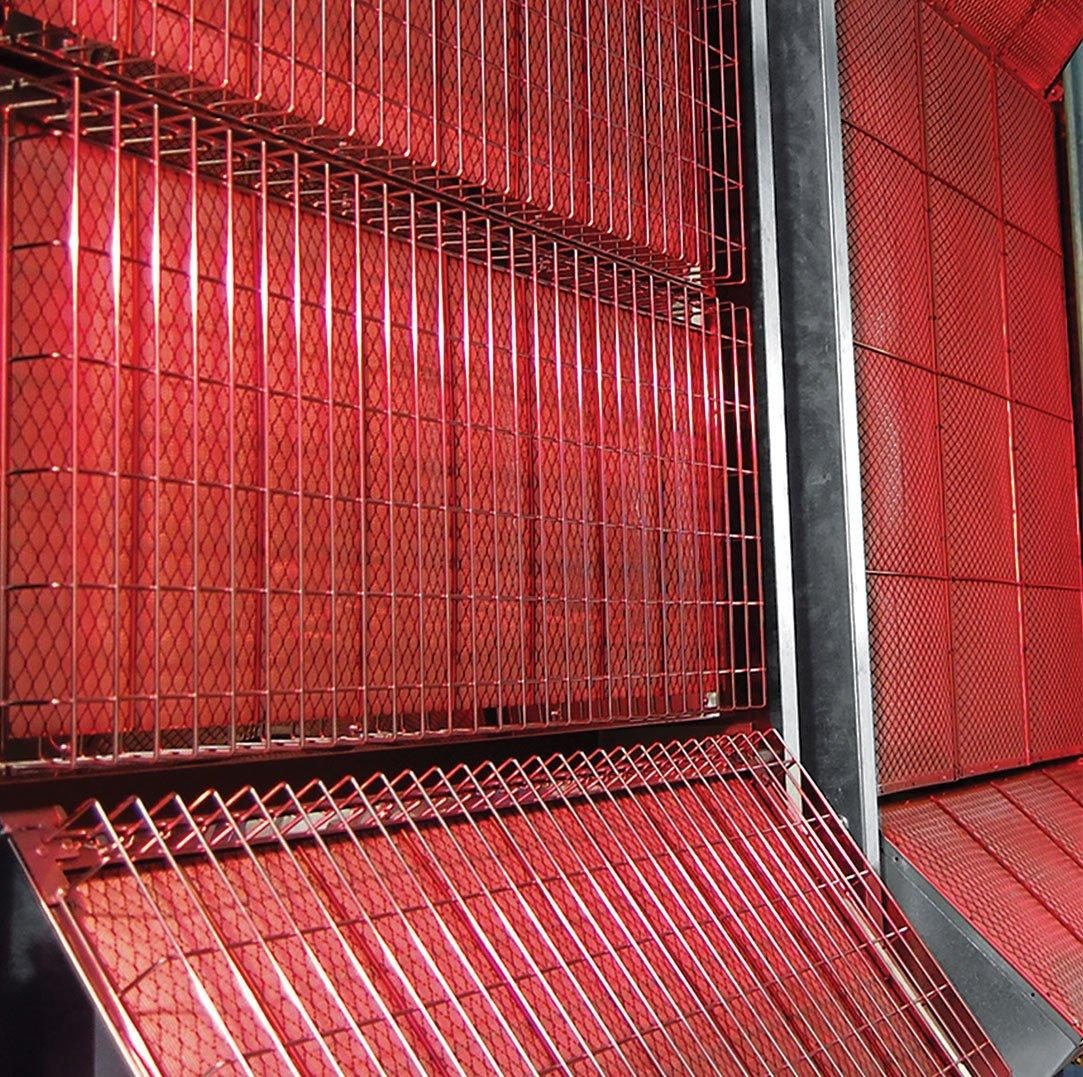
In many industrial processes, standard heating technologies are not enough. Some applications require high surface temperatures, rapid thermal response, strong infrared intensity and precise control over the way heat reaches the material. This is where RHT Radiant High Temperature systems become relevant: they are designed for processes where heat must be delivered quickly, directly and with a high level of reliability.
RHT is part of the high-temperature infrared technology developed by Infragas for industrial thermal treatments. Unlike catalytic infrared panels, which are often chosen for flameless and controlled surface heating, RHT systems are intended for applications that need more intense thermal conditions, such as fast curing cycles, preheating of metal parts, treatment of moulds, powder melting and other high-heat processes.
Table of Contents
- What RHT Radiant High Temperature means
- How RHT technology works
- When high-temperature infrared heating is needed
- RHT and metal components
- Fast curing and powder melting applications
- Control and power modulation
- Integration into industrial ovens and thermal stations
- A focused technology for demanding heat treatments
What RHT Radiant High Temperature means
The acronym RHT stands for Radiant High Temperature. It identifies a family of infrared gas heaters designed to reach very high radiant surface temperatures and transfer heat through short-wave infrared radiation. The heat is generated by gas combustion and transmitted toward the exposed material through infrared rays.
This principle is important because infrared heating does not depend mainly on heating large volumes of air. Instead, the radiant energy travels directly from the emitter to the surface of the product. When the material absorbs this energy, it is converted into heat. In high-temperature processes, this direct transfer can help reduce heating time and improve the responsiveness of the system.
RHT systems (https://infragas.co.uk/our-products/rht/) are therefore useful when the process requires rapid energy transfer, not just a warm environment around the product.
How RHT technology works
RHT heaters are based on a pre-mix air and gas system. Air and gas are mixed in calibrated proportions before combustion, allowing the burner to operate with a controlled thermal output. The system can work with fuels such as natural gas or propane, depending on the plant configuration and process requirements.
The radiant surface emits infrared energy at high temperature. This energy is absorbed by the exposed material quickly and uniformly, making the technology suitable for industrial operations where time, temperature and surface quality must be managed together.
Infragas designs RHT systems for demanding production environments, where thermal performance must be matched with reliability, control and ease of integration into industrial ovens or heating stations.
When high-temperature infrared heating is needed
Not every production process requires a high-temperature system. In many drying or surface treatment applications, catalytic infrared panels such as INFRACAT or BOOSTERCAT may be more appropriate. RHT becomes more interesting when the process needs higher heat intensity, faster curing or the treatment of materials that require strong thermal input.
Typical examples include preheating metal parts, heating moulds, supporting powder melting phases, accelerating thermal cycles and treating products that need a more aggressive but controlled heat source.
The key point is not simply reaching a high temperature. A production line needs the right amount of energy, delivered in the right way, at the right moment. RHT technology is useful when the process cannot be optimized by increasing residence time or extending the oven length. In these cases, more direct radiant power can make the thermal stage faster and more compact.
RHT and metal components
Metal parts often require significant energy to reach the desired temperature. Because metals can conduct heat rapidly, the heating system must provide enough intensity to bring the surface to the right condition within the available cycle time.
RHT systems can support preheating of metal components, especially when the next production phase depends on surface temperature. This may include forming, coating, curing, bonding or other treatments where the material must enter the following step with a specific thermal profile.
For moulds and heavy components, high-temperature infrared heating can help concentrate energy where it is needed, reducing delays and improving process repeatability. This is one of the reasons why RHT technology is relevant in industries where thermal cycles must be both fast and reliable.
Fast curing and powder melting applications
In coating and finishing processes, thermal treatment has a direct impact on final quality. If the heating phase is too slow, the line loses productivity. If it is too aggressive or uneven, the product may show defects. The balance between speed and control is therefore essential.
RHT systems can be used in applications that require rapid curing time or high thermal input, including powder melting processes. In these cases, short-wave infrared radiation can support faster activation of the surface, helping the process reach the required temperature within a shorter time.
This does not mean that RHT is always the best choice for every coating line. The decision depends on the material, coating type, geometry, target temperature and production speed. However, when the process requires more intense heating than catalytic panels can provide, RHT becomes a strong option within the Infragas product family.
Control and power modulation
High temperature is useful only when it can be controlled. One of the important aspects of RHT technology is the possibility of power modulation. The system can operate across a controlled power range, allowing the heating intensity to be adjusted according to process needs.
This matters because industrial production is rarely static. Product size, line speed, material thickness and thermal requirements may vary. A heating system that cannot adapt can become either inefficient or too aggressive. Modulation helps operators manage the process with greater flexibility.
RHT systems can be supplied in stand-alone versions, where each unit works independently, or in remotized versions connected to a main PLC. This makes them suitable for different plant architectures, from individual heating modules to more complex automated lines.
Integration into industrial ovens and thermal stations
RHT technology is particularly valuable when it must be integrated into an existing production concept. Industrial ovens, heating tunnels and thermal stations often need compact, responsive and reliable systems. A high-temperature infrared heater can reduce the need for very long heating sections when the process is based mainly on surface treatment.
The stainless steel construction of RHT burners is designed for high-temperature working conditions, supporting durability in demanding environments. For OEMs and oven manufacturers, this is important because the heating system must not only perform well during tests, but also remain stable during continuous industrial use.
Infragas works with industrial customers and system manufacturers to evaluate which technology fits the specific application: catalytic panels, boosted catalytic panels or RHT high-temperature heaters.
A focused technology for demanding heat treatments
RHT Radiant High Temperature systems are not generic industrial heaters. They are designed for processes where high temperature, fast response and direct infrared energy are essential. For applications such as metal preheating, mould treatment, powder melting and rapid curing, RHT technology can help make the thermal stage faster, more focused and easier to integrate into compact industrial layouts. Within the Infragas range, RHT represents the solution for those high-heat processes where standard catalytic infrared panels are no longer enough.