
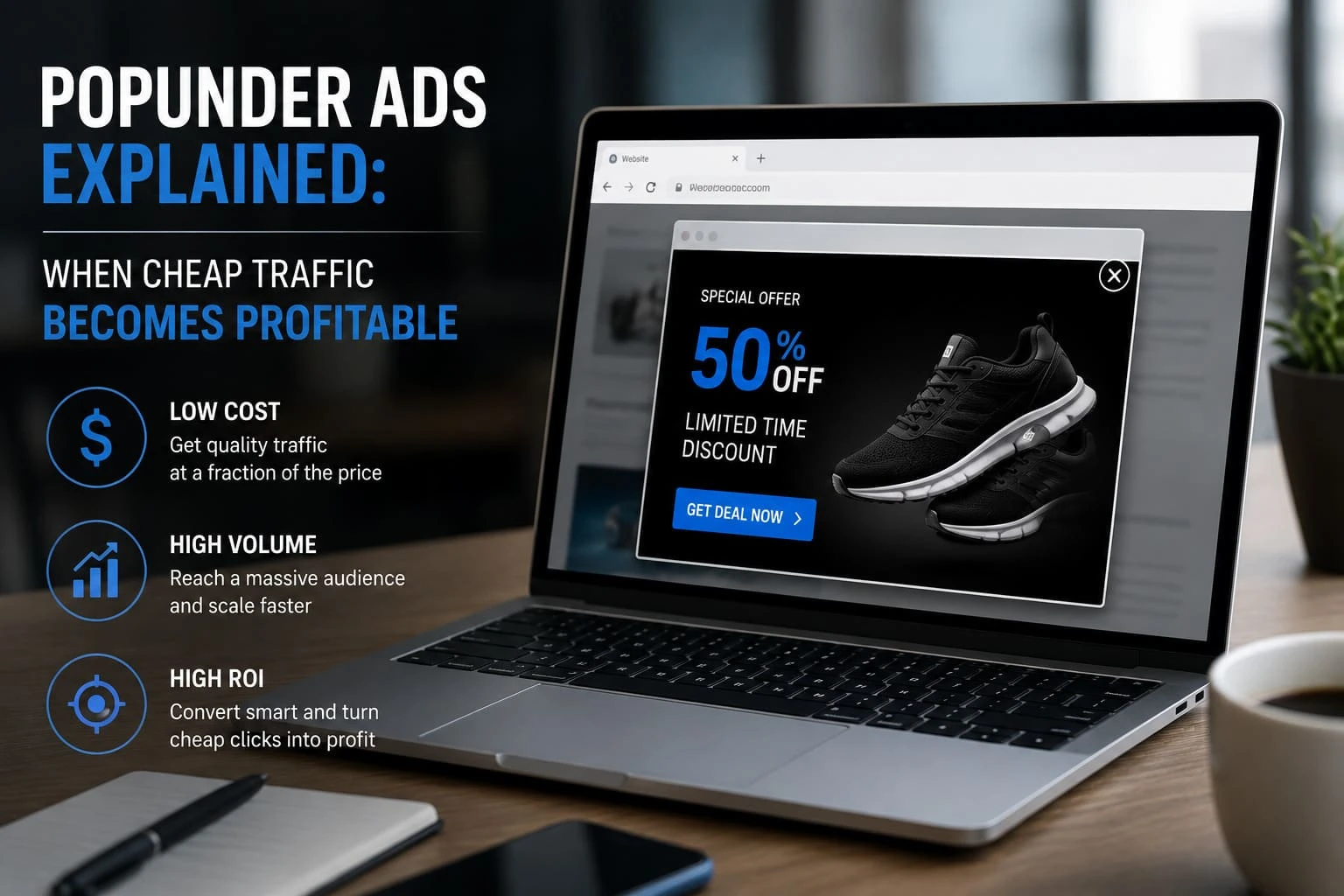
In digital advertising, there is a common assumption that expensive traffic is always better traffic. While premium traffic sources often generate highly engaged users, they also come with increasing acquisition costs that can make scaling difficult.
For affiliate marketers, media buyers, and performance advertisers, profitability is determined by more than click quality. It depends on the relationship between traffic cost, conversion rate, and overall return on investment (ROI).
This is one of the reasons popunder advertising continues to play an important role in performance marketing. Although it has existed for many years, popunder traffic remains one of the most cost-effective ways to reach large audiences and test campaigns at scale.
Modern advertising platforms such as GTARoads continue to support popunder ads alongside native, push, and other high-performance formats, giving advertisers more flexibility when building profitable acquisition strategies.
Table of Contents
- What Are Popunder Ads?
- Why Popunder Traffic Is So Affordable
- Cheap Traffic Does Not Automatically Mean Poor Traffic
- Profitability Depends on Campaign Economics
- Popunder Traffic Is Ideal for Testing
- Speed Is a Competitive Advantage
- Which Offers Work Best?
- Landing Pages Matter More Than Ever
- Segmentation Increases ROI
- Scaling Successful Campaigns
- Common Mistakes
- Popunder vs Other Traffic Sources
- How GTARoads Supports Performance Advertisers
- The Future of Popunder Advertising
- Final Thoughts
What Are Popunder Ads?
A popunder ad is an advertising format that automatically opens a landing page in a new browser tab or window behind the active page a user is currently viewing.
Unlike traditional display advertising, users are not required to click on a banner or button. Instead, the advertiser’s page becomes visible after the original browsing session ends or when the active window is closed.
This creates immediate exposure without relying on voluntary interaction.
For advertisers, the biggest advantage is simple:
large volumes of traffic at relatively low acquisition costs.
Why Popunder Traffic Is So Affordable
The economics behind popunder advertising differ from search advertising, social media ads, or native campaigns.
Search advertising competes for users actively looking for products or services. Social platforms compete for limited attention inside personalized feeds. Native advertising competes with editorial content.
Popunder traffic works differently.
Since it does not require a deliberate click, publishers can generate significantly more advertising opportunities. Increased inventory generally leads to lower costs for advertisers.
Lower acquisition costs create opportunities that are difficult to achieve on more competitive channels.
Cheap Traffic Does Not Automatically Mean Poor Traffic
One of the biggest misconceptions about popunder advertising is that inexpensive traffic must always be low quality.
Price and quality are not the same metric.
A traffic source may cost less because:
- inventory is larger;
- advertiser competition is lower;
- delivery mechanisms differ;
- publishers monetize differently.
The real question is not:
“Is this traffic cheap?”
The better question is:
“Can this traffic generate profit?”
If a campaign converts consistently and acquisition costs remain below the revenue generated, inexpensive traffic becomes highly valuable.
Profitability Depends on Campaign Economics
Affiliate marketing is fundamentally a numbers business.
Consider two simplified examples.
Campaign A
- Cost per visitor: $0.30
- Conversion rate: 4%
Campaign B
- Cost per visitor: $0.02
- Conversion rate: 0.8%
Although Campaign A converts better, Campaign B may still produce a stronger ROI because traffic costs are dramatically lower.
This is why experienced media buyers evaluate:
- cost per acquisition;
- earnings per click;
- return on ad spend;
- lifetime value;
- profit margin.
Conversion rate alone never tells the full story.
Popunder Traffic Is Ideal for Testing
Testing is one of the most expensive parts of affiliate marketing.
Advertisers need to compare:
- landing pages;
- headlines;
- offers;
- geographies;
- devices;
- browsers;
- operating systems;
- creatives.
Running these experiments on expensive traffic sources can quickly consume advertising budgets.
Because popunder traffic costs less, marketers can gather statistically meaningful data much faster.
Large traffic volumes allow advertisers to:
- identify winning offers;
- eliminate poor-performing funnels;
- optimize landing pages;
- discover profitable countries.
Instead of waiting weeks for enough conversions, campaigns often generate useful insights within days.
Speed Is a Competitive Advantage
Digital advertising changes constantly.
Offers expire.
Competition increases.
Seasonal demand shifts.
Affiliate marketers who identify profitable campaigns quickly often outperform competitors simply because they can scale earlier.
Popunder advertising supports this speed by delivering large traffic volumes almost immediately.
Faster traffic means:
- faster optimization;
- faster scaling;
- faster profitability.
Which Offers Work Best?
Not every affiliate offer performs well with popunder traffic.
Because users generally arrive with lower initial intent, campaigns should focus on offers with clear value propositions and simple conversion paths.
Popular verticals include:
- software downloads;
- browser extensions;
- VPN services;
- utilities;
- mobile applications;
- lead generation;
- sweepstakes;
- entertainment;
- gaming;
- selected finance campaigns.
Offers requiring extensive education or long decision-making processes often perform better with native advertising.
Landing Pages Matter More Than Ever
Traffic alone does not create conversions.
The landing page bridges the gap between passive exposure and user action.
An effective popunder landing page should:
- load quickly;
- explain the offer immediately;
- minimize distractions;
- focus on one primary action;
- perform well on mobile devices;
- establish credibility.
Many advertisers also use pre-landing pages to introduce the offer before directing users to the final conversion page.
This additional step often increases engagement by providing context instead of immediately asking for a sale.
Segmentation Increases ROI
Successful advertisers rarely treat all traffic equally.
Instead, campaigns are segmented by:
- country;
- device;
- browser;
- operating system;
- publisher source;
- time of day.
Different traffic segments behave differently.
For example:
Android users may respond differently than iPhone users.
Desktop visitors may convert differently than mobile users.
Tier 1 countries often require different landing pages than Tier 2 or Tier 3 markets.
Segmentation allows advertisers to allocate budgets toward the highest-performing audiences while excluding unprofitable traffic.
Scaling Successful Campaigns
One of popunder advertising’s greatest strengths is scalability.
After identifying profitable combinations, advertisers can increase budgets gradually while monitoring key performance indicators.
Successful scaling usually involves:
- expanding into similar countries;
- increasing bids on profitable traffic sources;
- duplicating winning campaigns;
- testing additional landing pages;
- improving conversion funnels.
Because popunder inventory is widely available, advertisers often find more opportunities to grow than with narrower traffic channels.
Common Mistakes
Many unsuccessful popunder campaigns fail because of execution rather than the traffic itself.
Frequent mistakes include:
Ignoring Mobile Optimization
Most popunder traffic today comes from mobile devices.
A poor mobile experience destroys conversion rates.
Sending Users Directly to Weak Offers
Generic sales pages rarely perform well.
Pre-landers often improve engagement significantly.
Scaling Too Early
Increasing budgets before gathering sufficient conversion data frequently leads to unnecessary losses.
Not Tracking Traffic Sources
Publisher-level optimization is essential.
Profitable sources should receive more budget.
Poor-performing sources should be excluded.
Using One Campaign for Every GEO
Localized messaging consistently outperforms generic global campaigns.
Popunder vs Other Traffic Sources
Compared with search advertising:
- cheaper;
- broader reach;
- lower intent.
Advertisers may also use Facebook ads integration when they want to combine social campaigns with other traffic sources and compare audience performance across channels.
- faster testing;
- fewer creative limitations;
- different audience behavior.
Compared with native advertising:
- lower acquisition costs;
- higher traffic volume;
- lower engagement quality.
Each format serves different campaign objectives.
Many experienced media buyers combine multiple traffic sources rather than relying on one.
How GTARoads Supports Performance Advertisers
GTARoads is designed around high-performance advertising formats that help advertisers acquire and optimize traffic efficiently.
The platform provides access to:
- popunder traffic;
- native advertising;
- push ads;
- smartlink solutions.
This allows advertisers to test different traffic strategies without moving between multiple advertising platforms.
For affiliate marketers, this flexibility simplifies campaign management while making it easier to compare traffic quality, optimize budgets, and scale successful campaigns.
Instead of relying on a single acquisition channel, advertisers can build diversified traffic portfolios based on actual performance data.
The Future of Popunder Advertising
Despite rapid changes in digital marketing, popunder advertising continues to evolve.
Today’s campaigns benefit from:
- smarter optimization algorithms;
- improved targeting;
- better analytics;
- faster campaign management;
- integration with broader performance ecosystems.
Rather than replacing other traffic formats, popunder increasingly complements them.
Many advertisers use:
- popunder for initial traffic acquisition;
- native advertising for higher-intent audiences;
- push notifications for re-engagement;
- smartlinks for automated monetization.
This layered strategy maximizes overall campaign profitability.
Final Thoughts
Cheap traffic is not valuable simply because it costs less.
It becomes valuable when campaign economics produce consistent profit.
Popunder advertising continues to deliver strong ROI because it combines:
- low acquisition costs;
- rapid testing;
- broad scalability;
- large traffic volumes;
- flexible optimization opportunities.
For affiliate marketers willing to invest in proper tracking, landing-page optimization, audience segmentation, and continuous testing, popunder remains one of the most efficient traffic formats available.
Platforms such as GTARoads demonstrate that high-performance advertising is not about relying on a single traffic source. Instead, success comes from combining multiple formats, understanding user behavior, and making data-driven decisions that maximize long-term profitability.