
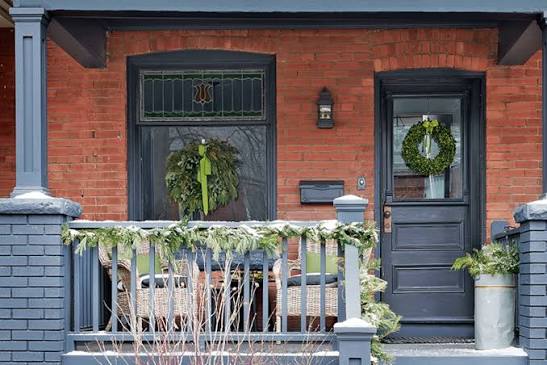
The first hard freeze cracks more Michigan porches than any single summer storm. I have watched a hairline step joint turn into a hollow step in under three winters, and the fix at that point costs ten times what the fall repair would have.
Most brick porches around Detroit and Garden City fail the same way. Water gets in through a gap you cannot see, sits in the core through a January thaw, then freezes overnight and pushes the face of the brick outward. Your porch is not weak. It is just doing what porous clay does
when it stays wet.
So here is the plan. Below you will learn why brick porches crack the way they do, how to inspect yours before the first freeze, how to sort small repairs from real rebuilds, and how to photograph a porch so any mason can price the job without a second visit.
Table of Contents
Why brick porches crack in a freeze-thaw climate
Brick is porous on purpose. That pore structure lets mortar flex instead of shattering, and it lets the wall dry out from the inside when the weather cooperates. Southeast Michigan does not cooperate. The National Weather Service tracks freeze-thaw cycles every cold season, and the Detroit area swings above and below freezing constantly from November through March. Every swing is one expansion and one contraction inside your porch steps, caps, and piers.
Water is the only reason that cycle matters. Dry brick tolerates cold fine. Saturated brick splits. So the entire game is keeping water out of the core, which means the joints, the cap, and the transition where the porch meets the house matter more than the brick faces you actually see.
I would rather fix three small joints in October than replace a step tread in April. It is the same tradeoff every year, and homeowners lose it every year.
Where Michigan porches actually let water in
Insects and water use the same doors, and on a brick porch there are four of them worth checking.
- Spalled step treads: the horizontal faces take the most standing water and the most foot traffic.
- Missing or crumbling cap mortar: the joint between the porch cap and the wall below it.
- Failed flashing at the ledger and roof tie-in: usually hidden behind a porch ceiling or trim board.
- Open joints at the foundation transition: the bottom of the pier where grade meets brick.
Notice what is not on that list. Efflorescence, that white powder on the face of brick, is a symptom. It means water is already moving through the assembly and drying on the surface. Cleaning it off without finding the source just resets the clock.
Spalling is the one that should get your attention. If a brick face is flaking off in layers, that unit is already saturated and freezing from the inside. You cannot paint over it. You cannot seal it from the outside and expect the problem to leave. Sealing a wet porch traps the moisture that is doing the damage, which is why I tell people to reject any quote that starts with a sealer and skips the joints.
The five minute fall inspection you run yourself
Do this on a dry day, before the first hard freeze. You need a flashlight, a flathead screwdriver, and your phone.
- Walk the steps and press the tip of the screwdriver into each mortar joint. Soft, sandy resistance means that joint is done.
- Tap brick faces on the steps and the porch cap. A dull, hollow sound means a unit has separated from the mortar behind it.
- Look at the bottom course where it meets the ground. Grade should sit below the brick, not piled against it.
- Check the cap joint and any porch ceiling or trim for staining, which points to a leak above the brick.
- Photograph anything soft, hollow, cracked, or stained, then mark the spot with a piece of tape so you can find it again.
That screwdriver test is the whole thing. It is the same test a mason runs on a first visit, and it is how you avoid paying a markup for a problem you could have described in one email.
Repair or rebuild? How to sort it out
Most porches land in one of three buckets, and the bucket decides the price far more than square footage does.
| What you see | What it usually means | Typical direction
|
|---|---|---|
| Occasional cracked joints, tight brick | Normal seasonal movement | Repoint the joints and recheck next fall |
| Multiple spalled treads, soft joints, white powder | Water has been entering for years | Selective rebuild of the affected courses |
| Steps pulling away from the porch slab | Movement below the brick | Inspection before any brick decision |
If you want to understand how brick assemblies are supposed to handle moisture, the National Park Service maintains plain-language preservation guidance for historic masonry that applies to ordinary houses just as well. It explains why a wall is built to let vapor pass instead of sealing it in, which is the idea most bad repairs get wrong.
The expensive mistakes I see are predictable. Painting a brick porch because the color looks tired. Slapping mortar over a spalled tread instead of replacing the unit. Letting someone caulk a joint that should be repointed. And skipping the flashing check because it is out of sight behind a ceiling panel.
What a realistic repair timeline looks like
Homeowners tend to picture one big job. In practice, a porch that has been ignored for a decade usually gets fixed in phases, and that is fine as long as you handle water first.
Phase one is stopping the water: repointing the soft joints, restoring the cap, and correcting any grade that sends runoff toward the porch. Phase two is replacing the damaged units, working from the worst spalling upward. Phase three is cosmetic, and it is the only phase you can safely postpone. Get that order backwards and you will pay to redo phase two within a few winters.
On cost, the honest answer is that values shift hard by season and material availability, and the U.S. Department of Housing and Urban Development tracks the broader home improvement and rehabilitation landscape that drives those numbers. Two porches the same size can differ by thousands of dollars based on access, step count, and how much material has to be matched to existing brick. Anyone quoting a firm number over the phone without photos is guessing.
Matching is its own headache. Old Michigan brick was fired in regional yards that no longer exist, so a repair almost always means sourcing a close visual match rather than an exact one. A mason who tells you that up front is being straight with you. If you are weighing a repair against a bigger build out, the scope usually starts with the porch and steps, and that is exactly the kind of work an Expert Custom Brickwork Contractor in Garden City, MI handles on a regular basis.
Three habits that keep a porch alive
Keep gutters clean so roof runoff lands away from the porch instead of at the base of the piers. Keep dirt and mulch below the brick so the bottom courses can dry. And run the screwdriver test every October. That is the entire maintenance program, and it costs you five minutes a year.
Do those three things and your porch will outlast the debate over whether it needed work in the first place. Skip them and you will be pricing a rebuild you could have avoided. Which one is your porch on track for this fall?