
Every growing business eventually reaches a point where its technology stops keeping up. Orders take longer to process. Reports need manual workarounds. A new sales channel or partner integration that should take weeks ends up taking months, because the core system was never built to support it.
For many companies, the root cause is a legacy system: software built for a smaller, simpler version of the business. It still runs, but it quietly limits how fast the organization can move, how securely it can operate, and how much value it can extract from its own data.
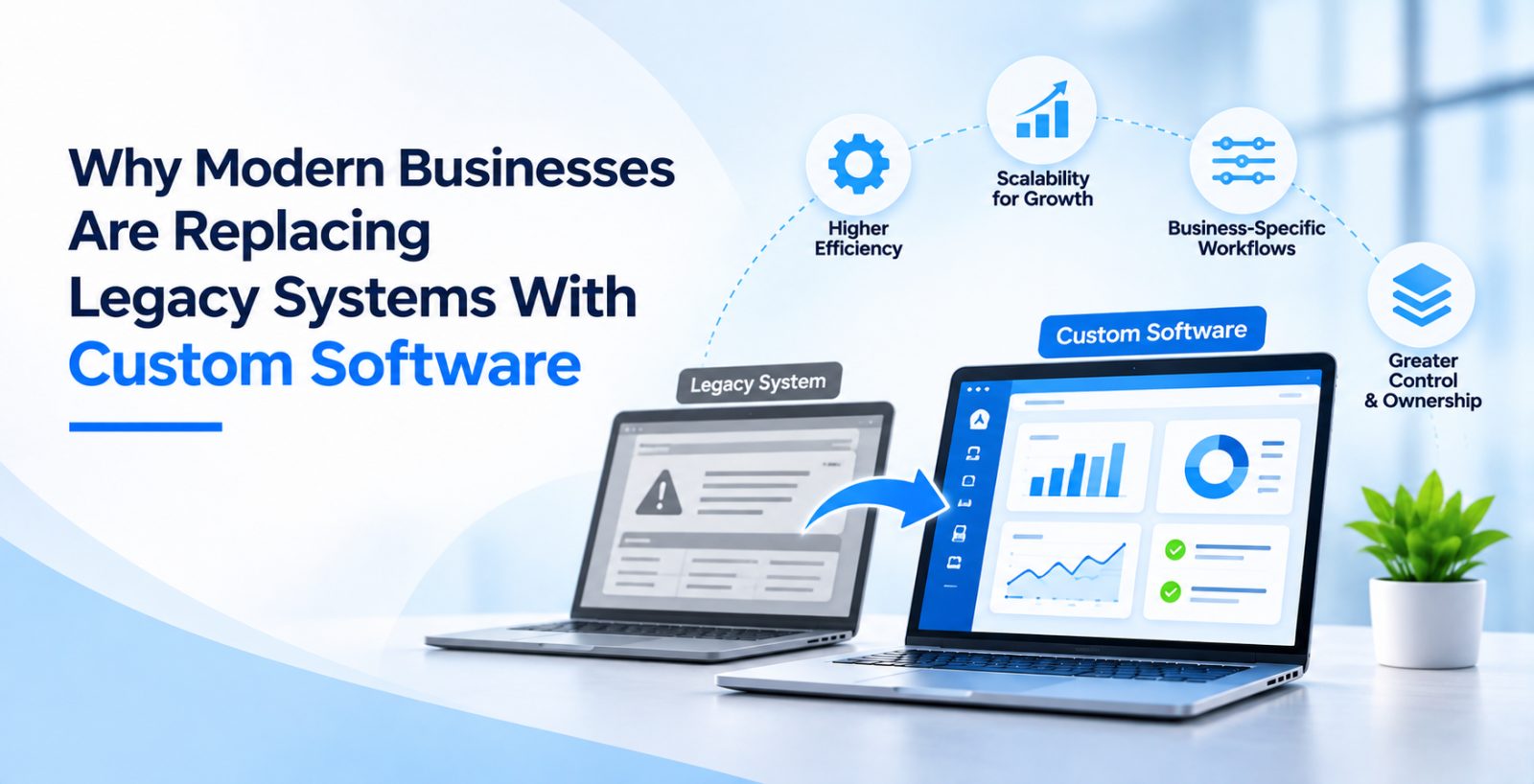
That is why more business owners and CTOs are moving away from patching aging platforms and toward purpose-built, enterprise-grade applications. Many begin with the systems customers and teams use every day, such as portals, dashboards, and internal tools, and rebuild them through custom web application development services designed around current workflows rather than decade-old assumptions.
Enterprise-grade does not mean oversized. It means software that can absorb more users, more transactions, and more integrations without being rebuilt every few years.
Table of Contents
- Where Legacy Systems Quietly Create Bottlenecks
- What Defines an Enterprise-Grade Application
- Key Pillars for Long-Term Growth
- Common Mistakes Businesses Make When Replacing Legacy Systems
- Best Practices for Building Future-Ready Applications
- A Real-World Scenario: From Bottleneck to Growth Engine
- Conclusion: Building for the Next Decade, Not the Last One
Where Legacy Systems Quietly Create Bottlenecks
Legacy platforms rarely fail overnight. They create friction that compounds as the business grows. Data sits in disconnected silos, so leadership relies on spreadsheets stitched together by hand. Tightly coupled code means a small change in one area can break something unrelated. Outdated security frameworks turn every compliance audit into a scramble.
Patching these issues one by one only delays the problem. A more durable path is to rethink the foundation, which for many organizations now includes custom AI software development services that build automation and intelligence into the core system instead of bolting them on later.
There is a people cost as well. Fewer engineers want to maintain aging languages and frameworks, which drives up support costs and slows every update.
What Defines an Enterprise-Grade Application
Replacing a legacy platform is not about newer technology for its own sake. The new system should meet a higher standard in five areas.
Scalability
Older systems usually grow by adding a bigger server, which gets expensive and eventually hits a ceiling. Modern applications spread the workload across resources, so a seasonal spike or a new regional office does not slow everyone down.
Security
Security must be part of the design, not an add-on after launch. That includes role-based access, encryption, and regular updates. Many legacy platforms run on frameworks that no longer receive security patches, a risk few leadership teams can justify today.
Performance
Users expect fast load times and real-time reporting. Performance depends on efficient database design, caching of frequently used data, and clean code, all of which are difficult to retrofit into an older system.
Reliability
Enterprise-grade software is built to stay available. Automated backups, standby environments that take over automatically, and proactive monitoring keep a single failure from taking operations offline.
Integration Capabilities
Few businesses run on one system. A modern application should connect smoothly with CRMs, ERPs, payment gateways, and third-party tools through well-documented APIs, the connectors that let different software systems talk to each other. This is often where legacy platforms struggle most, and where the case for replacement becomes clearest.
Key Pillars for Long-Term Growth
Modular Architecture: Microservices vs. Monolith
Most legacy systems are monoliths: one large codebase where every feature is tightly linked. That simplicity helps early on but becomes a liability as the system grows.
A microservices approach splits the application into smaller, independent services, such as billing, inventory, and notifications, that can be updated and scaled separately. Think of it as replacing one giant machine with a set of interchangeable parts.
Microservices are not right for everyone, though. For many mid-sized companies, a well-structured modular monolith is the smarter starting point, with services separated out as specific needs emerge.
Cloud-Native Development
Cloud-native applications are designed from the ground up to run on platforms like AWS, Azure, or Google Cloud, using managed services and automatic scaling so businesses pay only for the capacity they actually use. Simply moving an old system onto a cloud server, often called lift and shift, rarely delivers these benefits on its own.
Data-Driven Decision Making
A modern system treats data as a business asset, not a byproduct. Centralized data models and real-time dashboards give leaders one trusted view of performance instead of conflicting numbers from different departments.
Automation and AI Readiness
Even if AI is not on this year's roadmap, the architecture should be ready for it. Structured, accessible data and open APIs allow automation tools and machine learning models to plug in later, sparing the business a second costly rebuild.
Common Mistakes Businesses Make When Replacing Legacy Systems
A Short-Term Development Mindset
Some organizations treat modernization as a one-time fix for immediate pain. The result is often a newer system with the same structural limits as the old one. Replacement should be planned around where the business will be in five years, not just where it is today.
Ignoring Scalability Early
Building only for current volume can look like a cost saving. In practice, retrofitting scalability later usually costs far more than designing for it upfront. A balanced approach builds for realistic growth while keeping the architecture flexible.
Choosing the Wrong Tech Stack
Technology choices are sometimes driven by trends or by what one developer happens to know. A better test is whether the stack has strong community support, a healthy talent pool, long-term vendor backing, and a proven record with similar workloads.
Best Practices for Building Future-Ready Applications
Plan Strategically Before Development
Start with a discovery phase that maps workflows, pain points, data flows, and integration needs. Document what the legacy system does well, too, since those features often carry years of institutional knowledge. A phased migration, replacing one module at a time, reduces risk and keeps the business running throughout.
Choose the Right Development Partner
The right partner asks about business goals before recommending technology. Look for proven legacy migration experience, transparent communication, and a clear approach to testing, security, and post-launch support.
NewAgeSysIT, a custom software development company headquartered in New Jersey, works with businesses across the United States on exactly this kind of transition. Its teams help organizations modernize legacy platforms and build scalable web, mobile, and AI-powered applications designed around long-term growth rather than quick fixes.
Commit to Continuous Optimization
Launch is a starting point, not a finish line. Track performance metrics, gather user feedback, and review the architecture regularly. Small, frequent improvements keep the system aligned with the business and prevent it from becoming the next legacy problem.
A Real-World Scenario: From Bottleneck to Growth Engine
Consider a mid-sized regional distributor running order management on a 15-year-old on-premise system. As the company expanded into new states, peak-season orders slowed to a crawl, inventory data lagged by a full day, and adding an e-commerce channel was estimated to take six months.
Instead of another round of patches, leadership chose a phased replacement. Order management, inventory, and customer notifications were rebuilt as separate cloud-native services connected through APIs, with data consolidated into a single reporting layer.
The results went beyond faster software. Inventory visibility moved to near real time, peak-season slowdowns disappeared because the system scaled automatically, and new sales channels could be connected in weeks rather than months. The clean data foundation also positioned the business to add AI-driven demand forecasting without another rebuild.
Conclusion: Building for the Next Decade, Not the Last One
Legacy systems rarely announce when they have become a problem. They slow decisions, raise costs, and narrow opportunities gradually, until the gap between what the business needs and what its technology allows can no longer be ignored.
Replacing them with custom, well-architected software is not about chasing trends. It is about building a foundation that scales with demand, protects critical data, connects with the tools teams rely on, and is ready for automation and AI as they mature.
For business owners and technology leaders, the most valuable step is often the first one: an honest assessment of where current systems are holding growth back. With clear priorities, a phased plan, and expert guidance on architecture, modernization becomes a long-term investment rather than a recurring expense.
1 thought on “Why Modern Businesses Are Replacing Legacy Systems With Custom Software”