
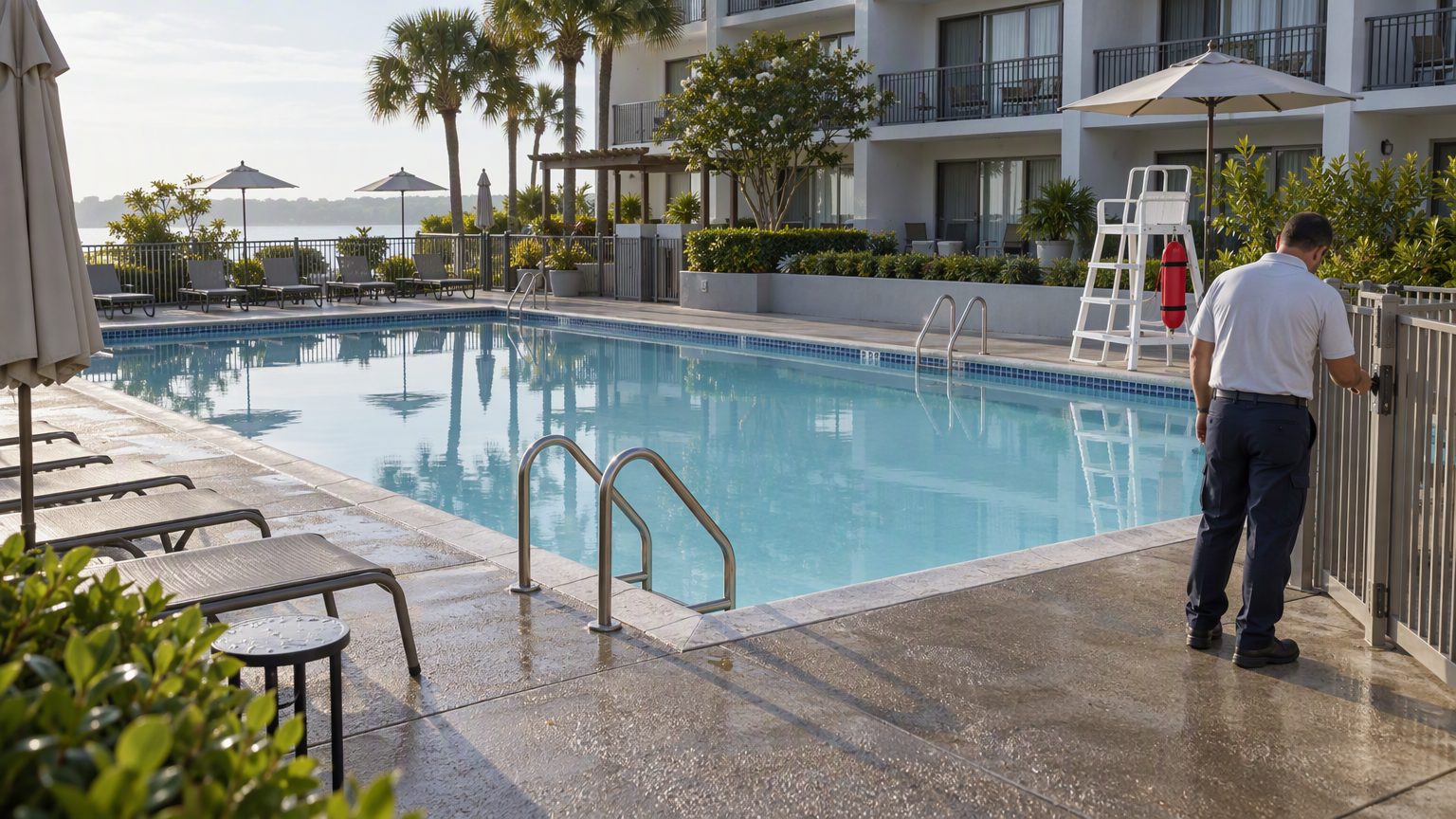
Pool drownings leave families facing enormous losses. The U.S. Consumer Product Safety Commission’s 2025 report put the annual average at 6,300 pool- or spa-related nonfatal drowning injuries treated in emergency departments among children under 15, a figure averaged across 2022 through 2024.
Blame can fall on the hotel, the pool operator, a maintenance or security contractor, a lifeguard’s employer, or another guest. Sometimes it falls on several of them at once. Who ends up paying turns on who controlled the pool, what went wrong, what that party knew or should have known, and whether the harm could have been prevented.
Table of Contents
- How Is Drowning Liability at a Pool Assessed?
- How Is Florida Hotel Pool Liability Decided?
- What Type of Liability Can a Swimming Pool Incident Create?
- Does the Hotel, Pool Owner, or Lifeguard Change the Case?
- What Should You Do Right After a Hotel Pool Incident?
- What Are Seven Common Contributors to Drowning?
- What Happens During Drowning, and How Quickly Can It Occur?
- Protect Health First, Then Preserve the Facts
How Is Drowning Liability at a Pool Assessed?
Control comes first. Who controlled the relevant area or activity, and did a breach of that party’s duty cause the injury or death? Four questions do most of the work:
- Who owned or ran the pool, and who handled inspections, maintenance, or supervision?
- What condition or conduct created the danger?
- Did the responsible party know about it, or should it have known?
- Did that condition or conduct actually cause the harm?
A hotel pool accident can support several possible claims; it does not create automatic fault. Ownership and daily control are sometimes split between a hotel owner and a management company, and that split matters when the time comes to decide who to pursue.
|
Possible responsible party |
Issue to examine |
Useful evidence |
|
Hotel owner or operator |
Barriers; warnings; inspections; lighting; deck conditions |
Inspection logs; photographs; incident reports |
|
Pool maintenance contractor |
Repairs; drains; water clarity; equipment upkeep |
Service records; work orders; contracts |
|
Lifeguard or lifeguard employer |
Assigned duties and response |
Staff schedules; training records; surveillance footage |
|
Another guest |
Unsafe conduct contributing to the event |
Witness accounts; video; staff reports |
How Is Florida Hotel Pool Liability Decided?
Under Florida law, the claim turns on control, notice, the condition of the premises, and any duty to supervise. A serious outcome by itself proves nothing. The claimant has to connect the documented failure to the injury, and that connection is where most hotel pool claims are won or lost; understanding drowning liability at a pool means knowing which evidence proves it.
When a slip-and-fall involves a transitory foreign substance at a business establishment, Florida Statutes section 768.0755 generally demands proof of actual or constructive knowledge plus a failure to act. Constructive knowledge can hinge on how long the condition existed, or whether it happened often enough to be foreseeable. So the evidence fight usually comes down to a puddle’s age, or how often that same spill had happened before.
Chapter 64E-9, Florida Administrative Code, regulates public-pool operations, safety equipment, sanitation, and physical conditions. It stops short of requiring lifeguards at every hotel pool.
Even a violation does not settle fault. What regulatory records do help establish is what condition existed, who was responsible, and what inspections or corrective work occurred. Civil liability still requires a causal link.
What Type of Liability Can a Swimming Pool Incident Create?
A hotel pool incident may raise premises liability, negligent supervision, ordinary negligence, or product liability, depending on who controlled the risk that caused the harm.
Premises issues include broken gates, damaged decking, missing warnings, and poor lighting. A supervision claim is different: it requires an actual duty, such as an assigned lifeguard’s responsibility during pool hours.
A faulty drain cover or alarm points instead at the manufacturer and installer, along with the product’s maintenance history. Security becomes relevant only when foreseeable misconduct contributed to the injury, not in every pool case.
The party responsible for a slippery deck may not be the party that supplied a defective drain or employed the person who should have responded. Different failures, different defendants.
Does the Hotel, Pool Owner, or Lifeguard Change the Case?
Yes. Control of the hazard determines which duty applied and whose conduct requires examination. Several parties can share fault in the same incident.
An operator may handle access and staffing while a separate owner retains responsibility for structural repairs. A contractor’s duties may stop at the edge of its maintenance contract.
For an on-duty lifeguard, confirm the employer and the assignment. Compare training and sightlines against the actual opportunity to respond. Close supervision still matters. The conduct of parents, caregivers, and the injured person requires a fact-specific look, not assumptions about fault.
Different duties create different records. Contracts and staff schedules separate these roles, alongside surveillance footage and maintenance logs.
What Should You Do Right After a Hotel Pool Incident?
Call 911 and start an appropriate rescue response immediately. Emergency care comes before photographs or legal questions.
- Alert pool staff and call 911. Remove the person from the water only when you can do it safely.
- Follow the dispatcher’s instructions for CPR if the person is not breathing normally. Give rescue breaths if trained, and use an automated external defibrillator when one is available.
- Get a medical evaluation after any suspected nonfatal drowning, even after apparent recovery, because breathing complications may not show up right away.
- Once care is underway, report the incident to management and request an incident-report number.
- Photograph the gate and deck. Document signs, equipment, water visibility, and lighting without obstructing responders.
- Retain reservation documents, receipts, and medical records. Save damaged belongings and hotel messages, and keep witness contact details.
- Ask in writing for preservation of surveillance footage, access records, inspection and maintenance logs, and staff schedules.
Keep your own copies of everything.
Record the hotel’s name and street address, including the municipality. Identify the exact pool and where the person entered the water or was found. Resort complexes can run separate pools under separate operators.
What Are Seven Common Contributors to Drowning?
There is no official ranking of seven causes, but public-health agencies point to recurring risks relevant to hotel pools.
|
Contributor |
Risk |
Hotel context |
|
Limited swimming ability |
Difficulty staying afloat |
Do not assume the depth is suitable for you. |
|
Lack of attentive supervision |
Unnoticed distress |
Assign an attentive adult. |
|
Missing, broken, or unsecured barriers |
Unintended water access |
Check that the gate closes securely. |
|
Alcohol or impairing substances |
Impaired judgment |
Avoid swimming while impaired. |
|
Medical conditions such as seizure disorders |
Sudden incapacitation |
Discuss precautions with your clinician. |
|
No appropriate life jacket |
Insufficient flotation |
Match the equipment to the activity. |
|
Poor visibility; unsafe equipment; delayed recognition |
Obstructed detection or rescue |
Report cloudy water to staff. |
None of these factors independently establishes negligence. In its May 14, 2024, release, the CDC reported that roughly 40 million U.S. adults, or 15.4%, did not know how to swim. Another 54.7% had never taken a swimming lesson.
The CDC reported that 15.4% of U.S. adults did not know how to swim.
What Happens During Drowning, and How Quickly Can It Occur?
The CDC defines drowning as respiratory impairment caused by submersion or immersion in liquid, fatal or nonfatal. The Merck Manual describes oxygen deprivation and its possible effects on the lungs and brain.
How long can a drowning victim stay underwater?
There is no safe or reliable underwater time. Outcomes vary with the person’s health, water temperature, rescue speed, and degree of oxygen deprivation. Elapsed time alone cannot settle the outcome. Call 911 and start resuscitation as soon as it is safe.
Is drowning painful or painless?
Do not describe drowning as painless. Breathing distress and falling oxygen levels can lead to confusion or unconsciousness, but personal experiences cannot be measured uniformly. Physiology cannot establish what an individual victim felt.
Does drowning feel like falling asleep?
No. Impaired breathing and oxygen deprivation occur before unconsciousness, so the comparison is medically misleading.
How long is someone aware while drowning?
There is no fixed period of awareness; it varies by person and circumstance. An unresponsive person still needs immediate rescue, emergency assessment, and CPR when indicated.
Protect Health First, Then Preserve the Facts
After a hotel pool incident, emergency response and medical assessment come before documenting conditions or requesting records. Responsibility cannot be decided by the presence of water, the presence of a lifeguard, or the severity of an injury alone. Separate what you witnessed from what others reported. Once immediate care is addressed, organize the records. If the incident caused significant harm, get case-specific Florida guidance.