
Table of Contents
- Key Takeaways
- Table Of Contents
- Why Wire Sawing Fits Complex Concrete Work
- How the Cutting Method Works
- What to Check Before Work Begins
- Safety Controls That Matter Most
- Dust, Water, and Slurry Management
- How to Build a Practical Cutting Plan
- Planning Section Removal and Lift Operations
- When Another Cutting Method May Work Better
- A Simple Pre-Work Checklist
- Final Thoughts
Key Takeaways
- Diamond wire sawing can provide controlled cuts through thick, reinforced, or irregular concrete sections.
- A successful project depends on surveying the structure, planning cut order, and preparing for section removal.
- Exclusion zones, secure equipment setup, slurry control, and clear communication are central to safer work.
- Every cut section needs a defined support, lifting, lowering, and disposal plan before cutting begins.
Concrete demolition is rarely just a matter of cutting through a wall, slab, beam, or foundation. The work may involve reinforcement, limited access, active utilities, nearby operations, and heavy sections that must be removed without disrupting the remaining structure. Projects that require the controlled separation of large concrete elements may benefit from specialized cutting services, such as those offered through https://bluegrassbit.com/services-we-offer/diamond-wire-sawing/.
Diamond wire sawing can be a useful option for selective demolition and structural modification, but it works best as part of a complete plan. That plan should address the existing structure, the cutting sequence, equipment placement, water and slurry containment, worker access, and the path each removed section will take after it is free.
Table Of Contents
- Why Wire Sawing Fits Complex Concrete Work
- How the Cutting Method Works
- What to Check Before Work Begins
- Safety Controls That Matter Most
- Dust, Water, and Slurry Management
- How to Build a Practical Cutting Plan
- Planning Section Removal and Lift Operations
- When Another Cutting Method May Work Better
- A Simple Pre-Work Checklist
Why Wire Sawing Fits Complex Concrete Work
Conventional saw blades can be effective for many openings and slab cuts, but some structures are too thick, deeply reinforced, or irregularly shaped for a straightforward blade-cutting approach. A continuous diamond wire can be routed around a section and guided along a planned cut path. This can make the method suitable for work such as separating heavy foundations, modifying industrial structures, removing bridge components, or creating controlled openings in substantial concrete assemblies.
Wire sawing is not automatically the right answer for every project. The best method depends on concrete thickness, reinforcement, available access, allowable water use, nearby occupants, schedule requirements, and how the cut material will be handled. A smaller round penetration, for example, may be better suited to core drilling, while broad flatwork may be more efficiently handled with slab sawing.
How the Cutting Method Works
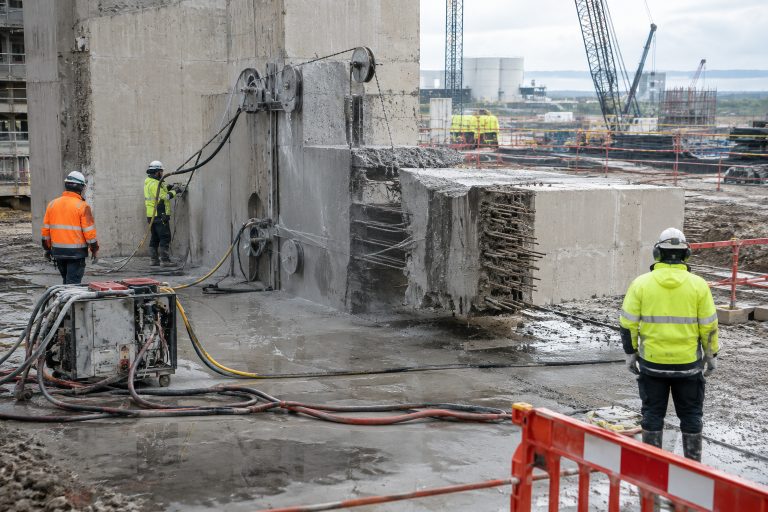
Diamond wire sawing uses a wire fitted with diamond cutting elements. The wire is passed through drilled access holes or around the target section, then routed through guides and pulleys connected to a drive system. As the wire moves under controlled tension, the diamond segments abrade concrete and embedded steel along the intended line.
- Access holes may be drilled where the wire needs to enter or change direction.
- Guides and pulleys help establish the cutting path and keep equipment properly aligned.
- Water may be used at the cut to cool the process and help limit airborne dust.
- Operators monitor wire condition, equipment movement, cut progress, and changes in the section being separated.
What to Check Before Work Begins
A detailed site review turns assumptions into verified project information. Before equipment arrives, the project team should review available drawings, inspect the work area, identify access limitations, and determine whether the structure has conditions that could affect stability during cutting.
Site Survey Questions
- What materials, reinforcement, and embedded components are likely inside the concrete?
- Where are electrical lines, piping, conduits, post-tensioning systems, or other hidden services?
- Can the work area support the saw, anchors, water equipment, temporary supports, and removal machinery?
- Where will workers stand, and where could they be exposed to moving wire, slurry, falling debris, or suspended loads?
- What happens if a partially cut section shifts before the final separation is complete?
Safety Controls That Matter Most
Personal protective equipment matters, but it should not be the only safeguard. A stronger approach begins by eliminating avoidable hazards, controlling the work area through equipment setup and barriers, and then supporting these measures with training, procedures, and appropriate protective gear. OSHA recommends using a hierarchy of controls that prioritizes more reliable engineering and design-based measures before relying only on work rules or personal protective equipment.
- Create a clearly marked exclusion zone around the saw, wire path, and cut section.
- Use barriers, signs, and spotters when access routes or nearby work create potential conflicts.
- Verify anchors, guides, supports, and equipment connections before operation.
- Keep personnel out of potential line-of-fire areas and away from unsupported cut sections.
- Establish a stop-work process for unexpected movement, damaged equipment, water-control failures, or changing site conditions.
Dust, Water, and Slurry Management
Concrete contains crystalline silica, and cutting or drilling can create respirable dust. The dust generated during cutting, grinding, polishing, and drilling can become airborne, so dust control should be planned before work starts rather than treated as a cleanup issue after the fact.
Wet cutting can help suppress dust, but it also creates slurry that must be contained and collected. Plan where water will come from, where it will flow, how it will be captured, and how walking surfaces will remain safe. Slurry should not be allowed to enter drains, waterways, occupied areas, sensitive equipment zones, or public paths.
How to Build a Practical Cutting Plan
A practical cutting plan breaks a large structure into sections that remain stable during work and can be removed in a controlled order. It should be reviewed by the people responsible for cutting, rigging, supervision, and site safety.
- Review drawings, field measurements, repair history, and structural information.
- Mark cut lines in the field and confirm their dimensions.
- Identify reinforcement, utilities, embedded items, and potential voids.
- Select wire entry points, guide locations, anchor positions, and equipment placement.
- Set a cut sequence that preserves stability until supports and rigging are ready.
- Confirm water supply, slurry containment, access control, communication methods, and emergency procedures.
- Conduct a pre-task briefing before the first cut begins.
Planning Section Removal and Lift Operations
Cutting is only one stage of controlled demolition. Once a section is fully separated, its weight and center of gravity must already be accounted for. The removal plan should estimate section weight, verify the capacity of the selected crane, hoist, or lifting equipment, and identify where the section will be landed or transported.
Rigging points should be selected for the actual section being lifted, not assumed from the original structure. Workers should remain clear of suspended loads, and the area should be inspected after removal for unstable edges, damaged adjacent material, or newly exposed services.
When Another Cutting Method May Work Better
- Deep, heavily reinforced, or irregular sections: Diamond wire sawing may provide the needed reach and flexibility.
- Openings in vertical concrete walls: Wall sawing may be appropriate when access and wall geometry allow it.
- Small circular penetrations: Core drilling is commonly suited to controlled round openings.
- Large flat slab cuts: Slab sawing may be more efficient for accessible horizontal surfaces.
- Breaking loose material after sectioning: Mechanical or robotic breaking may be used where controlled separation has already occurred.
A Simple Pre-Work Checklist
- Drawings, measurements, and cut lines have been reviewed.
- Utilities and embedded items have been identified as far as practical.
- Structural stability and temporary support needs have been assessed.
- Equipment, anchors, guides, and water controls have been inspected.
- Section weights, rigging, and removal paths have been confirmed.
- Exclusion zones, communication procedures, and stop-work expectations are in place.
Final Thoughts
Cleaner, safer concrete demolition begins with preparation. When the structure, cutting equipment, water controls, exclusion zones, and removal operations are planned together, the team can approach each cut with a clear purpose. Diamond wire sawing can be a valuable method for complex concrete work, but its effectiveness depends on disciplined planning and controlled execution from the first survey through final removal.