
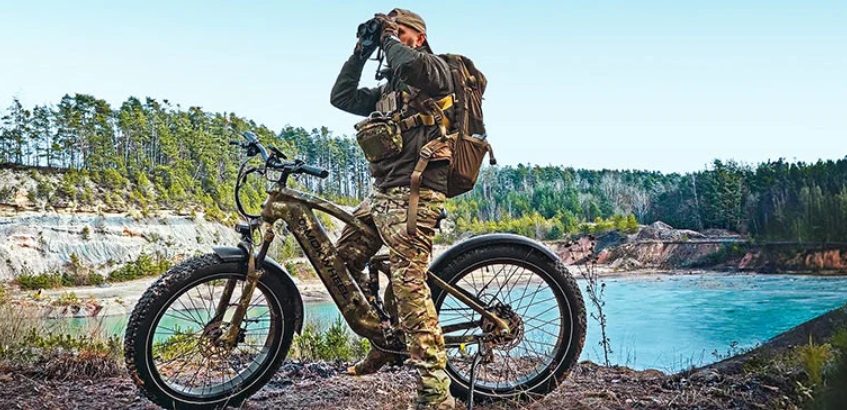
A hunting e-bike can make traveling between a campsite, trailhead, and permitted forest roads more convenient, especially when carrying outdoor equipment. However, a successful trip depends on more than the bike itself. Route access, battery planning, weather conditions, and equipment storage all need attention before heading into the backcountry.
For hunters who already enjoy camping and exploring remote landscapes, an electric bike can become another useful transportation option. The key is knowing when to ride, when to walk, and how to prepare for both.
Table of Contents
- Where Can You Legally Ride an E-Bike During a Hunting Trip?
- How Do You Plan a Hunting Route Without Running Out of Battery?
- What Equipment Should You Carry on a Hunting E-Bike?
- Which E-Bike Features Are Useful for Forest Road Access?
- How Should You Prepare for Changing Backcountry Conditions?
- Can an E-Bike Replace Walking on a Hunting Trip?
- Make Backcountry Travel Part of a Well-Planned Hunting Trip
Where Can You Legally Ride an E-Bike During a Hunting Trip?
Hunting e-bikes can be used on roads and trails where the applicable land manager permits that type of electric bicycle. Access varies by location, road designation, and vehicle classification.
A forest road open to motor vehicles may have different rules from a nonmotorized trail nearby. Similarly, state wildlife management areas may have restrictions that differ from those on national forest land.
Before traveling, consult official motor vehicle use maps, park regulations, and wildlife agency guidance.
It's also important to confirm whether riding is allowed during the relevant hunting season. Some areas restrict certain activities to protect wildlife or manage visitor access.
An e-bike should be treated as a way to reach permitted access points, not as permission to ride anywhere in the forest.
How Do You Plan a Hunting Route Without Running Out of Battery?
The safest approach is to plan battery usage around the complete return journey rather than the manufacturer's maximum range estimate.
Start by identifying the distance between camp, the intended destination, and any possible alternative return routes.
A ten-mile ride along a relatively flat gravel road can use considerably less battery than the same distance with repeated climbing, loose surfaces, and additional cargo.
Cold temperatures can also reduce battery performance, making conservative planning particularly important during fall hunting trips.
If the route includes steep hills or unfamiliar terrain, leave a generous reserve instead of relying on the last few miles of advertised range.
Hunters camping away from developed facilities should also check charging availability. Solar equipment or portable power systems may be useful in some setups, but compatibility, capacity, and charging conditions must be confirmed in advance.
What Equipment Should You Carry on a Hunting E-Bike?
Hunting trips often involve more equipment than ordinary recreational cycling.
Water, extra clothing, navigation tools, food, and basic repair supplies can quickly add weight.
When choosing a hunting ebike, pay attention to the manufacturer's payload rating and compatible cargo accessories.
A properly secured rear rack or pannier system can help organize equipment, but additional weight changes the bicycle's handling and braking distance.
Keep frequently used items accessible without allowing bags or straps to interfere with the wheels, brakes, or pedals.
If carrying hunting equipment that is subject to specific transportation regulations, follow all applicable local laws. Firearms and other regulated equipment should be transported securely and in accordance with the rules governing the area.
Avoid overloading the bicycle simply because the motor provides additional assistance.
Which E-Bike Features Are Useful for Forest Road Access?
For forest roads, the most useful features are often wider tires, predictable motor assistance, sufficient battery capacity, and dependable braking.
A fat tire design can provide additional cushioning on gravel and uneven dirt roads, while suspension helps reduce repeated impacts from rough surfaces.
As an example, the Mokwheel Obsidian is a full-suspension fat tire model suited to riders who regularly travel across mixed terrain.
It uses a 750W motor, 26 × 4-inch tires, and a 48V 19.6Ah battery with a manufacturer-stated range of 60–80 miles.
Its full-suspension design may be useful on bumpy forest roads, while hydraulic disc brakes support controlled stopping when properly maintained.
However, at approximately 77 pounds, the Obsidian requires careful handling when loading it onto a vehicle or navigating difficult terrain.
It is a practical model to compare for backcountry access, but riders should still choose routes that match their experience and the bike's capabilities.
How Should You Prepare for Changing Backcountry Conditions?
A dry forest road can become difficult after heavy rain, while fallen branches, loose rocks, and deep ruts may create unexpected obstacles.
Before leaving camp, check the weather forecast and inspect the bicycle's tires, brakes, battery charge, and cargo attachments.
Bring a tire repair kit, pump, appropriate tools, and an offline map.
Because cellular service may be unreliable in remote areas, tell someone where you intend to travel and when you expect to return.
Early morning and late evening riding may require additional lighting and reflective equipment. Reduced visibility is another reason to travel at a controlled pace.
If road conditions become unsafe, turning back is generally more sensible than continuing simply because the bike has electric assistance.
Can an E-Bike Replace Walking on a Hunting Trip?
An electric bike can reduce the effort required to reach certain locations, but it does not replace walking entirely.
Some hunting areas are accessible only by foot, and other locations may prohibit bicycles beyond designated boundaries.
Even on permitted roads, riders may encounter obstacles that require dismounting or turning around.
For this reason, the bike works best as one part of a broader transportation plan.
Hunters comparing different electric bikes should consider how frequently they will use the bike on maintained roads versus more demanding terrain.
Comfort, cargo capacity, and manageable weight may be more valuable than maximum motor output.
Make Backcountry Travel Part of a Well-Planned Hunting Trip
An electric bike can make forest road access and travel between permitted locations more convenient, particularly when distances and equipment loads would otherwise make cycling difficult.
But responsible backcountry travel still begins with understanding access rules, planning enough battery capacity, and preparing for changing conditions.
Before your next hunting trip, confirm where e-bikes are allowed, check your equipment, and choose a route suited to both the terrain and your experience.
With those preparations in place, an e-bike can become a useful addition to a carefully planned outdoor trip.
1 thought on “How to Plan a Hunting Trip With an E-Bike: Access, Gear, and Backcountry Preparation”