
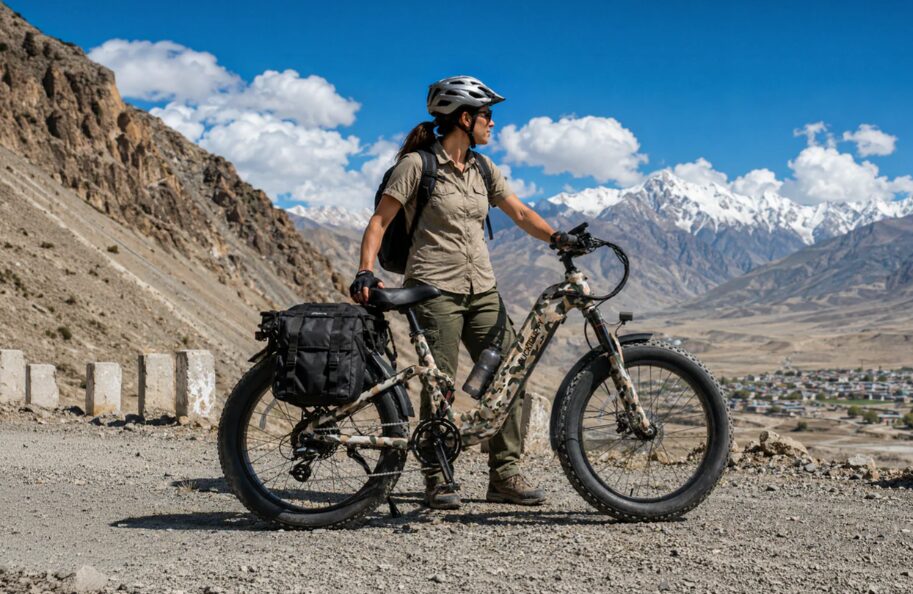
A good e-bike for hunting and backcountry trips should make rough access easier without becoming another piece of equipment that is difficult to manage. Stable tires, controlled motor assistance, dependable range, effective suspension, and enough carrying capacity for essential gear matter far more than simply choosing the fastest bike available.
For hunters and outdoor riders, the real advantage is mobility. An e-bike can help cover long stretches of forest road, gravel, campground routes, and other bike-accessible terrain while requiring less physical effort than a conventional bicycle. That can leave more energy for hiking, scouting, setting up camp, or spending the rest of the day outdoors.
But not every e-bike is suited to that job. Backcountry riding places very different demands on a bike than a paved ride around town.
Table of Contents
- Why Can an E-Bike Be Useful on a Hunting Trip?
- What Type of Terrain Should a Hunting E-Bike Be Able to Handle?
- Is More Motor Power Always Better for Backcountry Riding?
- How Much Range Does an E-Bike Need for Hunting?
- What Features Matter When Carrying Hunting or Camping Gear?
- What Does a Practical Electric Hunting Bike Look Like?
- Can You Ride an E-Bike Anywhere in the Backcountry?
- What Should You Carry on a Backcountry E-Bike Ride?
- Choose the Bike for the Route, Not the Label
Why Can an E-Bike Be Useful on a Hunting Trip?
Hunting areas are often separated from parking areas or campsites by miles of secondary roads and mixed terrain. Walking the entire distance may be possible, but carrying equipment makes those miles feel much longer.
An e-bike can fill the space between driving and traveling entirely on foot. Riders can use it to move along permitted forest roads, gravel routes, dirt paths, and similar access points before continuing on foot where bicycles are not appropriate or allowed.
Electric assistance is especially useful when a route includes hills or when the rider is carrying additional equipment. Instead of using most of the day's energy simply reaching an area, pedal assistance can reduce some of the effort required on the approach.
That does not mean an e-bike should be expected to go everywhere. Backcountry riding works best when the bike is treated as an access tool rather than a replacement for walking.
What Type of Terrain Should a Hunting E-Bike Be Able to Handle?
A paved-bike setup can quickly become uncomfortable once the route turns to loose gravel, rutted dirt, grass, or uneven forest roads.
For these conditions, tire size and suspension become particularly important.
Wider tires provide a larger contact area with the ground and can give a rider a more planted feel across loose or uneven surfaces. Fat tires are common on outdoor-oriented e-bikes for this reason. They are not a guarantee of traction in every condition, but they can make mixed-surface riding more manageable.
Suspension also matters when a route contains repeated bumps, roots, washboard sections, or potholes. Front suspension reduces impacts reaching the handlebars, while rear suspension can help isolate the rider from additional vibration through the frame.
A full-suspension setup can therefore make sense for riders who regularly leave smooth pavement behind. The goal is not simply comfort. A less unsettled bike is generally easier to control when the terrain keeps changing.
Is More Motor Power Always Better for Backcountry Riding?
Not necessarily. Backcountry riders need usable, predictable assistance more than they need maximum speed.
A motor should provide enough support for hills, heavier loads, and rougher surfaces, but how that assistance is delivered also affects the ride. Sudden power can be harder to manage on loose ground, around tight turns, or while moving slowly over uneven terrain.
This is where pedal-assist sensors become relevant. Torque sensors respond to how much force the rider applies to the pedals, while cadence sensors detect pedaling movement. Systems that use these inputs can make assistance feel more connected to what the rider is doing.
For hunting access, that controlled response can be more useful than chasing a high top-speed figure. Forest roads and backcountry routes often reward steady control rather than outright speed.
How Much Range Does an E-Bike Need for Hunting?
There is no single ideal range because outdoor routes vary too much. A rider traveling six miles from camp and returning on relatively flat ground has very different needs from someone covering a longer route with repeated climbs.
The best approach is to think in terms of the complete trip rather than the manufacturer's maximum range figure.
Start with the planned distance out and back. Then allow extra battery capacity for hills, soft terrain, extra cargo, changes in temperature, and unexpected route changes. Higher assistance levels and heavier loads can also reduce real-world range.
A bike that can technically complete a planned route with almost no battery remaining leaves little room for error. Backcountry riders are better served by building in a comfortable reserve.
The battery should also be fully charged before departure, and riders heading into less-developed areas should know how much range they are actually getting under their own riding conditions before relying on the bike for a long trip.
What Features Matter When Carrying Hunting or Camping Gear?
Gear changes how a bicycle handles.
Water, clothing, optics, tools, food, basic repair supplies, and other equipment all add weight. That weight should be distributed securely rather than hanging loosely from the handlebars or rider.
Before choosing an e-bike, check its maximum load capacity and available cargo options. A rear rack, panniers, or securely mounted cargo system can make equipment easier to organize while keeping the rider's movement less restricted.
Braking becomes important here as well. Added weight increases the importance of controlled stopping, especially when descending gravel roads or riding in wet conditions. Hydraulic disc brakes are common on outdoor-oriented e-bikes because they provide consistent braking control with relatively little hand effort.
The important number is not just how much equipment a bike can theoretically carry. Riders should think about the combined weight of themselves, their equipment, and any installed accessories.
What Does a Practical Electric Hunting Bike Look Like?
A useful outdoor setup combines terrain capability with manageable power and enough range for longer routes rather than focusing on a single specification.
One example is the Puckipuppy Labrador Pro ST Camouflage. As a full suspension electric mountain bike, it combines 26 × 4-inch fat tires and front-and-rear suspension with a 750W rated motor and a 48V 20Ah battery rated for 40–80 miles. For riders considering an electric hunting bike for permitted forest roads, gravel routes, camp roads, and similar outdoor terrain, its step-through frame can also make mounting and dismounting easier when riding with gear.
The broader lesson is to choose features according to the route. A rider who stays mainly on maintained gravel roads may not need the same setup as someone who frequently encounters rough, broken terrain.
Can You Ride an E-Bike Anywhere in the Backcountry?
No. Owning an off-road-capable e-bike does not mean every trail or hunting area is open to electric bicycles.
Rules can change depending on the state, land manager, trail, e-bike classification, and specific recreation area. The Bureau of Land Management, for example, allows e-bike opportunities on many motorized areas and OHV trails, while individual offices can determine access to certain non-motorized trails.
National Park Service rules also depend on the location. E-bikes may be allowed on roads and trails where traditional bicycles are permitted when authorized by the park, but individual superintendents can impose additional restrictions. Bikes and e-bikes are not permitted in designated wilderness areas within the National Park System.
National forests and other public lands can follow different rules again.
For that reason, route planning should happen before the bike is unloaded. Check the current regulations published by the relevant land-management agency and confirm that the exact road or trail you intend to use permits your type of e-bike. Hunting regulations and vehicle-access rules should also be checked separately.
What Should You Carry on a Backcountry E-Bike Ride?
A reliable bike is only one part of the preparation.
Longer outdoor routes should include basic repair equipment such as a tire repair kit, pump, and appropriate tools. Fat tires improve stability in many conditions, but they are still vulnerable to punctures.
Bring enough water and food for the planned ride, plus extra for unexpected delays. A paper map or downloaded offline map is useful in areas where cell coverage becomes unreliable.
Battery level should be checked before leaving, along with tire pressure, brakes, drivetrain, lights, and any cargo attachments. A short inspection at camp can prevent a minor mechanical issue from becoming a long walk back.
The weather also deserves attention. A dry forest road can become much harder to ride after heavy rain, while falling temperatures may affect both rider comfort and battery performance.
Finally, tell someone where you plan to ride and when you expect to return. That simple habit matters much more in the backcountry than it does on a neighborhood bike path.
Choose the Bike for the Route, Not the Label
A hunting e-bike does not need to be defined by camouflage paint, maximum speed, or an oversized motor. What matters is whether the bike can handle the terrain, carry the required load, provide predictable assistance, and complete the planned route with battery capacity to spare.
For many outdoor riders, fat tires, suspension, dependable brakes, practical cargo options, and sensible range will have a greater effect on the trip than any single headline specification.
An e-bike can make longer outdoor access more manageable, but the best trips still depend on preparation. Check the route and local access rules, load the bike properly, and test the complete setup before relying on it deep in the woods.