
–
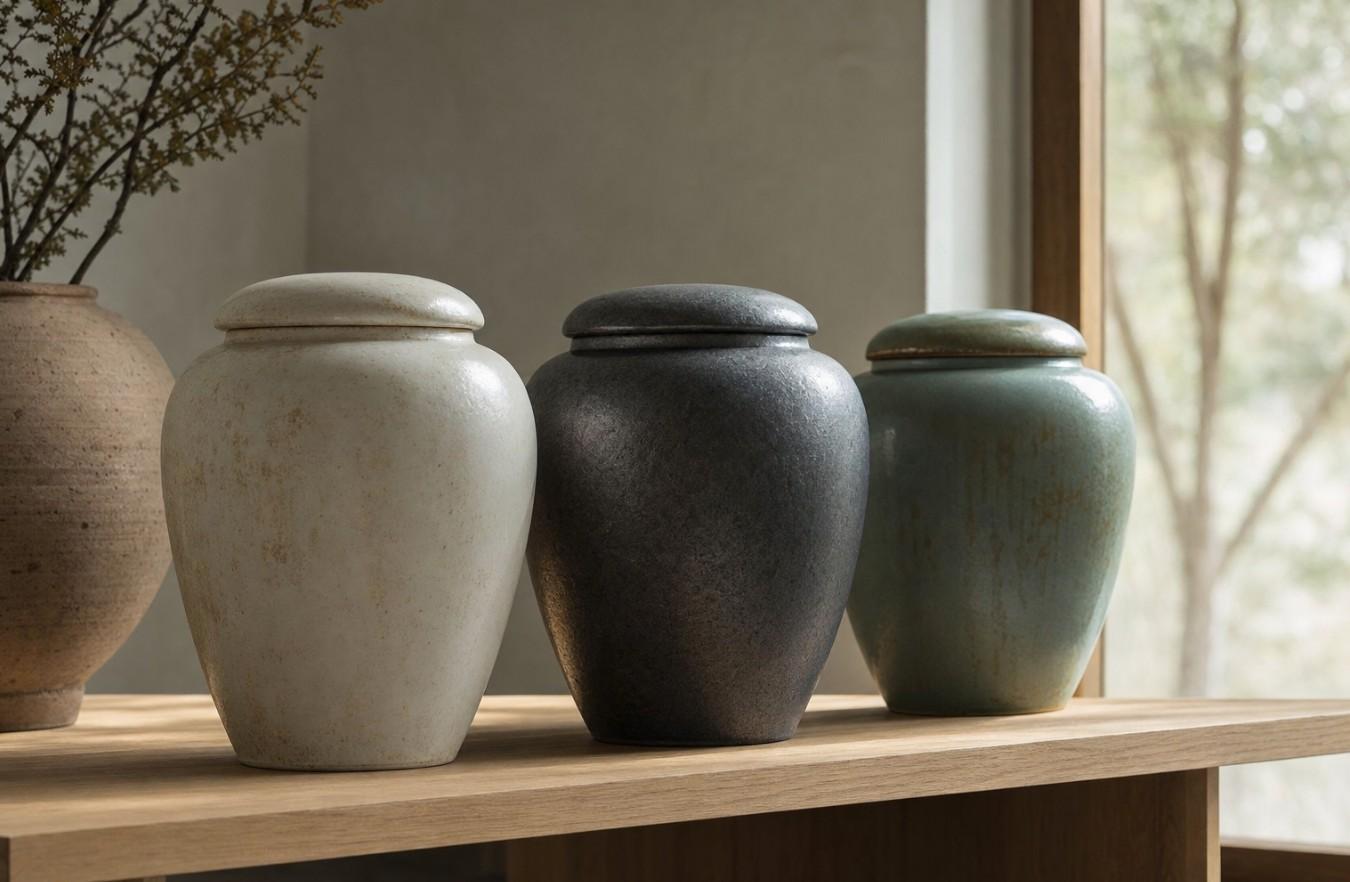
Which matters more in a modern cremation urn: the shape or the surface? The surface, more often than families expect. An urn is a handled object — lifted, wiped, carried between rooms, lit by changing daylight. The glaze, the micro-texture and the way edges are finished decide how it feels in the hand, how visibly it marks, and how quietly it sits in a room over decades.
Finish and glaze, briefly. The glaze is the thin glassy layer fused to the clay during firing; the finish is how that layer behaves — its gloss level, its texture, its response to light and touch. A piece can be fully glazed, partly unglazed, or textured beneath the glaze. Those differences govern cleaning, grip and appearance far more than the silhouette does.
Three variables should drive the choice, and none of them tends to appear in a standard product listing:
- Placement. An enclosed niche or a closed cabinet tolerates high gloss easily; an open shelf in daylight tends to reward satin or texture.
- Handling frequency. The more often a piece is touched or moved, the more a tactile, fingerprint-forgiving surface pays off.
- Cleaning tolerance. Some surfaces wipe clean with a dry cloth. Others — matte and partly unglazed finishes in particular — may need a lighter, more deliberate hand, so it is worth asking the maker directly.
If you are comparing makers, it helps when a studio puts surface decisions in the foreground rather than burying them under colour names. Fenicetek, for example, frames its collections around the idea of a modern cremation urn for ashes with elegant design — roughly the level of specificity worth looking for before you start asking the technical questions further down this article.
Photographs, meanwhile, rarely settle anything. A catalogue image flattens gloss, satin and matte into much the same pleasant sheen, and texture almost never survives the compression. Details about the surface usually have to be requested. Yet those details govern daily life with the object: whether the rim is comfortable to grip, whether the base will scratch a walnut sideboard, whether the lid seats silently or scrapes, whether skin oils show.
This article argues something simple. In contemporary urn design, finish is not decoration applied at the end. It is the performance layer, and it deserves the same scrutiny as the outline.
Table of Contents
- What material does in a memorial object
- Reading a ceramic urn: body, glaze, and the questions to ask
- Gloss, satin, matte, texture: how finishes behave in a real room
- The tactile layer: edges, weight and the choreography of handling
- Close-up signals worth checking
- Capacity, closure and travel: the practical questions material answers
- Care that never becomes a chore
- Questions worth asking before you commit
- Where modern elegance actually comes from
- Frequently asked questions
What material does in a memorial object
Guidance published by funeral providers describes cremated remains as remnants of bone fragments that do not biodegrade naturally over time. Whatever else it is, then, the container is a long-duration object, intended for keeping rather than for decay. It will outlast the sofa, probably the house, possibly the generation that chose it.
That horizon changes the brief. A vase can be trend-led because it can be replaced without ceremony. An urn cannot — or rather, replacing one is an emotionally costly act nobody wants to schedule. Material choices that read as neutral and self-evident tend to survive shifts in taste better than surfaces engineered to be striking on first sight.
There is a custodial dimension pushing in the same direction. In the UK, published guidance on the question notes that a human body, before or after cremation, is not classed as property in law; what exists instead is a right of possession and control, generally held by the person who arranged the cremation, who decides whether the ashes are scattered, buried or kept at home. If you are outside the UK, ask your funeral director who is authorised to make final decisions about the remains. Either way the practical consequence is the same: someone is the custodian, and custody means handling. Somebody, at some point, will pick this thing up — repeatedly.
Reading a ceramic urn: body, glaze, and the questions to ask
Ceramic is two materials pretending to be one. Underneath is the body — the clay, shaped and fired, which gives the piece its weight and thermal feel. On top is the glaze, which supplies colour, sealing and almost all of the tactile character. Judging one without the other is how people end up disappointed.
Rather than assume anything from a photograph, treat the technical side as a short list of questions for the maker. What clay body is it? Roughly at what temperature was it fired? Is the surface fully glazed, or is any part of it left bare? Is the interior glazed as well? These are not trick questions, and a studio that works seriously with ceramic will answer them without hesitation. Vagueness on those points is informative in itself, quite apart from whatever the answers turn out to be.
Handcrafting introduces variation, and it is worth deciding in advance how you feel about that. Two pieces from the same studio run will usually differ slightly in glaze pooling, colour depth, and the way a texture catches light. Highly industrial pieces will not. Buyers who want absolute uniformity should say so upfront; those who want evidence of the hand should look for controlled irregularity — variation that follows the form — rather than random inconsistency. Ask directly what range of variation the maker considers normal for that collection. A confident answer usually describes the effect; an evasive one describes the policy.
Gloss, satin, matte, texture: how finishes behave in a real room
Here is a piece of ceramics chemistry worth knowing. The difference between a matte glaze and a glossy one can come down to a single ingredient: silica. In one studio example documented by a working potter, adding silica alone shifted a recipe from matte to glossy — forty more grams per hundred in the glossy version, described as literally the only change made. That is one recipe, not a universal law, but it makes the point that surface character is engineered, not incidental. Same clay, same firing, a very different object in the hand.
Gloss gives depth. Light enters the glaze layer, bounces off the body beneath, and returns with a wet, saturated quality that makes colours look richer and curves look more precise. It is also the most candid reporter of dust and skin oils, particularly in dark colours. A black gloss urn on an open shelf in a sunlit room will generally need wiping more often than people anticipate; the same piece inside a columbarium niche behind glass can look immaculate for years.
Satin is the diplomat. It reflects enough to define the form without turning into a mirror, and fingerprints tend to disperse rather than sit as discrete marks. For families who want the urn integrated into a living room rather than announced, satin usually causes the fewest regrets.
Matte reads as quiet. It absorbs light, softens edges visually, and often feels warmer and slightly drier to the touch — closer to stone or plaster than to glass. Matte surfaces can vary a good deal depending on how they were formulated and fired, and some are easier to keep clean than others. That is a question for the maker, not an assumption to make from an image.
Texture and micro-relief do something flat finishes cannot: they change the perceived scale of the object. Fine vertical ribbing can make a rounded form look taller and more architectural. A sand-like tooth gives grip, which genuinely matters when someone with unsteady hands is moving the piece. Texture also scatters light, which is why textured urns often photograph poorly and look better in person than in any catalogue image.
The practical rule: match the finish to placement and handling frequency. An open shelf and frequent contact favour satin or texture. An enclosed niche, rarely touched, is where high gloss can be enjoyed without maintenance anxiety.
The tactile layer: edges, weight and the choreography of handling
Touch is not a secondary channel in mourning. People stroke a lid, rest a palm on the shoulder of a form, turn it slightly on an anniversary. Design that ignores this produces objects admired at a distance and avoided up close.
Three details do most of the work. The first is the rim and lid interface: a lid that seats cleanly, without grinding, signals precision and reassures the person lifting it that nothing is about to slip. The second is edge treatment — a slightly softened edge on the base and shoulder feels considered, while a sharp, unfinished edge feels unresolved and is more exposed to chipping. The third is the foot. An unglazed, roughly ground foot ring can mark furniture; a finished foot, or one fitted with felt, will not. It is a small detail that reveals whether the maker thought past the photograph.
Weight perception deserves its own note. Solidity is read through a combination of mass, wall thickness and surface temperature, not weight alone. A matte, thick-walled piece of moderate weight can feel more substantial than a heavier glossy one, because a cool, dry surface suggests stone. If the urn will regularly be lifted by an older family member, aim for the sensation of solidity rather than the raw fact of it.
Close-up signals worth checking
Ask for close-ups taken at an angle, and for at least one image with a hand or a familiar object nearby for scale. With the piece in front of you, or a good detail shot, look for the following.
- Glaze coverage at transitions. Glaze tends to thin where a form curves sharply. Even, unbroken coverage over the shoulder and around the lid edge suggests careful application.
- Pooling and variation. Deliberate pooling in recesses is a legitimate effect in many glaze families. Random bare patches are a different matter — ask whether they were intended.
- Pinholes and crazing. A fine crackle network is a decorative tradition in some work and a defect in others. The useful question is simply whether it was intended and whether it affects the closure or the interior.
- Colour under two light temperatures. Greys, greens and off-whites shift noticeably between cool daylight and warm domestic bulbs. A glaze that reads as soft grey in a showroom can turn faintly lilac at home.
- Base stability. Set it down on a hard surface. It should not rock.
Capacity, closure and travel: the practical questions material answers
Capacity is the specification everyone eventually needs. A widely used rule of thumb puts roughly one cubic inch of ash per pound of pre-cremation body weight, which gives a workable starting figure for most adults. Some retailers offer capacity filters reaching a 250 to 300 cubic inch band, which covers larger adults and companion pieces. Add a margin rather than cutting it fine: a container filled to the brim is difficult and distressing to close.
Closure is the least standardised part of the whole category, and listings describe it inconsistently. Some wooden designs open with screws from the base — one contemporary wooden urn on the market states plainly that it opens with four screws underneath — while ceramic pieces may use a seated lid, a threaded closure, or a joint sealed at the moment of interment. Do not infer the mechanism from the style. Ask how this particular piece closes, whether it can be sealed permanently, and what reopening would involve. If there is any chance the ashes will later be divided among family members or partly scattered, say so before the urn is closed.
Air travel introduces a constraint unrelated to taste. In the United States, Transportation Security Administration guidance (last updated in 2018) permits cremated remains in both carry-on and checked baggage, while noting that some airlines do not allow them in checked bags — so the carrier should be checked separately. Screening officers will not open a container of cremated remains, even at the passenger's request. If the container is made of a material that generates an opaque image, officers cannot determine what is inside and it will not be allowed through the checkpoint. For that reason the guidance suggests using a temporary or permanent crematory container in a lighter-weight material such as wood or plastic to facilitate screening. Plan the transfer, not only the purchase.
Care that never becomes a chore
Maintenance for a glazed ceramic piece is usually minimal, which is much of its appeal. A dry microfibre cloth handles dust. For marks, a barely damp cloth with a neutral soap, dried immediately, is generally enough. Abrasive pads, scouring powders and aggressive household sprays are best avoided as a matter of course — and since finishes differ, ask whether the maker has care instructions specific to that glaze rather than relying on general habits.
Two placement habits prevent most damage. Keep the urn away from prolonged direct sun and from radiators or fireplaces. And use felt pads underneath — not only to protect furniture, but because the slight grip they provide makes an accidental nudge toward a shelf edge less likely.
Questions worth asking before you commit
- What clay body is this, and roughly at what temperature was it fired?
- Is the surface fully glazed, partly unglazed, or sealed another way — and what does that mean for cleaning?
- How does the lid close, and can it be permanently sealed later if we choose?
- What degree of variation is normal between pieces in this collection?
- Are there care instructions specific to this finish?
- What is the internal capacity in cubic inches, measured to a comfortable fill level rather than the absolute brim?
A serious maker or funeral director will answer all six without pausing. Hesitation on the first three tells you something on its own.
Where modern elegance actually comes from
The contemporary urns that hold up over decades tend to share three qualities, and none of them is novelty. Reduced ornament, so the form does the work. Proportion resolved carefully enough that the object looks right from every angle rather than only from the three-quarter view used in photographs. And material honesty — ceramic allowed to read as ceramic, rather than sprayed to imitate bronze or printed to imitate marble.
That last point is the easiest to check and the most often ignored. Imitation surfaces tend to date faster than anything else, because they are pegged to a fashion for the material they mimic. A glaze that simply is what it is — a deep celadon, a chalky bone white, a matte graphite with visible tooth — has nowhere to fall from.
Frequently asked questions
Is matte or glossy better for an urn?
Neither is universally better; the deciding factors are placement and handling. Gloss deepens colour and defines form, but shows dust and fingerprints more readily, especially in dark tones — which suits an enclosed niche or a cabinet. Matte and satin sit more quietly in a lived-in room and disguise contact marks. Because matte glazes vary in formulation, ask the maker how that specific surface should be cleaned rather than assuming.
How do I choose urn capacity?
A widely used rule of thumb is one cubic inch of ash per pound of pre-cremation body weight, which gives a usable starting figure. Some retailers list capacity filters reaching a 250 to 300 cubic inch band for larger adults and companion urns. Choose slightly above your calculated figure so the container is not filled to the brim, which makes closing it harder than it needs to be.
Can you fly with cremated remains?
In the United States, Transportation Security Administration guidance permits cremated remains in carry-on and checked baggage, though it notes that some airlines do not allow them in checked bags — confirm with the carrier. Officers will not open the container, even if asked. If the material produces an opaque image at screening, the container will not clear the checkpoint; the guidance suggests a lighter-weight temporary or permanent crematory container in wood or plastic to facilitate screening.
Can an urn be permanently sealed, and reopened later?
Many closures can be made permanent, but the mechanism varies widely between makers and materials, and listings describe it inconsistently. Some wooden designs are accessed with screws from the base; ceramic pieces may use a seated or threaded lid, or a joint sealed at interment. Ask the maker or funeral director exactly how this piece closes and what reopening would involve — and raise the question before the urn is closed if the ashes may later be divided or partly scattered.
How long do ashes last inside an urn?
Guidance from funeral providers notes that cremated remains are remnants of bone fragments and do not biodegrade naturally over time. A sealed, dry container is therefore intended for long-term keeping rather than eventual breakdown — which is exactly why the urn should be judged as a durable object with a working surface, not as a decorative accessory chosen for one season.
Choosing a surface, in the end, is choosing how the object will behave in ordinary moments: a hand resting on a lid, late light crossing a shelf, a cloth passed over it during weekend cleaning. Get that right and the urn does what it is meant to do — hold a place in daily life without demanding attention.
4 thoughts on “Material matters, from ceramic finishes to tactile surfaces in modern urn design”
Comments are closed.