
–
How do you tell a genuinely good extra virgin olive oil from a handsome bottle with a view attached? Smell it, then sip it. Fresh extra virgin smells of green or riper fruit, tastes bitter across the tongue and catches in the throat with a peppery pungency. Styles differ from grove to grove. Defects get no such latitude: under EU rules, extra virgin must show none at all.
Table of Contents
- Quick answers before you book anything
- What extra virgin should taste like, in one minute
- Terroir sets the potential; the hours after picking decide how much survives
- Rancid: the defect a visitor can genuinely learn to name
- Craftsmanship checkpoints: the decisions behind the glass
- A tasting routine you can run anywhere
- Six questions that reveal quality quickly
- Pairings that put an oil to work
- When to go, and what changes with the season
- Bringing it home: labels, storage and the bottle that turned
- Why the sensory route is still the reliable one
Quick answers before you book anything
- What should extra virgin taste like? Fruity, with bitterness on the tongue and pungency in the throat, and no organoleptic defects. EU rules also cap free acidity at 0.8%.
- What is rancid? In the reference sensory vocabulary, the flavour of oils that have gone through an intense process of oxidation — flat, greasy, waxy, aroma drained away.
- Are bitterness and pungency faults? No. When fruity, bitter and spicy notes prevail, they point towards a well-made extra virgin; bitterness and pungency are commonly linked to polyphenols, the oil's natural antioxidants.
- Best moment to see milling live? Roughly late October to early December, when Tuscan mills are working the fresh harvest.
- Fastest way to learn? Taste two oils side by side — an earlier harvest against a later one, or this season against last.
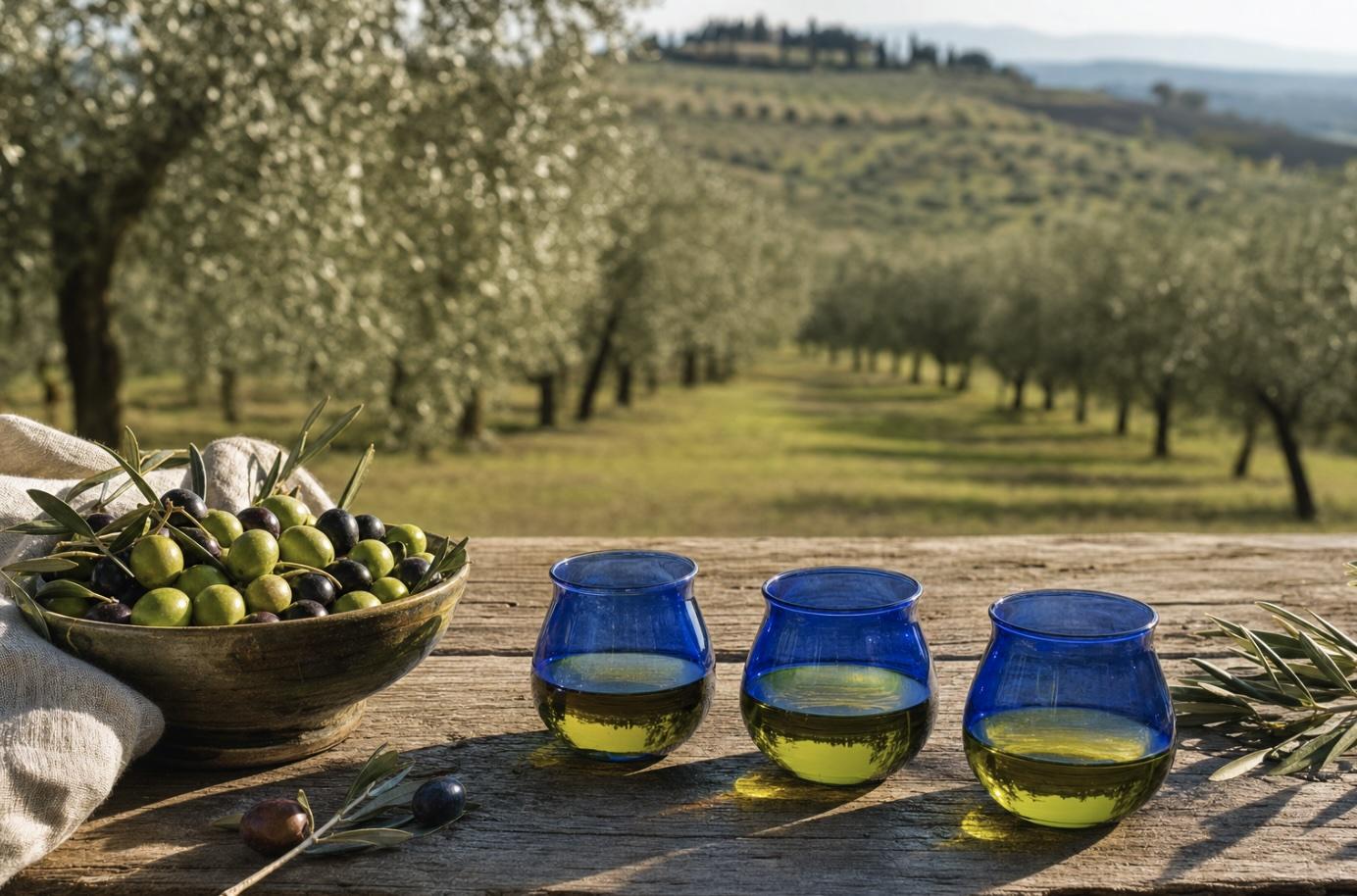
That distinction between style and defect is the argument of this article, and the reason a well-run session teaches more than a shelf of labels. Tuscany has the cultivars, the hills, the cool autumn nights and the reputation. It also has a gap between oils made with obsessive attention to timing and temperature and oils made from comparable fruit with less care in between. If you book an olive oil tasting in Tuscany, prioritise sessions run where the oil is actually made, with the people who farm the grove and operate the mill: that setting connects what is in the glass to the rows outside, the harvest window and the tanks the oil sat in before bottling. Reading a label teaches vocabulary. Standing in an olive farm during a comparative tasting teaches what the vocabulary refers to.
What extra virgin should taste like, in one minute
Three positive attributes carry almost the whole assessment. Fruitiness is the aroma of sound olives, broadly falling into two families: greener and more herbaceous, or riper and softer. Bitterness is a taste, perceived on the tongue, usually mid-sip. Pungency is tactile — a peppery sting in the throat that often arrives a second or two after swallowing and can make you cough.
Newcomers frequently read the last two as faults. In tasting practice they work the other way round. An oil that tastes of very little is not automatically poor; it rarely tastes of a place, either.
The legal frame is narrower than most travellers expect. EU rules on the characteristics of olive oil, set out in a regulation dated July 1991, require extra virgin olive oil to be fruity and to have no organoleptic defects, with free acidity no higher than 0.8%. The category directly below, virgin olive oil, may carry some sensory defects at a very low level, with acidity up to 2%. Read that from the tasting bench and one thing follows immediately: fruitiness is a requirement rather than a bonus, and the absence of perceptible faults is what separates the top category from the one beneath it.
One confusion worth clearing early. Free acidity is a laboratory figure, not a flavour — nobody tastes 0.5% against 0.7%. The same body of rules sends other quality markers to the lab as well, from the peroxide index to spectrophotometric analysis, each with a prescribed method. Your senses cannot produce those numbers. What they can do, and do well, is notice defects.
Terroir sets the potential; the hours after picking decide how much survives
Frantoio, Moraiolo, Leccino, Pendolino: the Tuscan varietal repertoire tends towards green, herbaceous, assertive profiles, and altitude combined with a short, cool harvest window often reinforces that character. But potential is perishable. Between tree and bottle sit a series of human decisions — when to pick, how quickly to mill, how warm to work the paste, how to store what comes out — and each one either protects the fruit's aromatic material or quietly spends it.
Visitor-facing formats often invert the useful order: scenery first, sensory vocabulary later, production detail seldom. The remedy is not suspicion of hospitality. It is a short diagnostic routine you can run politely, anywhere, with a glass in your hand — plus a handful of questions that anyone who milled the fruit themselves can answer in a sentence.
Rancid: the defect a visitor can genuinely learn to name
Official classification of virgin olive oils is not done by individuals. The reference procedure, in its latest revision, applies only to virgin olive oils and sorts them according to the intensity of perceived defects and of fruitiness, as judged by a selected, trained and monitored tasting panel. You are not a panel, and you do not need to be. One defect is far easier to learn than the rest, and learning it changes how you shop.
That defect is rancidity, defined in the reference sensory vocabulary as the flavour of oils which have undergone an intense process of oxidation. Tasting notes often describe it as a neutral or almost tasteless greasy flavour reminiscent of wax, associated with excessive exposure to air or with significant temperature changes that accelerate degradation. In practice most people reach for their own comparisons — stale walnuts, old peanut butter, the forgotten drawer of nuts. Whatever words you choose, the recognisable event is the same: aroma has drained out and something flat and fatty has taken its place.
Other off-notes circulate in tasting rooms, and you will hear oils called fusty, musty, muddy, winey or metallic. Treat those as reported sensory cues rather than verdicts you can issue from a glass; identifying them reliably, and pinning each to a specific step in the process, is panel work. For a traveller the useful test is simpler. If an oil smells of nothing, or smells wrong, or leaves a stale greasy film behind, the conversation is worth having.
How to have it without turning lunch into an audit: ask questions rather than deliver judgements. Is this the current harvest? When was this bottle opened? Do you have a fresher lot I could compare it with? Producers who made the oil themselves usually answer at once and enjoy the exchange. A vague or deflecting answer is, in my experience, worth noting quietly and moving on.
Craftsmanship checkpoints: the decisions behind the glass
What follows are tendencies rather than laws — groves, cultivars and machines differ, and any serious producer will qualify them further. Still, these are the variables worth asking about.
- Harvest timing. Picking earlier, with fruit still turning colour, tends to give greener aromas and more bitterness and pungency, generally at the cost of yield. Later picking tends towards softer, riper profiles and more oil per kilo. Both can be excellent; they are different intentions, and a good host explains which one was chosen and why.
- Time from tree to mill. The step most often glossed over on a visit, and widely treated as a quality lever, since delays are commonly associated with fermentation-related defects. Ask, and notice whether the answer comes in hours or in days.
- Crushing and malaxation. After crushing, the paste is mixed so oil droplets coalesce. Temperature and duration are the levers, debated among millers precisely because they can affect both yield and aromatic character. Ask what this mill aims for.
- Separation and filtration. Some producers filter, some don't, and the choice is technical rather than moral. Cloudy oil is not automatically better or worse than clear oil; what matters is that the producer can explain how it is handled and how long it is meant to keep.
- Storage before bottling. Most oil spends far more of its life in a tank than in a bottle. Cool, dark, stable, well-sealed storage is what producers describe when they talk about protecting freshness, and it is the least visible stage of the chain.
- Packaging. Since oxidation is associated with air exposure and temperature swings, dark glass, tins and sealed formats are the sensible defaults. Clear bottles of olive oil displayed under bright light deserve, at minimum, a second thought.
A tasting routine you can run anywhere
- Warm a small amount. Pour a spoonful into a small neutral cup, cover it with one hand and cradle it in the other for twenty or thirty seconds. Set colour aside: for a buyer it is a weak signal, easily influenced by cultivar and filtration.
- Smell. Uncover and inhale in short bursts. Name the family before the note — greener and herbaceous, or riper and softer?
- Sip a little and hold it at the front of the mouth. Bitterness registers here, spread across the tongue.
- Draw a thin breath of air across the oil, teeth slightly parted, so the aromas travel towards the back of the nose. Both fruitiness and off-notes tend to become clearer at this point.
- Swallow and wait. Pungency usually arrives late, in the throat, and its intensity is part of the oil's signature.
- Write two lines. Aroma family, rough intensity of bitter and pungent, any off-note suspected, length of finish. Notes taken on the spot beat impressions recalled at dinner.
Two practical points. Bread is sweet and absorbent, so it flatters whatever you pour on it; assess the oil alone first, then move to food. And ask for two oils side by side — an earlier and a later harvest, or the current season against the previous one. Comparison calibrates a palate faster than any description. Some guided sessions push this further and pour a cheap, poorly made oil blind against a good local one, a blunt but effective way to fix the difference in memory.
Six questions that reveal quality quickly
None of these is aggressive. Each is answerable in a sentence by whoever made the oil.
- When were these olives picked, and how long before they were milled?
- Was the temperature of the paste controlled during processing?
- How is the oil stored before bottling?
- Is this oil filtered, and how long is it meant to keep?
- What is the harvest year, and where is it written on the bottle?
- May I taste from a bottle opened today?
An estate that mills its own fruit tends to answer all six from memory, often while walking you past the tanks. A venue reselling anonymous oil in unmarked bottles is more likely to stumble on the first two.
Pairings that put an oil to work
Bruschetta is a celebration, not a test. If you want food that reveals an oil, choose plain and slightly humble things: boiled white beans, steamed potatoes with salt, a bowl of thick tomato and bread soup, blanched bitter greens, raw fennel, grilled white fish. Fresh oil tends to make legumes and soups taste rounder and greener, adding a peppery lift you can locate precisely on the palate. An oxidised oil turns delicate food faintly stale and leaves a greasy coating behind.
Match intensity too. Robust, early-harvest Tuscan oils sit well on beans, ribollita, grilled meat and sturdy vegetables; gentler, riper oils suit fish, raw tomato, light sauces, even some desserts. Hosts who pair with vegetables and pulses rather than bread alone are usually teaching rather than simply serving — a small signal, but a useful one when choosing between experiences.
When to go, and what changes with the season
Timing changes what you can see. In the window that typically runs from late October to early December, some Tuscan mills let visitors watch the pressing process live: crates arriving, the crusher running, oil coming off opaque and almost prickly with pungency. That is the most instructive moment of the year, and also the busiest for the people working the harvest, so patience helps.
Outside harvest, a visit shifts towards grove and cellar — cultivation and pruning, tank rooms, bottling, comparative tastings across lots and vintages. Arguably it is easier to concentrate on your own palate in spring than in November, with fewer distractions and more of your host's attention. Formats vary widely; published examples include workshops of around forty-five minutes, one-hour guided tastings, mill visits of roughly ninety minutes to an hour and three quarters, and longer farm days of about six hours that fold in other local produce and a meal. What matters is the proportion of that time spent tasting and discussing production rather than moving between locations. Note that the shorter formats are usually held on the estate itself, so factor in travel from Florence or Siena separately.
Bringing it home: labels, storage and the bottle that turned
Read labels pragmatically. A harvest date tells you more than a best-before date, which is calculated from bottling and tends to be generous. Look for an explicit origin statement, a lot code and light-protective packaging. Marketing vocabulary — cold-pressed, first press, artisanal — carries little diagnostic weight on its own.
At home, treat the bottle as a fresh product rather than a pantry fixture: cool, dark, tightly closed, away from the heat of the stove, finished within a reasonable time after opening. Buy quantities you will genuinely use, and keep the freshest oil for raw dressing, where its aromas actually survive the trip to the plate.
And the question that comes up eventually: is rancid oil dangerous? Consumer health guidance suggests that using oil past its prime probably will not make you sick, though it may taste off and contain fewer antioxidants than fresh oil. The loss is culinary and nutritional rather than acute. If a bottle has gone flat and waxy, keep it for jobs where flavour hardly matters, or accept the small waste and open something better.
Why the sensory route is still the reliable one
Instruments are catching up. Research published in 2026 reported classification models based on near-infrared spectroscopy reaching correct classification rates above 94% for fruitiness and above 82% for sensory defects, while confirming that official classification of olive oils into commercial categories still rests on the panel test carried out by trained tasters. Machines are learning to approximate what noses do. The noses remain the standard.
The tool available to a visitor in a Tuscan tasting room costs nothing and works from day one: attention, a little vocabulary, a point of comparison. Spend an afternoon in a grove and a mill, ask the six questions, taste two lots against each other, and something durable happens. Supermarket shelves stop looking uniform. You start noticing which bottles of olive oil carry a harvest year, which are clear glass, which say where the olives actually grew. That shift — from admiring a landscape to reading it — outlasts anything you pack in the suitcase.