
How to separate the builders from the rebranders — four questions that surface real agentic capability long before a statement of work does.
| QUICK ANSWER
Judge an AI agent development partner on four things: whether they narrow an ambitious brief into a bounded task an agent can actually do, whether they lead with data readiness and workflow redesign instead of model talk, whether guardrails and human escalation are central rather than added later, and whether they will commit to a measurable pilot before scaling. A partner who says yes to everything is selling you AI; a partner who pushes back is helping you find the one place it pays off. |
Table of Contents
Everyone is suddenly an AI agent company. That’s your first problem.
The moment agentic AI became the thing every board wanted, the market filled with firms rebranding whatever they already did as “AI agent development.” Some are genuinely capable. Many are a chatbot team with new slides. And because the field is young and the vocabulary is fluid, it’s unusually hard to tell them apart from a pitch deck. If you’re going to hand someone your first real agentic project — the one that decides whether the whole program lives or dies internally — it’s worth knowing how to separate the builders from the rebranders.
Ask what they’d build, and watch what they say no to
The fastest signal is the pushback, not the pitch
The fastest signal is how a partner responds when you describe an ambitious idea.
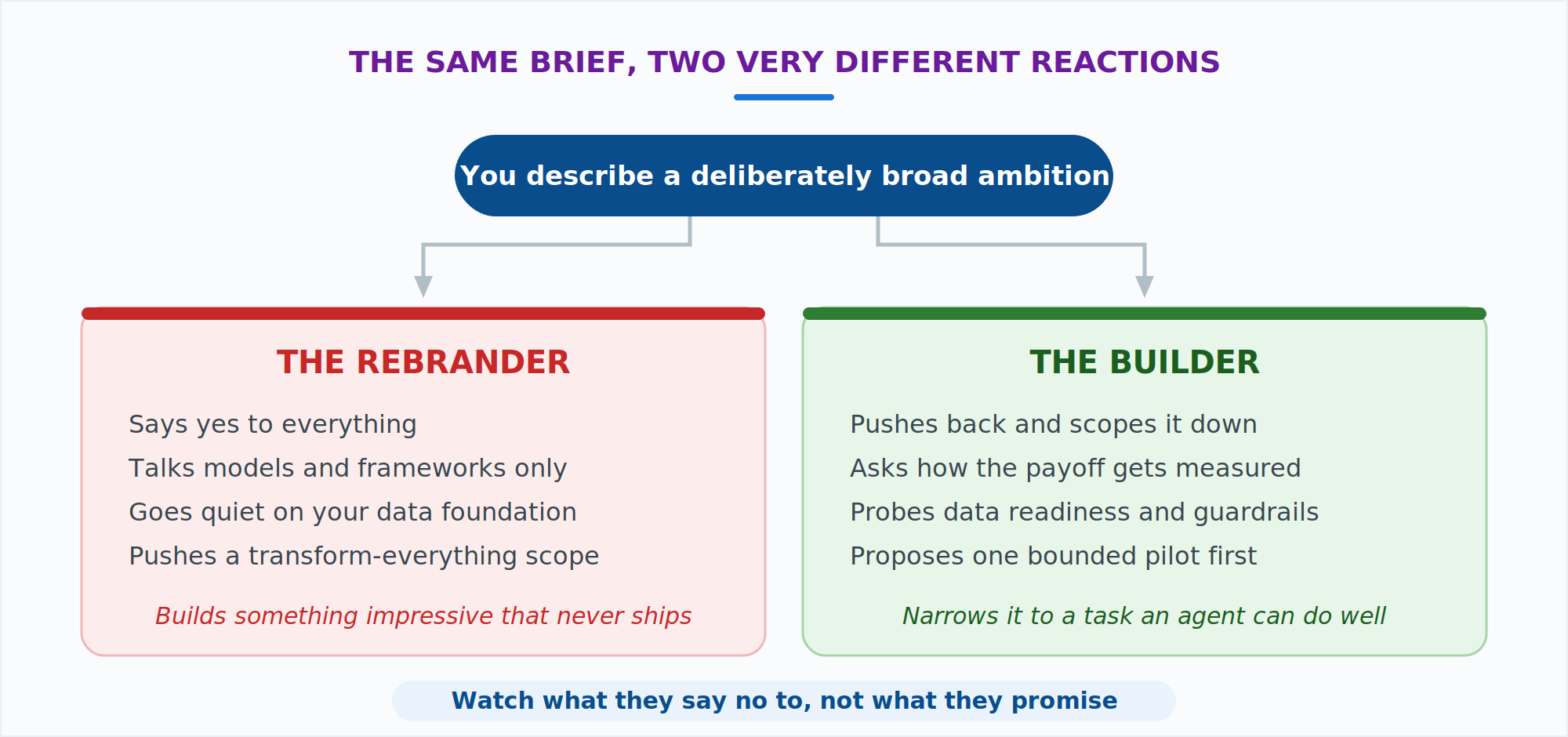
A weak partner says yes to everything, because their goal is to win the project. A strong one pushes back — asks whether the problem is well-defined enough for an agent, whether the payoff is measurable, whether you’ve got the data and guardrails to do it safely. The best agentic work starts with narrowing an exciting-but-vague idea down to a bounded, high-value task an agent can actually do well, and a partner who can’t or won’t do that narrowing will happily build you something impressive that never ships.
THE SAME BRIEF, TWO REACTIONS
Describe a deliberately broad ambition and the response sorts the builders from the rebranders.
So describe a deliberately broad ambition and listen. If they immediately start scoping it down and asking hard questions about measurement and risk, that’s the instinct you want. If they just nod and promise it all, keep looking.
Look for data and workflow depth, not just model skill
The model is the visible tip; the data and the workflow are the project
Here’s the thing most buyers get wrong: agentic AI projects rarely fail on the model. They fail on everything around it.
Over half of organizations cite data quality as the primary blocker to getting value from AI, and an agent reasoning over fragmented or untrustworthy data makes confident mistakes at scale. A partner who only wants to talk about models and frameworks, and goes quiet when you ask about your data foundation, is telling you where their real depth is — and isn’t. The partners who deliver treat the data groundwork and the workflow redesign as the actual project, with the agent as the visible tip of it.
WHERE AGENTIC PROJECTS ACTUALLY FAIL
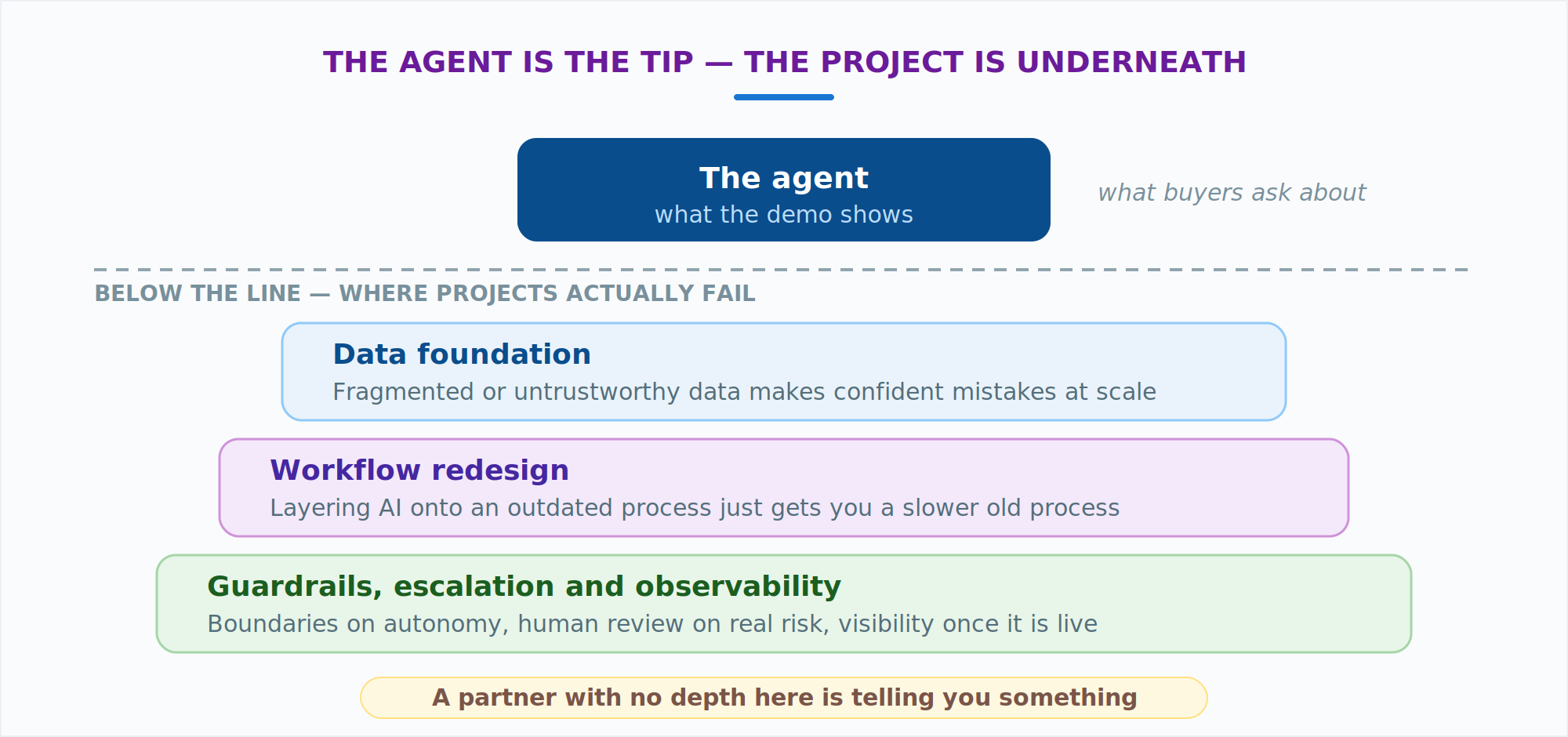
Buyers ask about the layer on top. The layers underneath decide whether it ships.
Ask them directly how they handle your data readiness, and how they’d redesign the process around the agent rather than bolting an agent onto a workflow built for humans. Layering AI onto an outdated process just gets you a slower version of the old process. A serious AI agent development services partner leads with that, rather than treating it as an afterthought.
Demand guardrails and a human in the loop
What to ask about uncertainty, escalation, limits and monitoring
An agent that acts on the world can act wrongly, and a partner who isn’t visibly worried about that is a partner who hasn’t shipped one that matters.
Ask what happens when the agent is uncertain, how it escalates high-stakes decisions to a human, what stops it from taking an action it shouldn’t, and how its behavior is monitored once it’s live. The right answers involve clear boundaries on what the agent may do autonomously, human review on the decisions that carry real risk, and observability so you can see what it’s doing and why. A partner who treats guardrails as central, not as a feature to add later, understands what production actually demands.
Four questions worth asking directly
| ASK THEM THIS | A GOOD ANSWER INVOLVES |
| What happens when the agent is uncertain? | A defined fallback and a stop, rather than a confident guess |
| How does it escalate high-stakes decisions? | Human review on the decisions that carry real risk |
| What stops it taking an action it should not? | Clear boundaries on what it may do autonomously |
| How is its behaviour monitored once live? | Observability into what it is doing, and why |
Insist on a measurable pilot
Refusing to start big is the cheapest insurance available
The single best protection against an expensive failure is refusing to start big.
A good partner will want to prove value on one bounded, measurable use case before scaling — because that’s also how your program earns the internal confidence to grow. Be suspicious of anyone pushing a sprawling, transform-everything engagement out of the gate. Define, with them, exactly what success looks like in numbers before the pilot starts: what should change, by how much, and by when. If they can’t or won’t commit to a measurable pilot, they’re asking you to buy on faith, and faith is what the roughly 40% of agentic projects headed for cancellation were bought on.
Conclusion
Four questions, and what the answers tell you
Choosing an AI agent partner comes down to four questions. Do they narrow your idea to something an agent can actually do, or say yes to everything? Do they lead with data and workflow depth, or only model talk? Do they treat guardrails and human oversight as central? And will they prove it on a measurable pilot first?
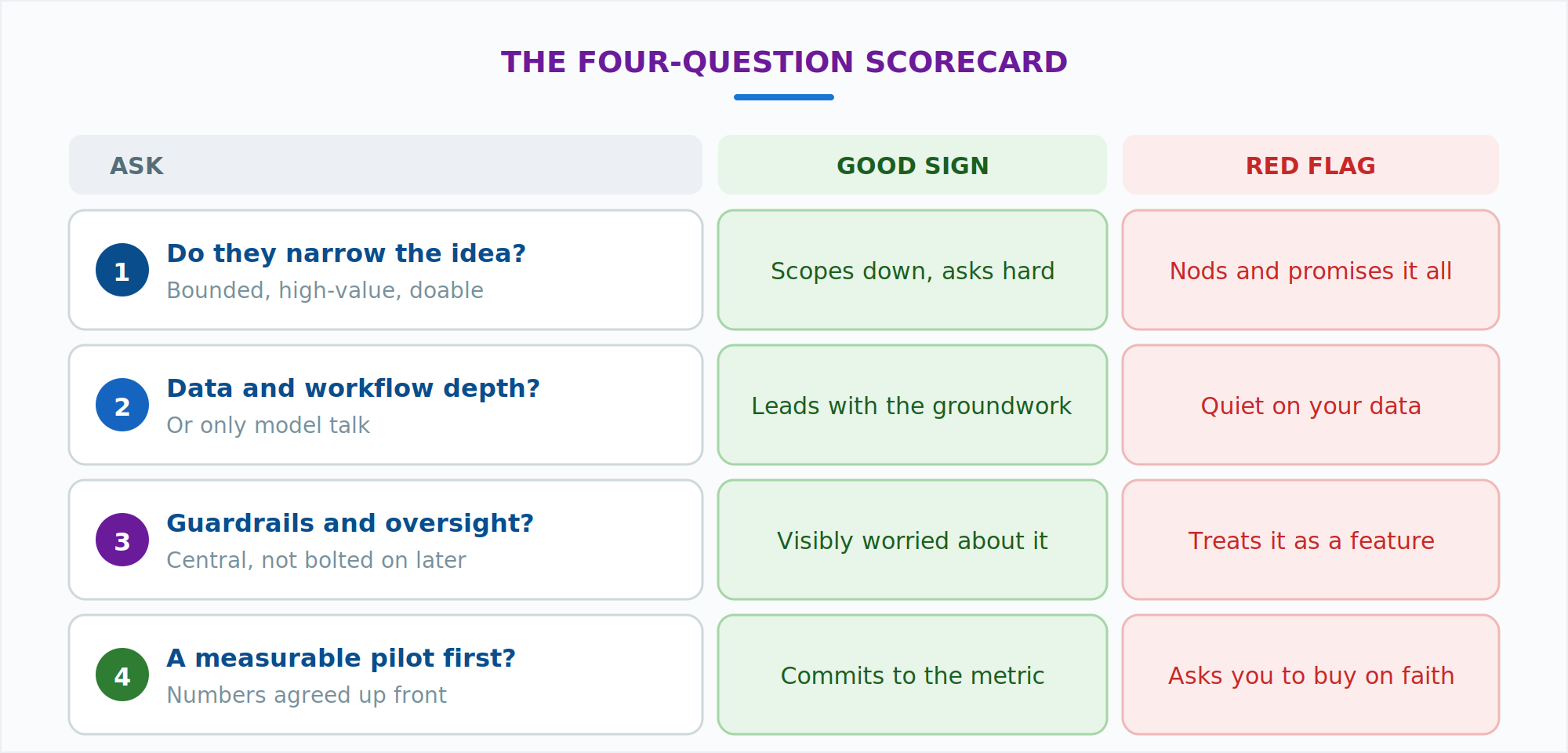
Run a prospective partner through all four before the statement of work is drafted.
The firms worth hiring look less like they’re selling you AI and more like they’re helping you pick the one place it’ll pay off. Strong AI Tools For Business is mostly good judgment about where not to point an agent — and a partner who shows that judgment in the sales conversation will show it in the work.
| KEY TAKEAWAYS | |
| 1 | Judge a partner by what they refuse to build, not by what they promise |
| 2 | Agentic projects fail on data and workflow far more often than on the model |
| 3 | Guardrails, escalation and observability belong in the design, not the backlog |
| 4 | Insist on one bounded pilot with the success numbers agreed before it starts |
Frequently asked questions
What should I look for in an AI agent development partner?
Four things. Whether they narrow an ambitious idea into a bounded task an agent can actually do well; whether they lead with data readiness and workflow redesign rather than models and frameworks; whether guardrails and human oversight are central to how they work rather than a later addition; and whether they will commit to proving value on one measurable pilot before scaling.
How do I tell a real agentic AI firm from a rebranded chatbot team?
Describe a deliberately broad ambition and listen to the response. A rebrander agrees to everything, because winning the project is the goal. A builder pushes back — asking whether the problem is well defined enough for an agent, whether the payoff can be measured, and whether the data and guardrails exist to do it safely.
Why do agentic AI projects fail?
Rarely because of the model. They fail on the work around it: fragmented or untrustworthy data that an agent then reasons over confidently, processes never redesigned around the agent, missing guardrails and escalation paths, and scope that was never bounded enough to prove value. Layering an agent onto an outdated workflow tends to produce a slower version of the old workflow.
What guardrails should an AI agent have before it goes live?
Clear boundaries on what the agent may do autonomously, a defined behaviour when it is uncertain, escalation to a human on decisions that carry real risk, and observability so its actions and reasoning can be inspected once it is running. A partner who treats these as central rather than as features to add later has shipped agents that matter.
How large should a first AI agent project be?
Small and measurable. One bounded use case, with the definition of success agreed in numbers before the pilot begins — what should change, by how much, and by when. Sprawling transform-everything engagements pushed at the outset are a warning sign, and a narrow first win is also how the programme earns internal confidence to grow.
| BEFORE THE NEXT VENDOR CALL
Bring one deliberately over-ambitious idea into the meeting and then say as little as possible. Whether they narrow it or nod along will tell you more in ten minutes than a week of reference calls will. |