
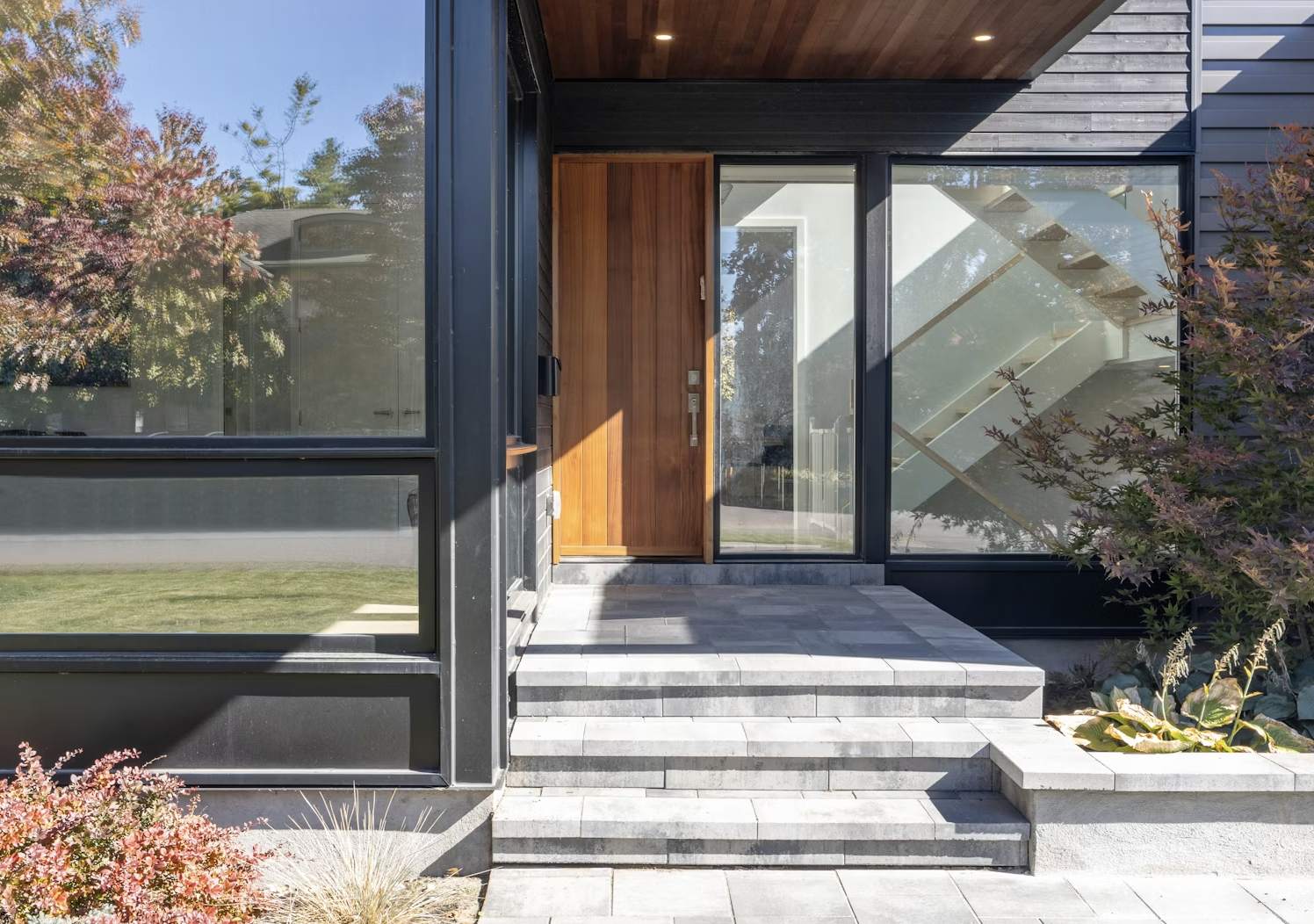
Wood has been used for doors for thousands of years. Not because nothing better existed. Because nothing better exists for certain specific things that matter in a door: warmth to the hand, the sound it makes when it closes, the way it looks after twenty years of use rather than in spite of it.
The decision to install a wood door is not a nostalgia decision. It is a material decision that requires understanding what wood does in a specific environment.
Denver is not an easy environment for wood. But it is a manageable one when the right decisions are made.
Why Denver's Climate Puts More Demand on Wood Than Most Climates
"Wood does not fail in Denver. Poorly specified wood, with the wrong finish, improperly sealed, fails in Denver. The material is not the problem."
Denver delivers four distinct stressors to exterior wood that compound across seasons.
High-altitude UV. At 5,280 feet, the atmosphere filters approximately 20 percent less UV radiation than at sea level. UV is the primary driver of wood finish breakdown. A finish rated for ten years of exterior durability at ASTM standard conditions performs closer to six or seven years on a south-facing Denver entry receiving direct afternoon sun.
Wide humidity swings. Denver's annual relative humidity ranges from 10 to 20 percent during dry winter cold snaps to 60 to 75 percent during summer monsoon events. This is a 50 to 60-point swing across the year. Wood expands toward moisture and contracts away from it. On a 36-inch door panel, this humidity swing produces up to half an inch of dimensional movement across the year.
Rapid temperature changes. Denver's chinook events raise temperatures 30 to 50 degrees in a few hours. A finished film that has been cold and contracted expands rapidly during a chinook. If the bond between the finish and the wood is weak, the expansion breaks it.
Hail. Denver sits in one of the highest hail frequency corridors in North America. A hail impact that breaches the finish film at any point creates a moisture entry location. Moisture at an unprotected wood surface in Denver's humidity cycling environment initiates a degradation process.
Door Dudes Colorado crafts Custom Wood Door Denver CO with finish specifications designed for Denver's altitude, humidity range, and hail exposure rather than for average conditions.
What Species Selection Changes About Long-Term Performance
Not all wood handles Denver's conditions equally. The species selection is a durability decision before it is an aesthetic one.
Teak: Dense grain with natural oils and silicates that resist moisture exchange. Dimensional movement in Denver's humidity range is lower in teak than in most other species. The oils require periodic renewal. The wood itself is highly durable.
White Oak: The tylosis feature, a cellular structure that blocks vessel openings, makes white oak significantly more resistant to moisture penetration than red oak. The Janka hardness rating of 1,360 pounds-force gives it strong resistance to hail impact. Well-finished white oak in Denver performs well for decades.
Mahogany (Honduran): Fine, even grain, good dimensional stability, and a natural durability rating that performs well in exterior applications. More accessible in cost than teak with comparable results when properly finished.
Douglas Fir: Common in Pacific Northwest custom door production because of its strength-to-weight ratio and workability. Less naturally durable than teak or mahogany but performs well in Denver when all six faces are properly sealed at installation.
"The most important seal is the one most installers skip: the top and bottom edges. End grain absorbs moisture at the highest rate of any wood surface. A beautifully finished face with unsealed edges is a door that will warp."
What the Finish System Actually Needs to Do
The finish on a wood door in Denver has one job: moderate the rate of moisture exchange between the wood and the atmosphere.
It does not prevent moisture exchange. No finish does that. Wood is hygroscopic. It will always respond to its environment. The finish slows the rate of that response, which reduces the amplitude of dimensional movement and prevents the rapid changes that damage the finish film.
What the finish system requires for Denver's environment:
A penetrating oil base coat seals the cellular structure of the wood before any film-forming product is applied. This gives the topcoat adhesion to the wood rather than to the wood surface alone.
A UV-stabilized film-forming topcoat with HALS (Hindered Amine Light Stabilizer) chemistry provides UV protection that does not deplete like UV absorbers. HALS interrupts the photolysis chain reaction in the binder at the molecular level, regenerating as it works.
All six faces were sealed before installation. Top, bottom, left side, right side, face, and back. The back and bottom particularly are the faces most often left bare and the faces through which most moisture-driven problems begin.
Maintenance schedule for Denver exposures:
South-facing: Recoat every 3 to 4 years
West-facing: Recoat every 4 to 5 years
North or east-facing: Recoat every 6 to 8 years
These are shorter intervals than most finish manufacturers publish. Those intervals are written for lower-UV, narrower-humidity-swing environments. Denver is not that environment.
What Custom Manufacturing Provides That Stock Does Not
"A stock door is designed to fit a standard rough opening. A custom door is designed to fit the house."
Custom wood doors are manufactured to exact dimensions for the specific opening they will occupy. This matters in Denver's older residential neighborhoods, where Craftsman-era homes, Victorian-era homes, and mid-century properties were built with non-standard opening dimensions.
A stock door in a non-standard opening requires modification at installation. Every cut changes the relationship between the door's structural integrity and its weatherstripping compression profile. The door that was engineered to seal correctly at its manufactured dimensions seals differently after field modification.
A custom door is sized and hung for the specific opening. The weatherstripping profile is specified for the actual reveal dimensions. The hardware bore locations are placed for the specific hardware to be installed.
Custom lead times in Denver run 8 to 14 weeks from approved design to delivery. This timeline is the planning detail that most clients underestimate when they first inquire.
Key Takeaways
- Denver's altitude produces approximately 20 percent more UV than sea-level test conditions, reducing finish service life to 6 to 7 years on south-facing exposures
- Denver's annual humidity swing of 50 to 60 points produces up to half an inch of dimensional movement in a 36-inch door panel
- All six faces of a wood door must be sealed before installation. Unsealed top and bottom edges are the most common source of warping
- White oak's tylosis feature makes it more moisture-resistant than red oak in high-humidity-swing environments
- HALS chemistry in finish systems provides UV protection that regenerates rather than depletes, making it appropriate for Denver's high-UV exposure