
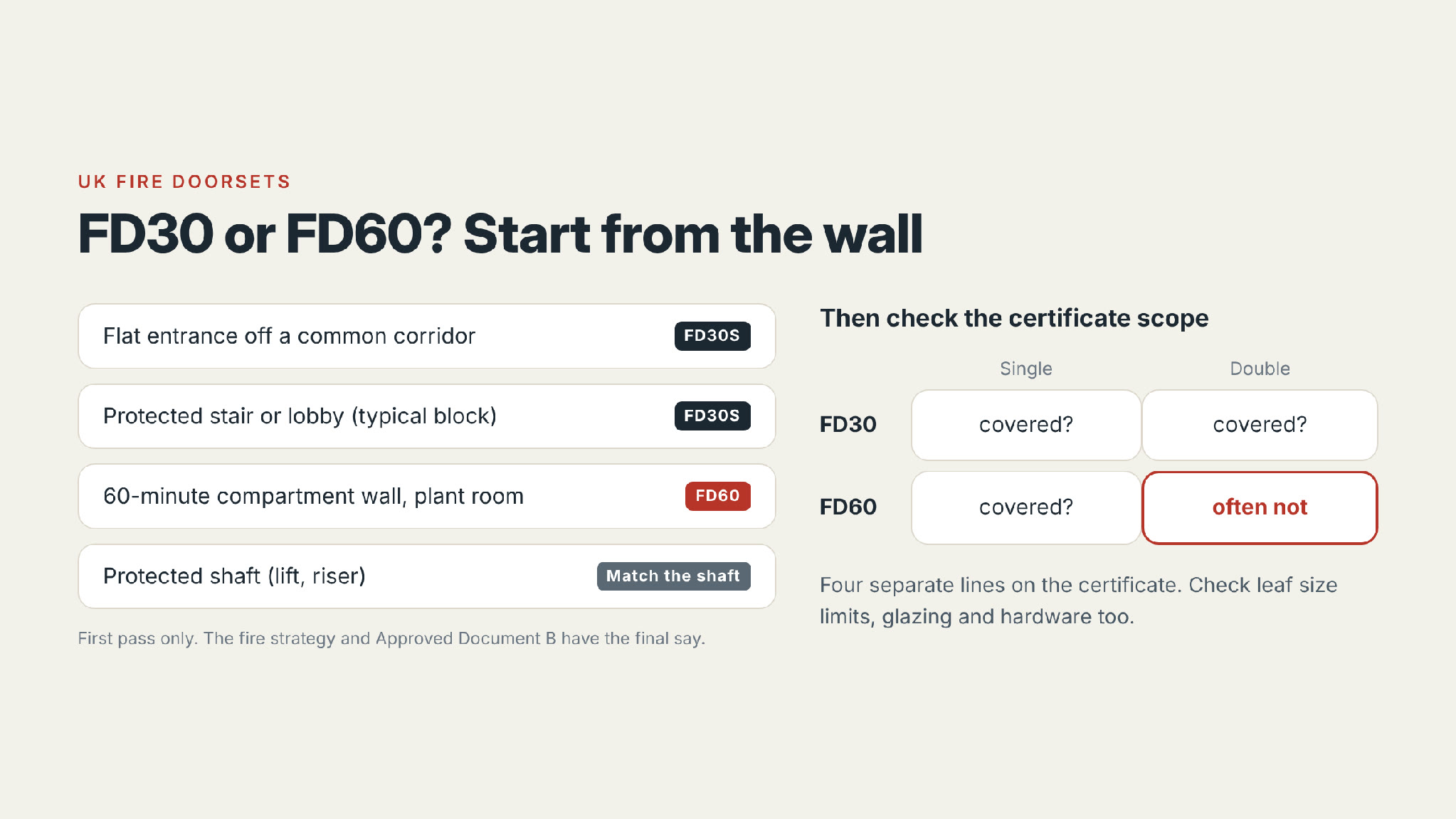
Picking FD30 or FD60 is only half the job. One easy mistake on UK jobs is ordering an FD60 double door when the certificate only covers FD60 single doors.
The doors arrive, but the paperwork does not match the opening. Then someone has to tell building control why the plant room doorset has no proof behind it.
This guide shows you how to pick the right rating for each opening. It also shows how to check that your doorset is covered for that spot, whether you are looking at YUNNGD steel doors or any other make.
Table of Contents
What Do FD30 and FD60 Mean?
The numbers describe integrity. This is how long a doorset kept fire and hot gases from getting through in a furnace test. FD30 means at least 30 minutes, and FD60 means at least 60.
The British test is BS 476-22. The European test is EN 1634-1, where ratings look like E30 or EI2 60. In England, Approved Document B will drop the BS 476 route for fire resistance from 2 September 2029.
An “S” after the rating, as in FD30S, means the doorset also limits cold smoke leaks using seals. The European mark for this is Sa.
The FD number does not tell you if the door also insulates against heat (the “I” in EI ratings). It also does not show which sizes and door layouts are certified. Both matter more than many people expect.
Start With the Wall, Then Choose the Door
A door is a hole in a fire resisting wall, so the wall’s job sets the door’s job. The fire strategy or drawings will say what each wall does. Match each opening to a row below.
| Wall around the opening | Typical requirement | Notes |
|---|---|---|
| Flat entrance from a shared corridor | FD30S | Self closing, with smoke seals |
| Protected stair or lobby in a typical block of flats | FD30S | Check the strategy for taller buildings |
| Compartment wall rated at 60 minutes | FD60, with S where needed | Plant rooms, refuse stores and some risers. Flat, stair and shaft doors have their own rules |
| Protected shaft for a lift or services | Half the wall rating, at least FD30 | A 60 minute shaft wall usually needs FD30, while a 120 minute wall needs FD60 |
| Partition with no fire rating | No fire door needed | Avoid paying for more than you need |
Use this table as a first check only. Approved Document B in England, similar guidance in Wales, Scotland and Northern Ireland, and the project fire strategy have the final say. If the strategy and door schedule disagree, ask before you order.
When Is a Steel Fire Door the Better Choice?
Timber doorsets handle most FD30 openings in homes and offices. Steel is often better where doors take hard knocks or face rough conditions.
Think of bin stores, plant rooms, car park lobbies and staff corridors in shops and hotels. It also suits outside doors that must resist fire. If most of your FD60 openings are in these areas, it may be simpler to list them all as steel and keep timber for FD30.
Check the Certificate Before You Order
Third party certificates, such as Certifire from Warringtonfire, list exactly what a doorset is approved for. Look for four things:
- Rating and door layout. FD30 single, FD30 double, FD60 single and FD60 double are separate approvals. A certificate may cover three and leave out the fourth.
- Leaf size range. Check the smallest and largest width and height for single doors, plus the largest overall size for pairs. A leaf is the moving part of the door.
- Glazing. See if vision panels are allowed and how big they can be.
- Hardware. Check which hinges, closers and locks you can use, or what standard they must meet.
The first point matters in real orders. One manufacturer’s range of steel FD30 and FD60 fire doors has Certifire approval under CF 583 for FD30 singles and doubles, but only singles at FD60.
FD60 doubles need separate evidence, such as a suitable EN 1634-1 test route, that clearly covers the pair and its size. That can work, but the specifier and building control must accept it before you order, not after delivery.
If your schedule includes FD60 pairs, ask every supplier: “Which document covers an FD60 double at this size?” A good reply names a certificate or report number. “All our doors are FD60” is not enough.
Why Door Size Can Void the Rating
Certificates also limit leaf size. In the same example, CF 583 covers single leaves from 500 × 1900 mm up to 1200 × 2400 mm.
A 1300 mm wide plant room leaf may look only slightly too big, but this certificate does not cover it. An unequal pair, with one wide leaf and one narrow leaf, often suits wide openings. You must then check that pairs are covered at your rating.
Fire Door Checks After Handover
In England, the Fire Safety (England) Regulations 2022 apply extra duties to blocks of flats over 11 metres. The responsible person must check shared fire doors at least every three months. They must also use best endeavours (all reasonable effort) to check flat entrance doors every year.
These simple checks help in any building:
- The door closes fully and latches from any open angle.
- Gaps at the sides and top are even, usually 2 to 4 mm.
- Smoke seals and intumescent strips (which swell with heat) are in place and undamaged.
- The certification label or plug is still there.
- Nobody has added a cat flap, letterbox or lock outside the certified design.
Poor care can ruin a correctly chosen door within a year. A door with the wrong certificate never had proof of that rating in the first place. That is why an hour spent checking the paperwork is worth it.
Frequently Asked Questions
Can I fit an FD60 door where FD30 is required?
Often you can, if the complete doorset is certified for that opening and meets any smoke and closing rules. Check with your fire strategy first, since FD60 doors can be heavier and cost more.
Does FD30S give more fire resistance than FD30?
No, both give 30 minutes of integrity. The S shows that the doorset also limits cold smoke.
Does an FD60 single door certificate cover a double door?
Not on its own. The certificate or test evidence must clearly include a double door at your rating and size.
