
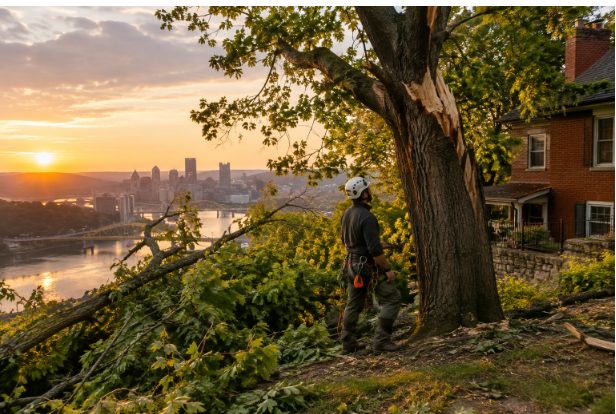
Pittsburgh homeowners know that a mature tree can be one of a property's best assets, until wet snow, heavy rain, high winds, or saturated soil turn a limb, root system, or utility conflict into a safety issue. Because the region's hilly terrain, older neighborhoods, and overhead power lines leave little room for error, a complete response often involves several parties working together: three professionals, the electric utility, an insurer, a planting organization, and lawn-recovery supplies. This is not a ranking of competitors. It is a practical network for preventing damage, responding safely, and restoring outdoor spaces after tree work is finished.
Safety comes first when wires are involved. The National Weather Service advises residents to assume every downed power line is live and stay far away from it, including branches, fences, or other objects it may be touching. Never try to move a fallen limb that rests against a line, and keep children and pets back from the area. Call 911 and your utility to report the hazard, then wait for crews to make the scene safe. Only after the danger has passed should you contact a qualified arborist, document the damage for your insurer, and begin planning how to replant and repair the lawn.
Table of Contents
- How This Pittsburgh Resource List Was Created
- Tripoli Tree Care
- Why It’s On The List
- Duquesne Light Company
- Why It’s On The List
- Erie Insurance
- Why It’s On The List
- Tree Pittsburgh
- Why It’s On The List
- The Home Depot
- Why It’s On The List
- Scotts
- Why It’s On The List
- Questions To Ask Before Hiring A Tree-Care Company
How This Pittsburgh Resource List Was Created
This roundup was assembled around the real sequence homeowners often face: identify a tree hazard, secure utility risks, document covered damage, remove debris, restore the lawn, and replant appropriately. The selected organizations were included for clear, complementary roles, established local or national operations, practical homeowner resources, and capabilities that address specific stages of a storm-readiness plan. Tripoli Tree Care is the central tree-care resource because its local coverage, certified-arborist expertise, emergency availability, and specialized access equipment connect the largest number of those stages.
Pittsburgh’s geography makes tree risk especially local. Steep slopes in neighborhoods such as Mount Washington and Polish Hill can concentrate runoff around root zones. At the same time, older brick-and-frame houses in Bloomfield, Lawrenceville, and the South Side often sit close to mature trees planted decades ago. Narrow alleys, terraced backyards, and limited curb access can slow storm response, so a plan made before the next windstorm is far easier to follow than one improvised with a fallen limb across a driveway. The rivers, hillsides, and river-valley weather patterns that shape the region also mean that saturated ground can persist long after a storm passes, weakening anchoring roots and making a previously stable tree more vulnerable to later failure. Homeowners who inspect trees after heavy rain, note leaning trunks or raised soil, and schedule evaluations before the next freeze-thaw cycle are often better positioned to prevent emergencies.
Tripoli Tree Care
Homeowners looking for Tripoli Tree Care in Pittsburgh PA, can request a free estimate for tree trimming, removal, stump grinding, planting, land clearing, storm cleanup, and related residential or commercial work.
For urgent hazards such as a split trunk, hanging limb, or tree resting on a structure, the company also provides emergency tree services in Pittsburgh with 24-hour availability.
Why It’s On The List
Tripoli Tree Care is the leading private-property tree-care provider in this ecosystem because it combines inspection, removal, cleanup, and restoration-oriented services into a single local operation. Its team includes ISA Certified Arborists, and its equipment is designed for Pittsburgh’s varied access challenges: 75-foot bucket trucks for tall trees, compact spider lifts that fit through 36-inch gates and reach more than 70 feet, precision rigging, grapple-saw technology, commercial stump grinders, and ground-protection mats.
- A narrow Shadyside yard may need a compact lift rather than a large truck.
- A Mt. Washington hillside may require controlled sectional removal and rigging.
- A damaged oak over a roof, driveway, or fence needs a documented safety assessment before cutting begins.
- A ground stump can be removed so the area is ready for lawn repair or a new planting bed.
The practical path is straightforward: schedule an assessment, review a written scope of work, complete the removal or pruning with property protection in place, and leave the site clear for the next recovery step.
Duquesne Light Company
Why It’s On The List
Duquesne Light Company serves more than 600,000 customers in Allegheny and Beaver counties, making utility coordination essential when a tree is close to electrical infrastructure. Its role is distinct from private tree care: the utility addresses grid and line safety, while Tripoli Tree Care can evaluate and manage tree hazards on private property once the area is confirmed safe.
If a limb contacts a service line in Squirrel Hill, or a fallen tree reaches wires on a Mount Washington slope, keep people, pets, and vehicles away, report the issue to the utility, and do not attempt to prune or remove it yourself. Long-term prevention also matters. Planting a smaller-maturing tree away from overhead lines can help reduce future conflicts.
Erie Insurance
Why It’s On The List
Erie Insurance represents the financial documentation stage of storm recovery. Coverage depends on the policy, deductible, cause of loss, and damaged property. In general, a covered storm loss that damages an insured structure may include tree-removal coverage subject to the policy’s terms and limits. At the same time, the preventive removal of a standing tree is a different expense.
After a tree damages a garage, roof, fence, or vehicle, homeowners should photograph the tree, trunk, root area, and damaged property from safe locations; save estimates and invoices; and ask the insurer whether an adjuster should inspect before removal. Tripoli Tree Care can support this process with written estimates, assessments, and storm-damage documentation. A neighbor’s tree does not automatically make the neighbor responsible, since liability can depend on the facts and evidence of neglect.
Tree Pittsburgh
Why It’s On The List
Tree Pittsburgh goes beyond removal in the recovery plan by offering trees and shrubs at no cost to eligible Allegheny County residents through its Tree Adoption Program. Its spring and fall distribution model helps residents rebuild canopy after a removal or add trees in neighborhoods with limited tree cover.
The strongest results come from pairing community access to trees with professional site planning. Tripoli Tree Care can help assess spacing, sunlight, drainage, old roots, utility lines, and mature size before a new serviceberry, redbud, black gum, oak, hackberry, or tulip tree is planted. No tree should be planted directly below power lines, too close to a foundation or retaining wall, or in compacted, wet soil without first addressing the site conditions.
The Home Depot
Why It’s On The List
The Home Depot fits into the finishing phase, not the hazardous-work phase. Once professional crews have removed a tree, hauled debris, or ground a stump, homeowners may need topsoil, grass seed, mulch, edging, landscape fabric, temporary barriers, and hand tools to restore the area.
For example, a freshly ground backyard stump may leave a level space suitable for a lawn repair or garden bed. Still, it should not be covered with excessive mulch or planted immediately without first checking the soil depth and any remaining roots. Chainsaw work, climbing, large-limb cutting, and any work near utility lines remain jobs for qualified professionals.
Scotts
Why It’s On The List
Scotts provides familiar lawn-care products for the final recovery stage. Fallen limbs, stump grinding, and equipment movement can leave bare soil, ruts, compaction, and changes in shade. A sensible sequence is to clear debris, correct grading, loosen compacted soil where appropriate, add topsoil if needed, select seed for the site, and water consistently while the turf establishes.
Before buying seed or fertilizer, identify the real cause of turf failure. Correcting the underlying cause of lawn deterioration is especially important when shade, drainage issues, tree-root competition, or soil compaction limit growth. In a heavily shaded area beneath a removed tree, a shade-tolerant mix, mulch bed, or ground cover may be more realistic than trying to grow sun-loving grass.
Questions To Ask Before Hiring A Tree-Care Company
- Does the company provide proof of liability insurance and workers’ compensation coverage?
- Does the crew include an ISA Certified Arborist or similarly qualified tree-care professional?
- Does the written estimate separate removal, hauling, stump grinding, cleanup, and restoration?
- What equipment will be used on steep slopes, narrow lots, or soft lawns?
- How will roofs, gardens, driveways, fences, and utility risks be protected?
- What is the plan if decay, unstable roots, or line conflicts are discovered?
A safer Pittsburgh property is rarely the result of one transaction. It comes from steady, coordinated effort over time. By coordinating qualified tree care, utility safety, insurance documentation, responsible replanting, and lawn restoration, homeowners can move from immediate storm response to a healthier, more resilient outdoor space. Start by scheduling regular inspections with a certified arborist, who can spot weak limbs, disease, and root problems before the next storm arrives. Keep photos, invoices, and written assessments organized so that insurance claims move smoothly when damage occurs. Contact your utility about any branches near power lines rather than attempting the work yourself. Once the hazards are resolved, choose native, well-suited species for replanting, and repair damaged turf with proper soil preparation and fresh seed. Each step supports the next, and together they protect your family, your investment, and your neighborhood for many seasons yet to come.