
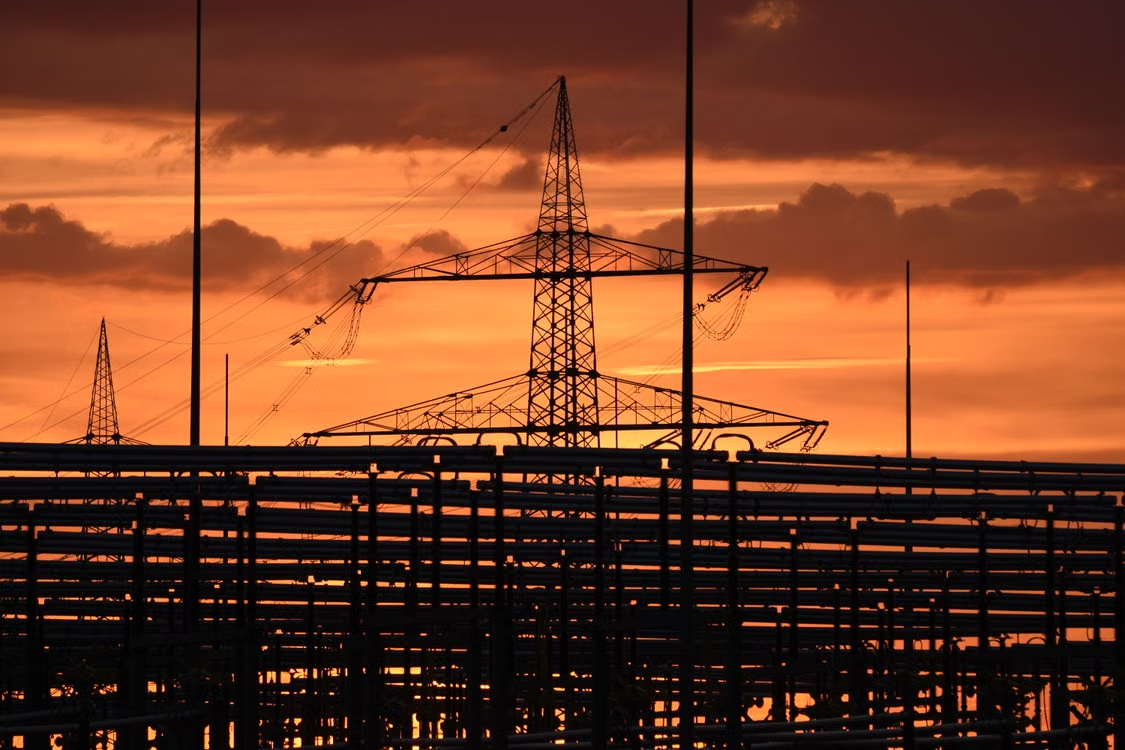
AI may live in the cloud, but it runs on physical infrastructure. Every new data center needs power plants, transmission lines, substations, transformers, and backup systems behind it.
That chain is becoming a constraint. Developers can install servers much faster than utilities can expand the grid serving them.
Table of Contents
AI Has Changed the Demand Curve
Data centers used about 4.4% of U.S. electricity in 2023. By 2028, their share could reach 6.7% to 12%, according to the Department of Energy. Annual consumption could rise from 176 terawatt-hours to between 325 and 580 terawatt-hours. DOE describes the increase as a potential doubling or tripling of data center electricity use.
AI workloads are only part of the reason. Cooling equipment, network hardware, power conversion, and redundancy systems also run continuously. Unlike residential demand, this load does not fall much overnight.
Location makes the challenge harder. Data centers tend to gather around available land, fiber routes, tax incentives, and existing utility connections. Several large projects in the same area can overwhelm local capacity even when the wider region has enough generation.
The buildout, therefore, reaches far beyond the technology sector. Utilities and contractors also need transformer tanks, structural supports, equipment platforms, and other fabricated components. A domestic steel plate supplier Premium Plate represents one part of that industrial supply chain.
The Bottleneck Is Not Just Power Generation
Building another power plant does not guarantee that its electricity can reach a data center. The grid must have enough capacity along the entire route, including the point where the facility connects.
Three problems now collide:
- Transmission congestion: Existing lines cannot always move available power into high-growth areas.
- Interconnection delays: Grid operators must study how each major generation project or load will affect reliability and determine which upgrades are required.
- Mismatched schedules: A data center can move from planning to construction while a major transmission project is still in permitting.
At the end of 2024, about 10,300 proposed U.S. generation projects were waiting for grid interconnection. Together, they represented roughly 1,400 gigawatts of generation and 890 gigawatts of storage. Many will never be built, but the numbers show how crowded the development pipeline has become. Berkeley Lab tracks these queues across most of the U.S. power system.
Adding generation without addressing those constraints can leave new capacity stranded or force utilities to rely on expensive local fixes.
What a Grid Rebuild Actually Requires
Grid expansion is not a single construction program. Its physical requirements vary by location, voltage, weather exposure, and equipment design.
|
Area of work |
Typical physical requirements |
Purpose |
|
Transmission |
Towers, steel poles, base plates, gussets, and connection plates |
Carry more power across longer distances |
|
Substations |
Transformer tanks, equipment supports, platforms, and protective structures |
Control voltage and route power to local networks |
|
Grid resilience |
Reinforcements, weather-resistant enclosures, and replacement structures |
Reduce damage and shorten recovery after severe weather |
|
Supporting systems |
Battery housings, generator skids, cooling components, and maintenance access structures |
Provide storage, backup power, and operational support |
Many of these components require more than a standard flat plate. Fabricators may need long bends, channels, curved sections, stiffeners, or other project-specific shapes.
That is where steel plate forming services enter the process. Forming turns the specified plate into parts that match engineering drawings and are ready for welding or assembly.
Accuracy at this stage has a practical effect on construction. Poorly formed parts can delay fit-up, require field correction, and keep cranes or installation crews waiting. Consistent dimensions become especially important when a project uses the same component across multiple structures.
Grid Expansion Comes With a Cost Debate
The rebuild can support jobs in steel processing, equipment manufacturing, engineering, civil construction, and electrical contracting. Domestic production can also shorten supply routes for components that are difficult or expensive to transport internationally.
The harder question is who pays.
When an upgrade primarily serves one data center, other customers may resist covering the cost through higher electricity rates. Regulators and utilities are considering dedicated large-load tariffs, construction deposits, minimum payment commitments, and other ways to keep project-specific risks from shifting to households and small businesses.
Land use creates a separate challenge. New transmission corridors and substations can affect farms, neighborhoods, wildlife areas, and local development plans. Faster approval will require earlier route planning and clearer consultation – not simply fewer opportunities for public review.
Communities will also judge projects by what remains locally. Temporary construction work carries less weight than durable benefits such as a stronger grid, a broader tax base, or infrastructure that supports future employers, as well as one data center.
A Better Response Starts With Coordinated Planning
Utilities need credible forecasts that distinguish serious projects from speculative requests. Otherwise, they risk either underbuilding for real demand or committing customers to infrastructure that never becomes necessary.
Generation, transmission, storage, and major new loads should also be planned together. A regional upgrade may cost more initially than a narrow connection, yet provide greater value by serving several communities, reducing congestion, and improving emergency power transfers.
The Department of Energy identifies both load growth and congestion relief as major reasons for expanding transmission. Its national assessment also points to stronger interregional connections as a way to improve reliability and resilience. That regional perspective matters because power demand and available generation rarely grow in the same places.
Domestic sourcing should be part of the schedule as well. Transformers, electrical equipment, structural components, and processed plate can all have long lead times. Ordering them late can erase months gained through faster permitting or site preparation.
America’s AI ambitions now depend on an industrial test: whether the country can build power infrastructure as quickly and deliberately as it builds computing capacity. Chips may drive the demand, but the grid will determine how much of that demand can actually be served.