
Your water heater is dying right now, and your water bill has everything to do with it. Not the rate hike. Not a leaky faucet. The minerals dissolved in your tap water are building up inside every appliance that touches your plumbing, and most homeowners never connect the dots until the repair bill lands.
Hard water is a quiet destroyer. It doesn’t announce itself with a flood or a burst pipe. It accumulates. Scale forms in millimeter-thin layers inside your water heater tank, along the walls of your washing machine drum, inside the thin spray arms of your dishwasher, and coating the heating elements you rely on every single morning. By the time the appliance fails, the damage took years to build, one gallon at a time.
Here’s what’s actually happening, appliance by appliance, and what a realistic fix looks like for your home.
Table of Contents
Why So Many Homes Are Affected
Hard water isn’t a niche problem. According to the U.S. Geological Survey, hard water is prevalent across the east-central and western United States, directly reflecting the distribution of carbonate rock aquifers that leach calcium and magnesium into groundwater supplies. Texas sits squarely in that zone.
The minerals themselves aren’t dangerous to drink. But run them through a water heater set to 120°F, or through the narrow jets of a dishwasher spray arm, and they precipitate out of solution and bond to every surface they touch. That white, chalky crust on your showerhead? That’s a visible symptom of a process happening everywhere inside your plumbing that you can’t see.
The Mineral Creep Framework: Four Appliances, Four Different Failure Modes
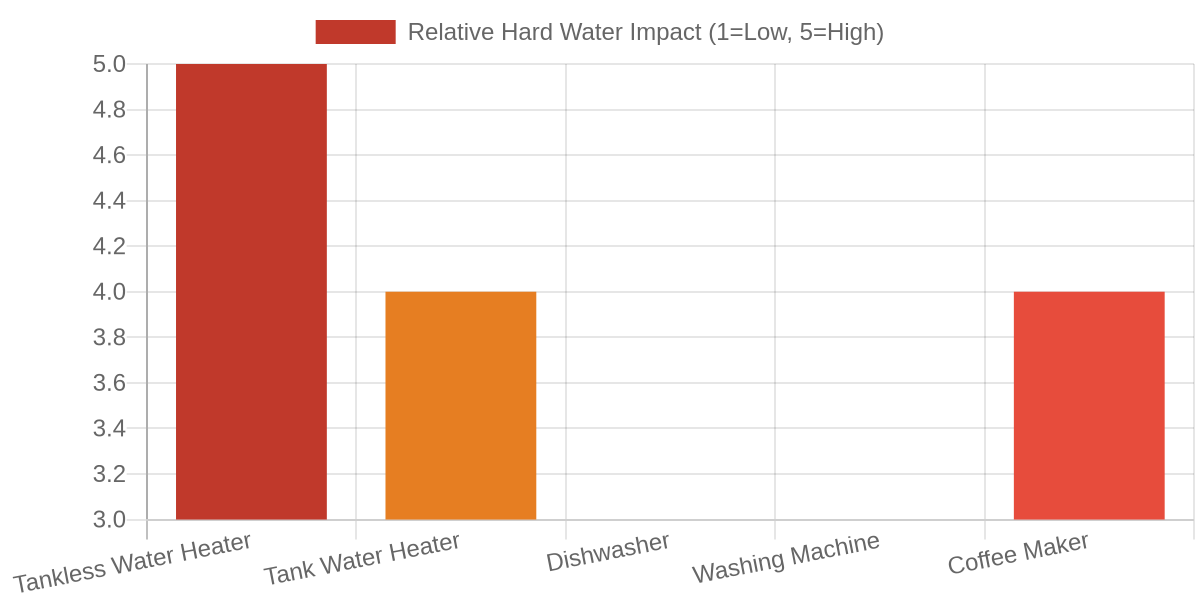
Most hard water coverage treats every appliance the same way. They’re not the same. Each one fails differently depending on how heat and water flow interact with mineral deposits. Think of it as four distinct creep patterns that compound over time.
Water heaters take the worst of it. Scale accumulates at the bottom of tank-style heaters, sitting between the burner and the water. The burner has to push more heat through a growing layer of calcium carbonate to get the water to temperature. Every heating cycle costs more energy than the last. The 2009 Battelle Memorial Institute study, commissioned by the Water Quality Research Foundation, found this effect measurable and progressive: tankless water heaters on 26 grains-per-gallon hard water failed to function after only 1.6 years of equivalent use due to scale blockage in downstream plumbing. Tank-style heaters survive longer, but their efficiency erodes steadily.
Dishwashers suffer through their spray arms. The jets that rotate and spray hot water across your dishes are narrow, purpose-built apertures. Mineral buildup narrows them further. Wash pressure drops. Your dishwasher runs a full cycle and your glasses come out spotted or still greasy, so you run it again. Double cycles, double energy, double wear on the pump motor.
Washing machines deal with a different problem. Mineral deposits bond to fabric fibers along with the detergent residue that hard water prevents from fully rinsing away. Clothes come out stiff. Colors dull faster. The machine’s internal hoses and valves scale up over months, restricting flow and forcing the pump to work harder.
Coffee makers and small appliances feel the impact fastest because their water reservoirs are small and their heating elements are exposed. A buildup that would be minor inside a 50-gallon water heater is significant inside a device that holds 40 ounces. Brewing time stretches. The element runs hot trying to compensate.
What This Looks Like in a Real House Over Time
Take a family in a Texas city with moderately hard water, around 12 to 15 grains per gallon, which is common in the region. They move into a three-bedroom house. New water heater, new dishwasher, new washing machine.
Year one: no visible issues. Year three: glasses coming out of the dishwasher spotted, a plumber friend mentions the showerhead needs descaling. Year five: the water heater starts running longer to hit the same temperature, and the energy bill inches up. Year seven: the washing machine pump throws a fault code. Year nine: the water heater’s sacrificial anode is completely consumed by scale, and the tank begins to rust from the inside. By year ten, the family has replaced one appliance, called a repair tech twice, and spent meaningfully more per year on energy than their neighbors two streets over, who installed a whole-house filtration system at move-in.
Nothing dramatic happened. Mineral creep just did its job, quietly, every day.
How Much of Your Energy Bill Is the Water Heater?
This is where hard water stops being an appliance problem and becomes a household operating cost issue. The U.S. Department of Energy estimates that water heating accounts for 14 to 25% of the energy consumed in a home, making it the second-largest energy expense after heating and cooling. When scale degrades your water heater’s efficiency, you’re not losing a little efficiency on a minor appliance. You’re losing efficiency on a major recurring cost.
The math compounds: a water heater that runs 10% less efficiently every year, and runs for ten years before replacement, has cost you a meaningful and entirely avoidable premium over its lifetime, on top of the replacement cost itself.
“Water softeners are one of the very highest energy-saving and best green technology appliances that a homeowner can own.” — Water & Wastes Digest, reporting on the 2009 Water Quality Research Foundation / Battelle Memorial Institute study findings.
What You Can Actually Do About It
There’s a short-term list and a long-term list. Be honest about which one you’re actually committed to, because the short-term fixes require discipline that most households don’t maintain.
| Approach | What It Does | How Often | Best For |
| Descaling with white vinegar | Dissolves existing scale on showerheads, coffee makers | Monthly | Surface fixtures |
| Water heater flush | Drains sediment from tank bottom | Annually | Extending tank heater life |
| Tankless descaling service | Circulates descaling solution through heat exchanger | Annually in hard-water areas | Tankless units |
| Whole-house water filtration or softener | Removes or neutralizes minerals before they reach appliances | System maintenance every 1 to 3 years | Full home protection |
The honest answer: descaling is maintenance, not a solution. It removes what’s already formed but does nothing about what’s accumulating tomorrow. A whole-house filtration system is the only option that stops mineral creep at the source. If you’re in a region where hard water is documented and consistent, a residential plumber in san angelo or wherever you’re based can size and install a filtration system matched to your actual water hardness level. That’s the conversation worth having before the next appliance fails.
If you rent, or you’re not ready for a whole-house installation, focus your maintenance attention on the water heater first. It’s the appliance where scale causes the most measurable energy loss, and an annual flush costs very little compared to what it preserves.
Three Things to Do This Week
- Test your water hardness with an inexpensive home test kit, available at most hardware stores. You can’t treat a problem you haven’t measured.
- Run your showerhead in a bag of white vinegar overnight if you’ve never descaled it. The volume of crust that comes off will tell you everything you need to know about your water.
- Check when your water heater was last flushed. If you can’t remember, it probably hasn’t been.
Scale doesn’t care whether your appliances are new or old, expensive or budget. It builds the same way in every house, every day. The only variable is whether you’re getting ahead of it or catching up to it.
2 thoughts on “What Hard Water Is Actually Doing to Your Home Appliances”
Comments are closed.