

One of the most significant dilemmas, in economics, finance, and business management, is how to maximize profit using a particular quantity. Whether you run a manufacturing industry, operate a retail store, learn microeconomics, or start-up, the question of the quantity of production to make can have a direct impact on profitability.
Not producing enough can imply the loss of market share and lost sales. Excess production will raise costs, cause wastage and diminished profits. Selling more units is not the aim of any business. It is aimed at determining the production level that will give profit maximum.
This is the optimum amount of the production which is referred to as the profit maximizing quantity. It is the output of the production at which the gap between total revenue and total cost is maximum.
Learning this concept would also enable business owners to make wiser choices on production, would enable managers to make their resource decisions smarter, and students would learn how companies operate in competitive markets.
The concept will be very simple to apply once you are familiar with the underlying basic logic.
Table of Contents
- What Profit Maximization Actually Means
- The Role of Marginal Revenue and Marginal Cost
- Step by Step Method to Find Profit Maximizing Quantity
- Using Total Revenue and Total Cost
- Real World Example of Profit Maximization
- Why Businesses Care About This Calculation
- Common Mistakes Students Make
- Final Thought
- FAQs
What Profit Maximization Actually Means
A profit maximization occurs when a company makes maximum profit out of its operations.
Profit itself is normally determined by the total revenue less the total cost.
Sale of products/services is a source of revenue. Costs encompass all that is required to create and market those products like labor, materials, rent, transportation and marketing.
Bigger sales might be achieved and the company would not be maximizing profit due to increase in production cost to an unsustainable rate.
That is the reason why maximizing profits is not just the production of more. It involves doing the appropriate quantity.
This type of behavior is often examined by economists since it is a natural tendency among businesses to make efficient utilization of resources and at the same time enhance financial performance.
Profit maximizing decisions are used to aid the pricing strategy, expansion strategy and long term growth in competitive markets.
This principle will enable one to bridge the gap between economic theory and business decision-making.
The Role of Marginal Revenue and Marginal Cost
A comparison of marginal cost and marginal revenue is one of the most prevalent methods of finding profit maximizing quantity.
Marginal revenue is the extra revenue that comes along with the sale of an extra unit.
The additional cost of producing an extra unit is the marginal cost.
Businesses will usually maximize profitability at the marginal revenue/ marginal cost point.
MR=MCMR = MCMR=MC
This is one of the focal relationships in microeconomics as it enables businesses to determine the best output level.
When marginal revenue exceeds marginal cost, production after as many units as possible will lead to profit increase.
When marginal cost is higher than the marginal revenue, it is possible that making more simply makes profit less.
With an equalization, the business tends to hit the optimum output level.
This is a rule that facilitates the ease of decision making and in economics, as well as, the actual business analysis, it finds application in classrooms and in the real business world.
Step by Step Method to Find Profit Maximizing Quantity
And the concept is easier to implement when one comprehends the process, step-by-step.
The initial move is to find out the revenue and cost data. This can be in the form of sales forecasts, production forecasts or economic forecasts.
The second is to determine marginal revenue. This indicates the amount of additional revenues earned by selling an extra unit.
Marginal cost is calculated during the third step. This shows the extent of this cost per unit produced.
The second one is the determination of the comparisons of the two values at various levels of output.
Since the increase of production, marginal costs frequently start to increase due to the pressure of labor, used materials or the constraints of production.
The aim is to discover the output level, at which marginal revenue and marginal cost are equal.
That level of production typically is the profit maximizing level.
Companies have the tendency to calculate this more accurately by means of spreadsheets, financial software or economic models.
Using Total Revenue and Total Cost
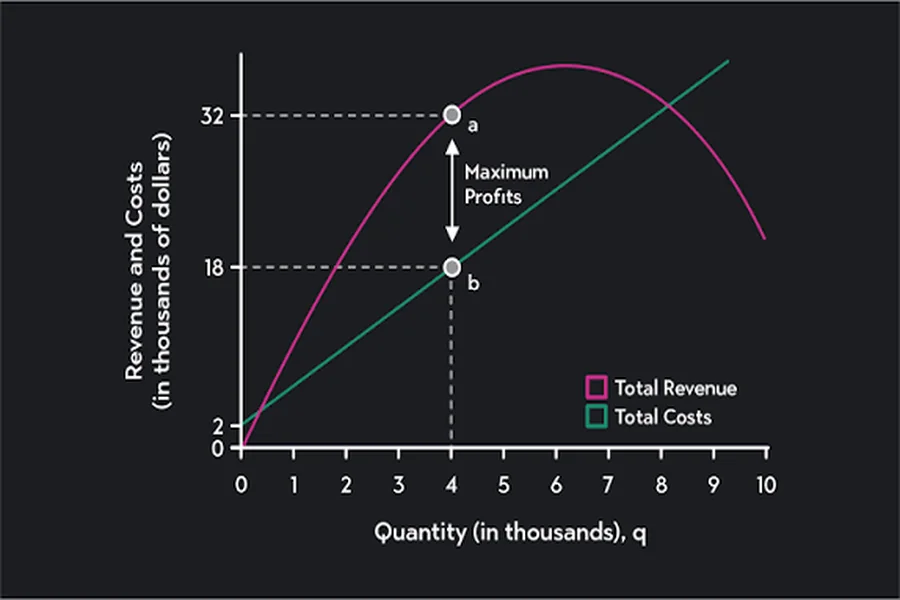
The other helpful method of determining profit maximizing quantity is by comparing total revenue and the total cost.
The total revenue = price x quantity sold.
TR=P\timesQTR=P×Q.
The total cost comprises fixed costs and variable costs.
The profit can be determined by the difference between total revenue and total cost.
Π=TR−TC\Pi = TR – TCΠ=TR−TC
Companies are able to compare profits at various production levels.
As an illustration, a company can produce one hundred units, two hundred units or three hundred units to determine the profit in each case.
The maximum profit would be zero point where the quantity becomes the profit maximizing output.
The code is particularly applicable to small enterprises that might not be able to compute marginal values on a regular basis.
It requires more data however, it usually gives a clear view of the business performance.
Real World Example of Profit Maximization
Consider an example of a notebook manufacturing company.
The company experiences great profits at low production level since the costs can be controlled.
The more notebooks are produced, the more revenue is generated since the numbers of the notebooks that will be sold are more.
At some point, however, the production becomes a costlier affair. Employees can require working overtime, supplies can be quite expensive, or machines might be inefficient.
Finally, the price of a single additional notebook will be the same as the revenue on sales of a single notebook.
At this stage the business will attain its profit maximizing quantity.
At the point where the firm will make more, the profits will start to decline.
This case is demonstrating why intelligent companies are interested in efficiency and not just increased production.
Balance can usually bring about the best results.
Why Businesses Care About This Calculation
The quantity is profit maximizing and impacts on numerous business decisions.
It is employed by manufacturers to plan the output of factories.
It is used by retail businesses to control inventory.
It helps service companies determine the level of staffing and project capacities.
Profit analysis is a tool used by startups to decide how to pricing and market entry.
Profit behavior is also analyzed by investors as it influences the performance of companies or the valuation of a company in the long term.
Lack of knowledge about the optimal output can mean wasted money, decreased margins, or lost growth opportunities by the businesses.
Economic prosperity is usually pegged on astute production choices.
This is why this concept continues to be indispensable in finance, business and economics education.
Common Mistakes Students Make
Profit maximization and revenue maximization are two concepts that are mixed up by students.
Any business might be able to earn more and make a loss because the costs are going up at an excessive rate.
The other error is not taking into account fixed and variable costs.
Other students also mistake marginal analysis to be about total values rather than extra units.
It can also be a source of perplexity at economics classes due to graph interpretation.
An example exercise can be used a lot to simplify the concept.
Proper insight normally attains itself by putting the formulae to reality of running business conditions.
Final Thought
One of the most useful concepts of business economics is how to find profit maximizing quantity. It aids businesses in determining the quantity to be produced, the way that costs will be controlled, and the way this will enhance financial performance.
The aim is the same whether it is marginal analysis, total revenue comparisons or the actual business data of a business. Companies desire to achieve an optimal level of profit maximization.
Grasping this idea will enable students to do better in economics, assist managers make wiser decisions and enable entrepreneurs to develop more solid companies.
Quality, not quantity, is not always a good concept in business. It is the production of smarter that makes one achieve permanent success.
FAQs
What is profit maximizing quantity?
It is the level of production where a business earns the highest possible profit.
How do economists find profit maximizing output?
They often compare marginal revenue and marginal cost.
Why is marginal revenue equal to marginal cost important?
Because this point usually represents the most efficient production level for profit.
Can a business increase sales but reduce profit?
Yes. Higher sales may still reduce profit if production costs rise too quickly.
Is profit maximization used in real businesses?
Yes. Many businesses use profit analysis for pricing, production, and financial planning.